• Skip to main content

Alcohol Review

Alcohol understanding for all

  • Highlights
  • AR2026
    • AR2025
    • Earlier events
  • Register
  • About
    • Organisers
    • Contact
  • Log In

alcohol

Fact-check: Support for alcohol health labelling

January 10, 2024

The alcohol industry’s Portman Group (PG) is using a study it co-funded to resist calls for providing health information on alcoholic drink labels. Here’s a look at what the study actually says.

[Read more…] about Fact-check: Support for alcohol health labelling
Europeans spend more on alcohol than on topping-up education

January 10, 2024

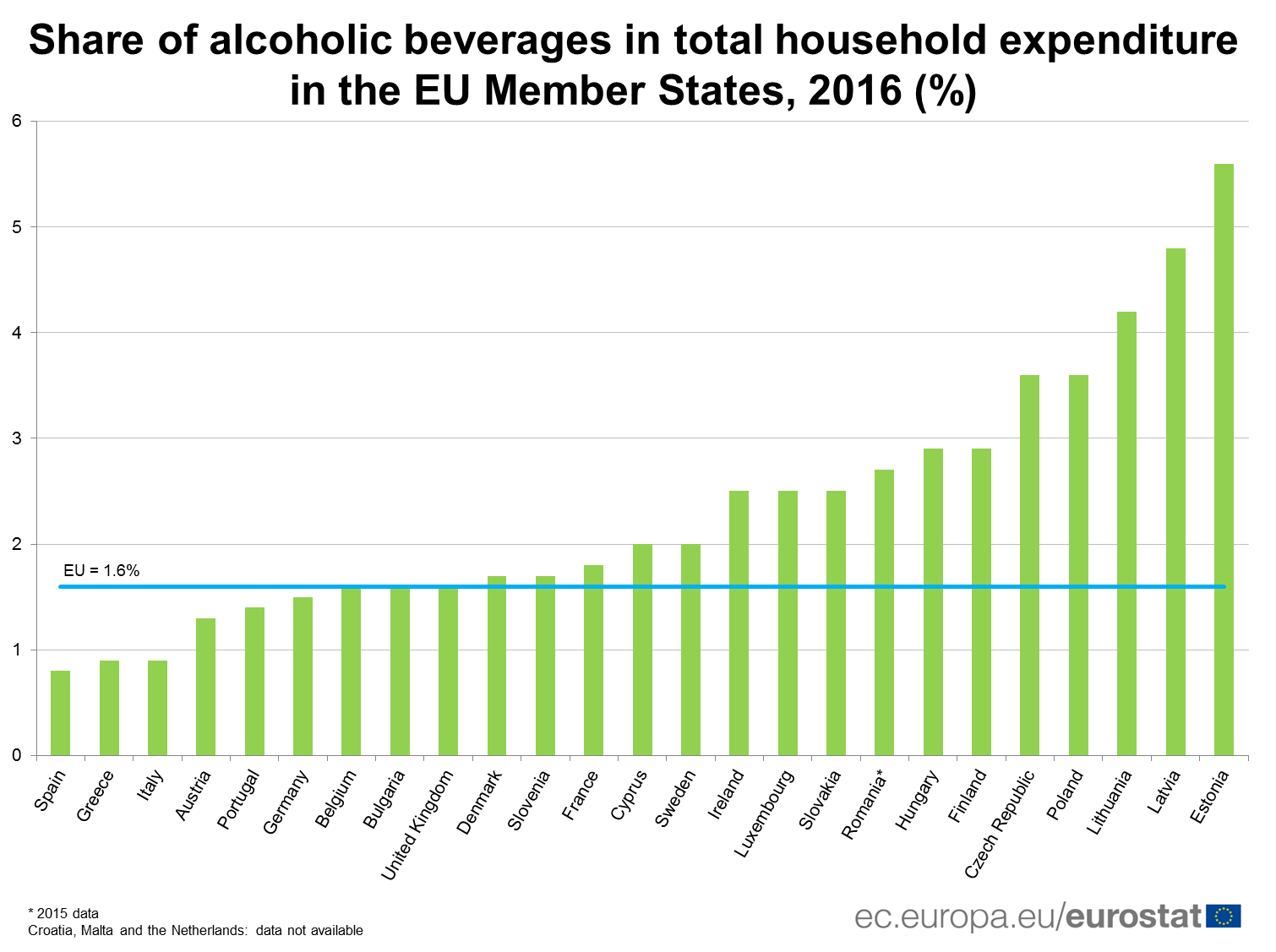
The average European’s household spends more on alcohol than on supplementing state education, says the European Commission. At €250 a year alcohol spending accounts for around 1.6% of household expenses, but the proportion varies widely across the bloc: In the Baltic States it is around four times the average, while in the Czech Republic, Poland, Hungary and Finland it is around three. The UK is almost exactly average in this regard, as is Germany, while Spain and Italy the percentage is around half the EU mean. ■

Source: http://ec.europa.eu/eurostat/web/products-eurostat-news/-/DDN-20171204-1

Minimal alcohol drinking linked to longer life

January 10, 2024

Our life expectancy is lower if we drink more than 125ml of alcohol a week, according to new research.

“Drinking alcohol at levels which were believed to be safe is actually linked with lower life expectancy and several adverse health outcomes,” says Dr Dan Blazer from Duke University, a co-author of the Lancet study.

The decline in life expectancy was found to start slightly below the UK’s guideline maximum amount of 140ml, or 14 UK units, a week. Guideline maximums in Italy, Portugal and Spain are almost 50% higher, while the US one for men is nearly double.

The lives of those who drank 125-250ml a week were shorter by around six months over the age of 40. Those who drank 250-438ml lived between one and two years less, while drinking beyond the top end of the range typically cut lifetimes by between four and five years.

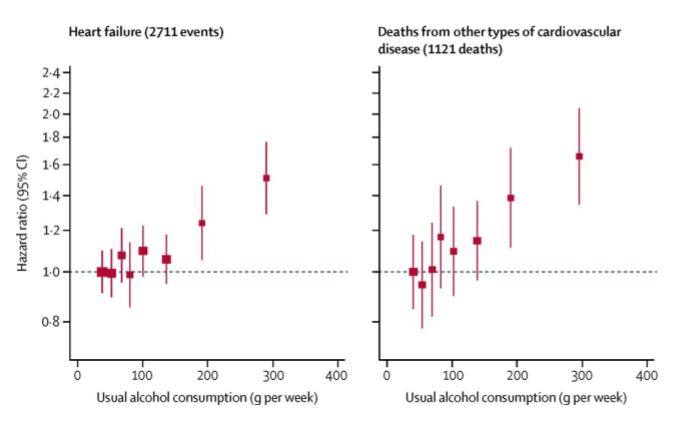
It strengthens evidence, the authors say, that “total cardiovascular disease risk is actually comprised of several distinct and opposite dose–response curves rather than a single J-shaped association”.

Higher alcohol consumption was associated with a higher risk of stroke, heart failure, fatal hypertensive disease, and fatal aortic aneurysm, with no thresholds below which lower alcohol consumption stopped reducing risk (see chart).

But higher consumption was also associated with a lower risk of non-fatal heart attacks, or “myocardial infarctions”. The authors say, however, that the increased risk of having fatal heart problems means we are likely to lose years of life if we were to drink alcohol to ward off non-fatal problems.

“The key message of this research for public health is that, if you already drink alcohol, drinking less may help you live longer and lower your risk of several cardiovascular conditions,” said Dr Angela Wood, lead author of the study from Cambridge University.

Non-drinkers were excluded from the study, because we often stop drinking when we develop health problems, so skewing the numbers. The study also excluded people with pre-existing heart conditions. ■

Estonia applauded for “courage and persistence” on alcohol harm

January 10, 2024

Estonia has received plaudits from a pan-European coalition for its “courage and persistence” in focusing the bloc’s attention on reducing alcohol harm during its six months holding the rotating EU presidency.

The Baltic state helped convince EU members to request: a new EU alcohol strategy; monitoring and evaluation of current measures on online advertising; a framework for a new joint action plan; more research on cross-border trade; and better provisions for alcohol labelling by the end of 2019.

“It is high time for European consumers to finally be told what is in their drinks,” said Mariann Skar, head of the European Alcohol Policy Alliance. “Having heard some disturbing rumours about QR codes, we are very concerned that the industry is taking us all for fools.”

But it is not certain the European Commission will heed the request raised during the Estonian presidency, with previous requests meeting with “hesitancy”, according to Lauri Beekmann, who leads the Nordic Alcohol and Drug Policy Network.

Estonia’s six-month presidency ends this month. Next year it will be held by Bulgaria and then Austria. ■


UPDATE: Ireland: WTO alcohol labelling trade obligations met

January 10, 2024

Ireland’s health department says it has met all its obligations under World Trade Organisation rules over the health labelling requirements of its alcohol bill.

The US government’s trade agency recently said it had asked Ireland to notify the World Trade Organisation about its health labelling plans so as to comply with the organisation’s Technical Barriers to Trade Agreement.

“We can confirm that all obligations under WTO in relation to the Public Health (Alcohol) Bill have been met by the Department of Health,” the department told Alcohol Companion.

“Ireland intends to notify WTO Members of all amendments made to the Bill at the earliest opportunity, ie once all amendments have been made.” ■

One-in-six parents defies youth alcohol advice

January 10, 2024

One-in-six British parents allows their under-15 to drink, contrary to official advice, with the educated, employed and white more likely to do so, according to a UK study.

The official guidance is that children should not drink alcohol before the age of 15, and from then up to the age of 17 only at a very low level, at most one day a week. Exposure to alcohol at any age tends to make us worse at controlling our future intake.

By the age of 14 around half of children in the UK had tried more than a few sips. Drinking below 14 is associated with greater chances of injury, involvement in violence, and suicidal thoughts and attempts.

Overall the level of drinking among children and young adults seems to be declining, perhaps because of technology. ■

  • « Go to Previous Page
  • Page 1
  • Interim pages omitted …
  • Page 19
  • Page 20
  • Page 21
  • Page 22
  • Go to Next Page »

Copyright © 2026 · Phil Cain Impressum