• Skip to main content

Alcohol Review

Alcohol understanding for all

  • Highlights
  • AR2026
    • AR2025
    • Earlier events
  • Register
  • About
    • Organisers
    • Contact
  • Log In

alcohol

Australia’s system of taxing alcohol is ‘incoherent’, but our research suggests a single tax rate isn’t the answer

January 10, 2024

by Ou Yang, The University of Melbourne and Preety Pratima Srivastava, RMIT University

The best word to describe the way Australia taxes alcoholic drinks is “incoherent”.

It was the word used by the 2010 Henry Tax Review to describe a system in which some wine effectively faces no alcohol tax, expensive wine is taxed heavily and cask wine lightly, beer (but not wine) is taxed by alcohol content, brandy is taxed less than other spirits, and cider is taxed differently to beer.

Industry calculations suggest cask wine is taxed at as little as six cents per standard drink, mid-price wine at 26 cents, bottled beer at 56 cents, and spirits at $1.24.

And yet it is cask wine that is often said to do the most damage.

The Henry Review recommended taxing all drinks containing more than a small amount of alcohol at the same rate per unit of alcohol, regardless of type. It was a recommendation backed by specialists in Australia’s tax system.

Implicit, and largely unexamined, in these recommendations is the assumption that alcohol does the same damage in whatever form it is taken.

Our new study, linking drinkers’ risky behaviours to the types of alcoholic beverages they mostly consume, finds this isn’t so.

Damage depends on the type of drink

Using data from six waves of an Australian recreational drug survey, we find that regular-strength beer and pre-mixed spirits in a can rank among the highest in their links to both drink-driving and hazardous, disturbing or abusive behaviours.

Mid-range are mid-strength beer, cask wine, and bottled spirits and liqueurs.

At the bottom are low-strength beer and pre-mixed spirits in a bottle, which have the weakest links to risky and abusive behaviours when intoxicated.


Probability of drink driving, by age and beverage type
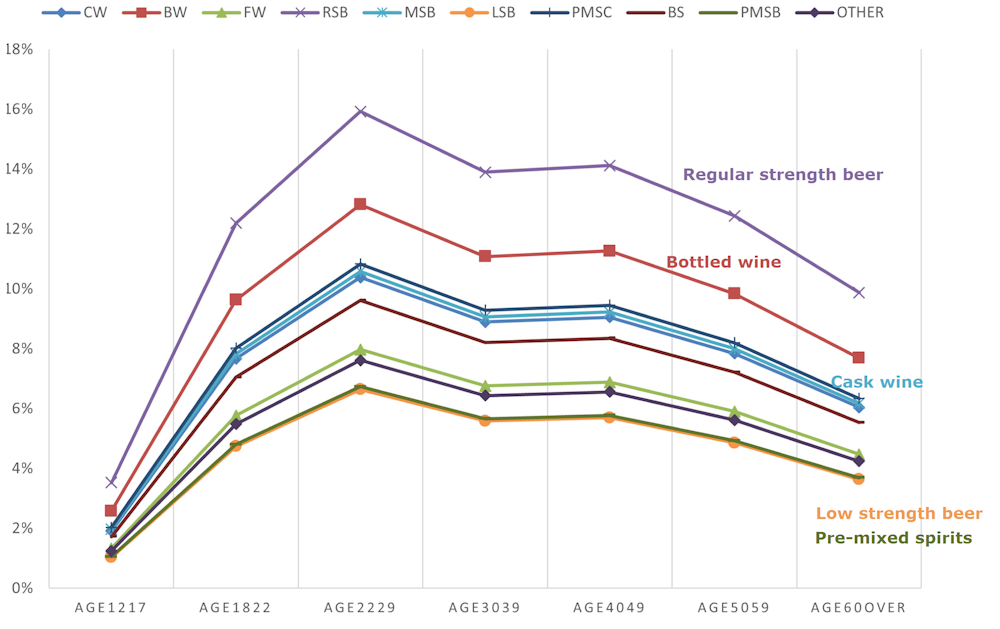
RSB = Regular-Strength Beer; LSB = Low-Strength Beer; MSB = Mid-Strength Beer; BW = Bottled Wine; FW = Fortified Wine; CW = Cask Wine; PMSC = Pre-Mixed Spirits in a Can; PMSB = Pre-Mixed Spirits in a Bottle; BS = Bottled Spirits and Liqueurs.
Source: Economic Record

Some of the relationships vary with the type of damage. While bottled wine is linked to a moderate to high probability of drink-driving, it is also linked to a low probability of hazardous, disturbing or abusive behaviours.

Pre-mixed spirits in a bottle are related to a low probability of both drink driving and hazardous, disturbing and abusive behaviours. But when account is taken of the gender of the drinkers (so-called alcopops are typically drunk by females), we find them no longer as safe.


Probability of hazardous, disturbing or abusive behaviour
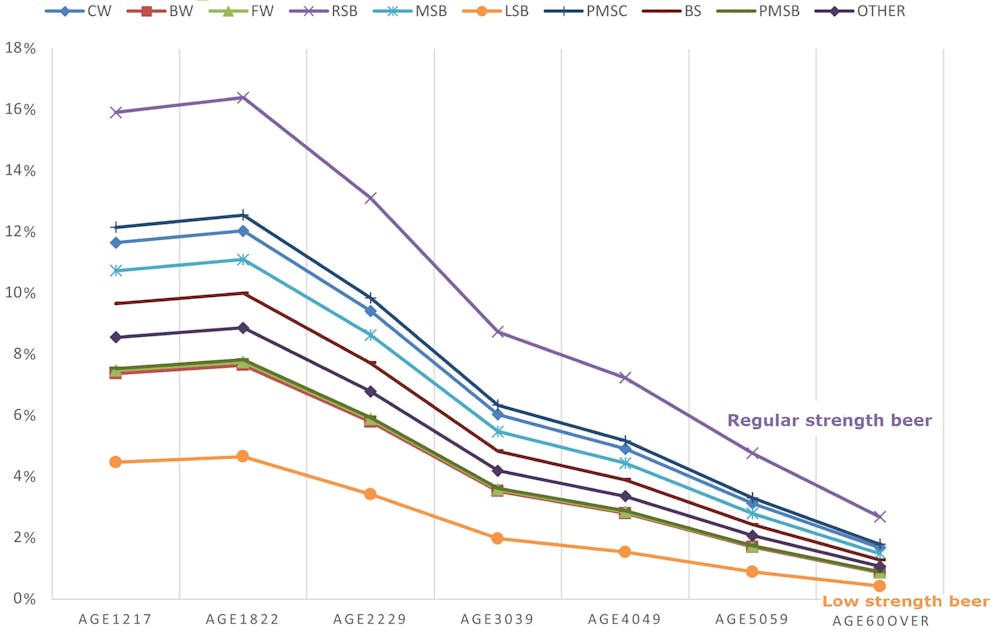
RSB = Regular-Strength Beer; LSB = Low-Strength Beer; MSB = Mid-Strength Beer; BW = Bottled Wine; FW = Fortified Wine; CW = Cask Wine; PMSC = Pre-Mixed Spirits in a Can; PMSB = Pre-Mixed Spirits in a Bottle; BS = Bottled Spirits and Liqueurs.
Source: Economic Record

Our study suggests that Australia’s haphazard system of taxing alcohol might have got some things right. Beer, which is typically taxed more highly than wine, seems to do more damage.

But it has got some things wrong. Cask wine appears to be significantly undertaxed relative to the damage it does.

More broadly, our findings suggest that if alcohol is to be taxed according to the damage it does, the tax system we adopt will need to be more complicated than a single rate for every unit of alcohol regardless of the form in which it comes. ■The Conversation

Note: Ou Yang, Research Fellow, The University of Melbourne and Preety Pratima Srivastava, Senior Lecturer, RMIT University This article is republished from The Conversation under a Creative Commons license. Read the original article.
Alcohol is not useful

January 10, 2024

Alcohol is not useful, with all of its purported benefits achievable by other means which are not hazardous to health or well-being. Please join the supporters of Alcohol Review to help bring alcohol understanding for all. ■

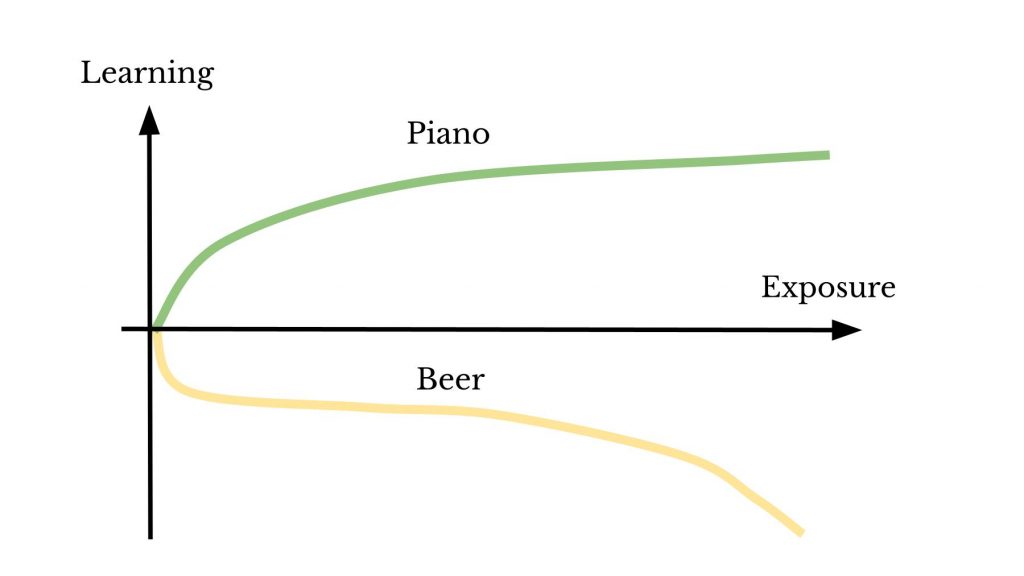
The alcohol “unlearning curve”

January 10, 2024

Alcohol has a reverse learning curve in which greater exposure tends to lessen our intuitive understanding of it rather than improving it. Alcohol Companion and Alcohol for Nerds were written to help rectify this unlearning process. ◼️

Why are we paying so much for alcohol-free drinks that aren’t taxed?

January 10, 2024

Image Shutterstock

by Cameron Shackell, Queensland University of Technology

Dry July, an Australian fundraising campaign to support people affected by cancer, is almost here again. The premise is that abstaining from booze and hangovers for a month frees up money to donate.

But with prices in the booming alcohol-free drinks category often rivalling those of regular tipples, participants this year might find they have less spare cash than they anticipate.

Traditional alcohol producers, who have expanded into the US$11 billion non-alcoholic drinks industry, have helped make the high prices charged seem acceptable to consumers by using a marketing tactic called price-anchoring.

Lured into paying more

When we encounter a new product, we latch onto whatever seems relevant in the immediate environment to estimate its value. Sellers often exploit this by staging information at purchase points. The classic is a price tag with $99 struck out and $79 written in. Whether it’s accurate or not, the $99 reference point shapes our perception of value and price.

This so-called “price anchoring”, is just one example of the broader anchoring cognitive bias described by psychologists Amos Tversky and Daniel Kahneman.

The essence of anchoring is that we tend to rely too heavily on an initial piece of information (the “anchor”) when making decisions. This can lead to skewed judgements and poor decisions in everything from deciding whether to have surgery to buying real estate.

Anchoring has been used to reinvent and elevate the virgin drinks category by exploiting the fact we are used to paying high prices for alcohol in bottles, cans or glasses of a certain size, shape and sophistication. When alcohol-free versions with similar labels appear beside them on the shelf, website or menu, we tacitly accept they should command roughly the same prices.

It’s not just that the next bottle along provides a suggestive price. Our brains, steeped in marketing, know that alcohol prices can range far upwards from “normal”, making them not just comparison points but the proverbial $99 scratched out. So even if we spend a lot on non-alcoholic wine, we feel like we have scored compared with what we might have dropped on a bottle of Grange.

Where we are most susceptible

The effect is strongest in bottle shops and bars, where the glitz of alcohol marketing, social pressure and the sheer number of expensive items overwhelms our rational thinking. But it also works on websites of the national liquor outlets where special zero-alcohol categories have been established beside the traditional beer, wine and spirits listings.

It doesn’t take much browsing to confirm that prices are similar. Currently, on one of the big retailers’ websites, a case of 330ml bottles of Heineken Lager (5% alcohol) is $55, Heineken 3 (3.3% alcohol) is $50, and Heineken Zero (less than 0.5% alcohol) is $49. Among the non-alcoholic spirits, 700ml of Lyre’s Dry London Spirit – “crafted to capture the essence of a classic gin” – is $51 at another outlet while the same size bottle of 37% alcohol Gordon’s London Dry Gin is $45. Gordon’s own non-alcoholic offering – Gordon’s 0.0 Alcohol Free – is listed at $38.

Price anchoring in the alcohol-free market comes with an extra twist of lemon.

Brands will encourage you to think their investment in developing “healthier options” using “high-quality ingredients” means high prices are fair enough, and that a non-alcoholic drink made with arcane “botanicals” and “adaptogens” in a nice bottle is worth a splurge.

But look at what makes up the price. All processed drinks incur a Goods and Services Tax (GST). And drinks that contain alcohol are hit with a heavy additional excise. The exact percentage is difficult to calculate, but the alcohol-related tax on a bottle of full-strength beer can exceed 30%.

Industry players don’t pay that tax on non-alcoholic drinks. So, in a sense, they are pocketing a hefty bonus that well-anchored customers forget is not being passed on to the government. Ouch.

Supermarkets and nurturing the next generation

Seemingly at odds with price anchoring is the appearance of non-alcoholic versions of some famous brands in supermarkets.

An incentive for names like Heineken, Coopers and Gordon’s to be in supermarkets is visibility in a family-friendly environment. Their brand becomes recognisable to customers who are underage now, but will soon be ready to buy alcohol for their 18th birthday bash.

It’s a risky strategy, however, and can attract adverse publicity. In fact, to protect their reputations, several supermarket chains in New Zealand require customers to show ID when purchasing non-alcoholic lookalike drinks.

Is there a way to overcome the illusion?

The Australian government’s Behavioural Economics Team (BETA) has an informative blog post on minimising the impact of price anchors. But research suggests even experts are susceptible.

Besides awareness, you can reduce the effect by curating your exposure to price information. If you need non-alcoholic drinks for home or an event, visit the supermarket before the bottle shop. The range may not be as big, the drinks may not be any cheaper, and you may need to go to the bottle shop anyway. But the experience will put the untaxed non-alcoholic products in a fairer context – the soft drink aisle. Comparing prices under those sober lights, you might suddenly feel like picking up a bottle of ginger ale instead.

In bars and clubs, you can try to flip the script. Ask for your soda water in a fancy glass with lots of ice and slices of lemon or lime. This anchors what’s in your hand to high-priced cocktails.

Of course, if you embrace the life of a true ascetic, H₂O is a zero-dollar option that, as Nietzsche said always suffices. In Dry July, you might even join the hype and call it non-alcoholic vodka.The Conversation

*Cameron Shackell is Visiting Fellow at Queensland University of Technology This article is republished from The Conversation under a Creative Commons license. Read the original article.
Alcohol calories

January 10, 2024

Labels don’t tell us: Alcohol has roughly the same calorie density as cooking oil. The 25ml of alcohol in a large beer contains around 175 calories and the 20ml of alcohol in a quarter of a bottle of wine is around 150 calories, the same as a 50ml double measure of spirits. ■

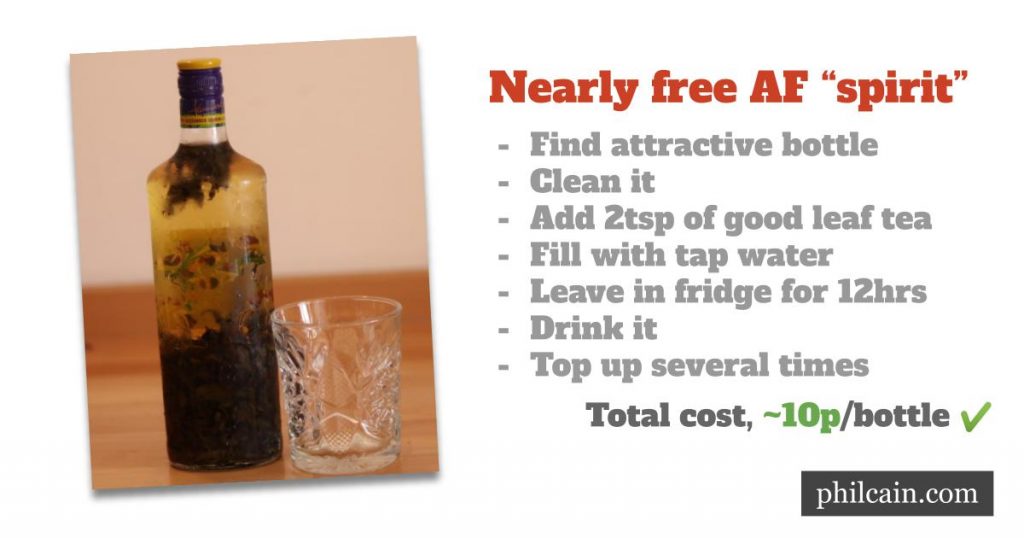
Nearly free “spirit”

January 10, 2024

  • « Go to Previous Page
  • Page 1
  • Interim pages omitted …
  • Page 7
  • Page 8
  • Page 9
  • Page 10
  • Page 11
  • Interim pages omitted …
  • Page 22
  • Go to Next Page »

Copyright © 2026 · Phil Cain Impressum