Alcohol is useless, with all of its purported benefits achievable by other means which are not hazardous to health or well-being. To find out more, join the supporters of Alcohol Review. ■
Alcohol understanding for all
Alcohol is useless, with all of its purported benefits achievable by other means which are not hazardous to health or well-being. To find out more, join the supporters of Alcohol Review. ■

Updated 28.8.2024 to include response from Men’s Sheds.
The UK Men’s Sheds Association acknowledged concerns from health experts and shed users about its partnership with alcohol giant Diageo, while highlighting the benefits of the controversial deal.
“It is genuinely a response to harmful drinking especially in the 50-70 age group,” Men’s Shed chief executive Charlie Bethel told Alcohol Review. The 18-month pilot of the DrinkIQ-branded co-created product will allow the charity to assess its impact. One shed which closed now meets at a Wetherspoons, Bethel noted.
Bethel said some shed users have objected to the deal, but he said it is comparable to other charities taking money from National Lottery scratch cards. He said he could not speak for Diageo’s motives, but noted the success of its alcohol free beers. There is currently no evidence alcohol-free beer cuts harm.
“It’s prob too late but worth having a read of the evidence on partnerships with harmful product industries They don’t have men’s health–or women’s, for that matter–as a strategic aim,” said Greg Fell, President of the The Association Of Directors of Public Health (UK), on X at the time of the announcement in late July.
“There are other places to get your information about alcohol harm to help with recovery, addiction and mental health regarding alcohol than those that make it profit from it,” commented alcohol harm reduction campaigner Mick Unwin.
“This is a very unfortunate move by UK Men’s Sheds,” said Sheila Gilheany head of Alcohol Action Ireland, echoing the similar concerns about the expertise an alcohol company might have in offering information on alcohol harm.
“Very sad to see this corporate capture of Men’s Sheds,” said another commenter who sits on the board of a harm reduction charity. ■
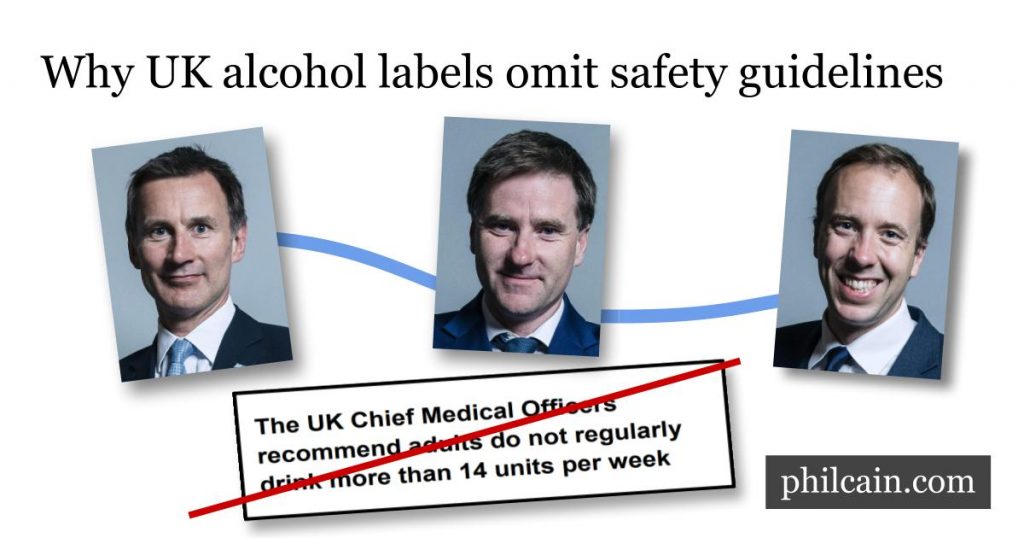
The UK government kept quiet for 22 months about the “grace period” it gave alcohol suppliers to omit the official safety guidelines, Alcohol Companion has discovered.
The department agreed the alcohol industry could omit the information from labels until September 1st this year in March 2017, only formally telling the public of the deal in January this year.
The deal was struck under Jeremy Hunt (left), who was thwarted in a bid to become prime minister this week. Hunt handed over the health department reigns to fellow would-be leader Matt Hancock (right) last summer.
The silence meant even the most informed onlookers were taken-aback when Alcohol Companion revealed the alcohol industry had suddenly dropped the guidelines from its voluntary code in October 2017.
The grace period first became a matter of public record in January thanks to a speech to parliament by Steven Brine (below), who started as a junior minister three months after the little-known pact.
The health department says an eagle-eyed observer might have inferred the industry had been offered the delay in labelling from a Food Standards Agency update issued in September 2017.
It also says it issued guidance on how to communicate the low-risk guidelines at the same time as it quietly agreed the alcohol industry could have 30 months more omitting them.
“We are starting to see more products with labels that reflect the new guidelines and the department will continue to work with industry to implement the guidance,” the department said.
Only around 14% of alcoholic drinks labels tell consumers of the 14 UK unit (140ml) a week guideline, according to a BBC Panorama investigation into the issue last month.
The guideline was first introduced in January 2016. As few as one-in-six UK consumers know it. ■
One book on alcohol is enough, surely? Well, not quite, which is the reason I recently put out Alcohol for Nerds, a slim compilation of self-contained pieces on alcohol. Here’s why.
The alcohol science presented in Alcohol Companion produced many useful answers, at least for me. But it also raised many difficult questions.“Don’t drink, don’t smoke, what do you do?” as Adam Ant neatly put it in 1982.
With Ant’s queries still echoing my mind after my first book I felt I should at least try to offer a few solid answers. There is the recreational vacuum Ant notes, but also the ingrained beliefs and ideas to re-mould.
The science makes it abundantly clear, for instance, that drinking alcohol to deal with tension, low mood, shyness or to gain inspiration is liable to backfire. But then, what do we do? In Alcohol for Nerds, I explore some alternatives, like learning improv, soothing my woes by plunging myself in icy water and taking imaginative flights of fancy through psychogeography.
It is also clear that the sense of freedom we get from alcohol has the fundamental flaw of coming with a disabled brain. But what is the alternative? There are performance skills, as I found. And we can also broaden our ideas of freedom. Freedom is not just about lowering barriers to commerce, it is also about self-realisation and an absence of dependence.
The science I explore in Alcohol Companion has universal implications, but the way we deal with these implications does not need to be universal. Alcohol for Nerds is the product of me, a nerd, wrangling with the issues it raises for the last four years. I hope the results are of some help.
There are many other perspectives on this which each chime with different people. They have one thing in common: there can be few more concrete ways to improve our mental and physical health, and our personal finances than to come to terms with consistent low-risk drinking.
With a pandemic running riot, this is, perhaps, a uniquely good time to give it a try. ■
by Simon Bratt, Staffordshire University

In the UK it’s estimated that 86% of people who access treatment for alcohol use experience mental health problems. Similarly, 70% of people in treatment for drug dependency also have a mental illness. For those people that report coexisting mental health difficulties, depressive and anxiety symptoms tend to be the most common.
Often people with substance use issues find getting help for their mental health is difficult and frustrating – as there’s often the view from mental health professionals that patients need to stop using drugs or alcohol before they can access treatment.
But herein lies the problem because, for many people, using a substance can be the way they cope – or mask mental health difficulties. Asking them to stop using drugs or alcohol means taking away their coping strategy and without immediate support it’s likely that person will return to using substances to cope with psychological distress.
This often leads to a revolving-door scenario, whereby the person will ask for support from mental health services only to be told to stop using substances. They stop using substances but can’t get support for months thanks to long waiting lists, so end up returning to substance use to cope.
‘Dual diagnosis’
Someone with both a mental illness and substance use disorder is considered to have a “dual diagnosis” – a concept that emerged in 1990. Back in 2002, the Department of Health reported that supporting people with dual diagnosis was one of the biggest challenges facing frontline mental health services.
The report highlighted how fragmented care leads to people falling between the cracks in services. It warned that “patients should not be shunted between different sets of services or put at risk of dropping out of care completely”.
The report also stated that people with dual problems deserve high-quality, patient-focused and integrated care, which should be delivered within mental health services. But 18 years on from these findings, sadly nothing has changed – if anything things have got worse.
Treatment and recovery
As part of my ongoing PhD research, I sent a freedom of information request to every mental health trust within England. I wanted to find out if high-quality and integrated care exists for people with a dual diagnosis.

Many suicides involve people with mental health problems and substance dependency. Viajero/Pexels
The results show that only 58% of the NHS trusts record data about people with a dual diagnosis and that only 28% of those trusts had specific teams that offered treatment. The remaining trusts outsourced treatment to voluntary or private sector substance use services. This means that where you live affects the type of care you will be given – creating a postcode lottery for people trying to access support and treatment.
From the data I collected, only 11,486 UK patients were recorded to have a dual diagnosis. Yet it’s estimated that 586,780 people are alcohol dependent in the UK – so it’s likely that the real figure is far higher.
A crisis on the frontline
There are several reasons why the data collected is not a true reflection of the prevalence of dual diagnosis – and one reason is the term itself. There isn’t a clear definition of “dual diagnosis” – and services often develop their own local word or use the term “co-occurring mental illness and substance use” instead.
Another reason is that people with a substance dependency may not go to the doctors for help with their mental health for fear of being rejected. Hearing the words: “We can’t treat your mental health if you are using substances” is becoming the norm for people with a substance use. This discrimination and stigmatisation puts people’s lives at risk.

People can fall between the cracks and struggle to access any help or support. pexels/sarah dietz
COVID-19 has presented significant challenges to UK healthcare systems and public health policies. Disruption has led to community-based services grinding to a halt due to the redeployment of healthcare workers and quarantine restrictions. People with a dual diagnosis not only suffer from their mental health and substance use, but most will also have multiple needs. Some will have experienced significant trauma, live in poverty, may be known to the criminal justice system and have little or no support in the community.
Research has shown how past crises significantly affected the more vulnerable in society, leading to an increase in substance use. So it would be remiss to think that mental health difficulties and substance use will not increase in the wake of the pandemic. In fact it runs the risk of overwhelming an already exhausted NHS.
This is why an integrated approach to care is needed, as well as a culture change in terms of how healthcare professionals work with and treat people with mental health problems and substance use. The stigma must be banished now – before it’s too late. ■
■
Simon Bratt, Mental Health Social Worker and PhD Candidate, Staffordshire University
Note: This article is republished from The Conversation under a Creative Commons license. Read the original article.