story
Alcohol: Why not all use millilitres?
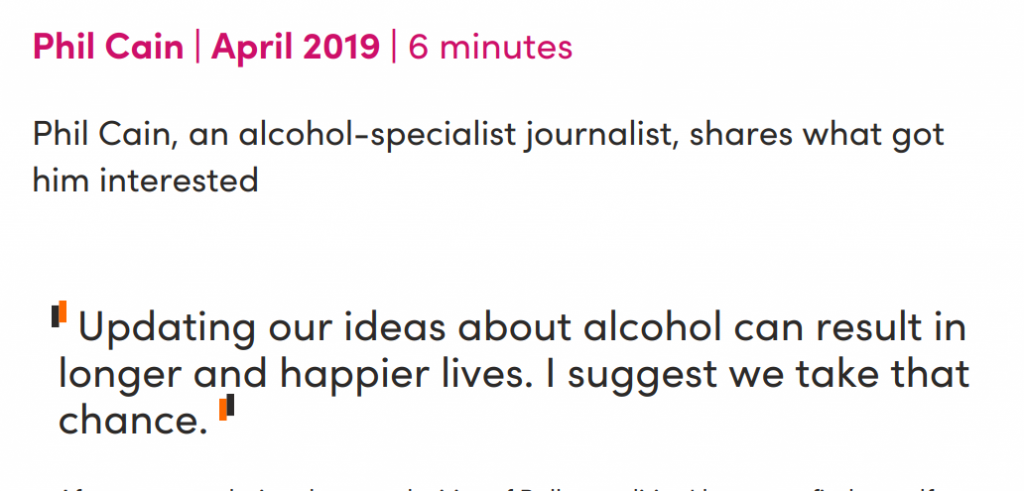
We could make alcohol health guidelines easier to picture, calculate and compare internationally by giving them all in millilitres.
We measure oil, water and every other liquid in metric units, so why use 20-odd different units for alcohol?
It is like a throwback to the bygone days in which Europe operated on a bewildering array of measurement systems.
An account of a medieval journey might mean converting the Finnish virsta (Russian or Swedish) to the Rheinland miele.
This week’s new proposed weekly guideline of saw us scrabbling for the definition of the “Australian standard drink”.
Once converted to 125ml it could be compared easily to the UK one of 140ml, itself normally given in local units.
Offering it to begin with in millilitres would avoid this process, allowing consumers and nerds a ready-made comparison.
It would make recommendations more intuitive too. We can imagine 100ml far more easily than a bespoke unit.
The volume of alcohol is a good guide too, giving a direct picture of the number of molecules it contains, so its effects.
Using millilitres as a standard means only needing to do a one-step calculation to work out a dose, not two or three.
The alcohol present in a drink is just a drink’s alcohol percentage by volume multiplied by its volume. That’s it.
So, for example, in 500ml of 5% beer there is 0.05x500ml of alcohol, or 25ml.
One large continental lager is, then, a fifth of the Australian weekly low-risk guideline total of 125ml.
Using alcohol specific units, by comparison, we might have two more stages, perhaps converting to mass on route.
We need not drop local units, which some may find helpful, but we could easily add the equivalent amount in millilitres in brackets.
This would be a simple way to reduce barriers in a field in which international cooperation is essential. ■
Alcohol shows ways we can improve
I started writing about alcohol nearly seven years ago now. Little did I imagine I would still be hard at it today. “Why are you?” you may well ask.
Well, for one, alcohol problems still kill 3m a year globally, playing a role in the untimely demise of one-in-ten people under 50, and bring misery to many millions more.
That’s a story, even if few seem to care. But, for two, just as important, is that tackling alcohol problems hints at routes to wider renewal when we seem short of ideas.
Alcohol problems arise from an interplay of individuals, social groups, business and regulation. An effort to minimise alcohol harm allows us to imagine ways to improve all four.
As individuals we can learn to make better sense of the misleading first-hand impressions alcohol gives and to identify the half-truths passed to us by word-of-mouth and media.
Alcohol sellers employ populist methods: dubious science, misleading propaganda, uncritical coverage, denying consumers information and opportunistic advertising.
Not being duped can reduce our risk of harm, reduce the chances we harm others, slash our overheads, improve our critical thinking, and find upsides typically ascribed to alcohol elsewhere.
Our social groups, meanwhile, are improved by becoming more accepting of differences on this choice. This requires us to develop tolerance and respect to replace of a herd mentality.
On the bigger scale, it means holding elected politicians and nobody else is responsible for alcohol regulation. They cannot be allowed to evade blame for what is their indivisible responsibility.
Fixing the institutional flaws, influence peddling and muddled thinking which allows persistent regulatory failure could form part of a programme of democratic renewal.
The type of principles, laws and institutions which prevent undue commercial influence on alcohol regulation could be applied other vexed areas of government decision-making.
Alcohol offers a window onto our vulnerabilities as individuals and as societies, and should provide our political leaders with plenty of ideas and inspiration for how to improve lives.
This is why I think it remains important to write about alcohol. It is unglamorous, awkward and woefully ignored, but it is also a rich source of untapped ideas on how to improve at a time when we badly need them. ■
Dry January is a vital part of the alcohol debate
The difficulty of putting a lid on our alcohol drinking for a month or more provides us with important understanding of alcohol and the often bewildering public debate around it.
How can we understand the impact of advertising, taxation tweaks or the complex interplay of mind, body and environment? The answer is, by experiencing them ourselves.
Having an ad for our favourite tipple pop up just as we managed to ignore the urge to pour ourselves one helps us understand how advertising stimulates alcohol demand.
The effort we need to make to swerve the alcohol aisle in the supermarket or the offie shows how availability is a challenge to those wanting to limit their consumption.
How can we understand the social pressures to drink alcohol without at some point trying to rebuff the alcoholic ribbing of our friends, family and colleagues?
Opening our wallets to find folding money in there on Sunday morning shows us in no uncertain terms that increasing alcohol prices increases the incentive to cut down.
So it is that Dry January, and all similar short-term quitting initiatives, offer valuable first-hand insight into the key elements of the policy discussion around alcohol.
It allows us to feel first-hand the challenges faced by anyone looking to reduce their alcohol intake, difficulties experienced most intensely by those of us most deeply affected.
Dry January and the like establish a valuable common ground of shared experience which can inform an often off-putting discussion which, nevertheless, has huge potential to improve health and well-being.
The exercise of quitting alcohol, albeit often temporary, connects a personal assessment of the benefits of changing our own alcohol habits to something far wider.
A DIY quitting exercise was fundamental to my writing. Alcohol’s complex challenges need to be tackled with empathy as well as analytical thought.
Wider understanding provides the platform needed for informed alcohol policy. Dry initiatives go a long way towards informing us on every level. ■
The year in alcohol
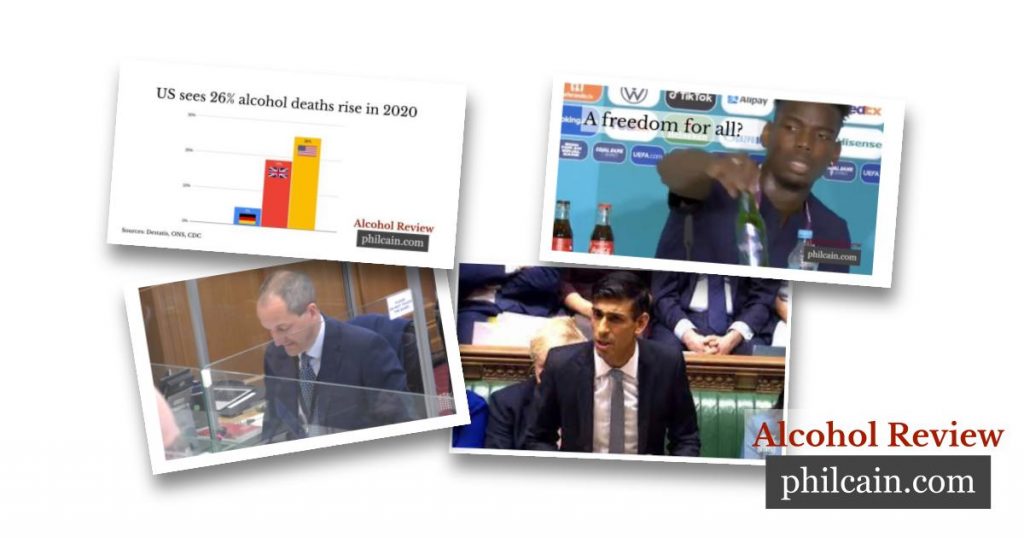
The world continued to bump its way through the covid pandemic, with alcohol playing a fringe role in public discussion, despite inflicting a far heavier death toll than before.
The year ended with the discovery that the US suffered a mystery 26% increase in alcohol-induced deaths last year, according to provisional CDC figures. This is higher than the UK’s 19% and five times the rise in Germany. The unexplained leap is set to be followed by 14% rise this year. The closest thing to an explanation for the US rise is the rise of home delivery.
In November Wales launched the first framework for caring for people with alcoholic brain damage, about 10% of people with dementia. At the same time the alcohol industry boasted that one in five alcoholic drinks in the UK does not include official guidelines, five years after they were introduced.
A lack of adequate labelling partly explains why few Brits know the basic facts about the alcoholic drinks they consume. Just one in five know how many calories are in their alcoholic drinks or know the official low-risk drinking guidelines, a survey found in July.
The UK Budget in October ignored health advice, freezing alcohol tax in 2022. This means prices will fall relative to inflation, so lowering the barriers to deadly levels of drinking despite 2020’s record rise. Tax reforms slated for 2023 were praised, but also leave a loophole for ultra-cheap cider.
There was little positive news for those who might develop alcohol drinking problems. Local government alcohol treatment services have seen their budgets cut by 17% over the last five years, according to Health Foundation figures. Alcohol was not part of its drugs strategy in December.
Not having an alcohol strategy may ultimately prove unpopular, with steps to help to curb future alcohol drinking problems wildly popular among the British public. Three-quarters of Brits want to see curbs on alcohol ads reaching children, an Alcohol Health Alliance survey found in August.
Not having an alcohol policy also runs counter to the government’s goal of “levelling up” society. A third of England’s alcohol deaths were among the most deprived, a Public Health England report said in July. Why, some ask, avoid popular policies and undermine a central manifesto commitment?
The government’s position was first confirmed in April by then health minister Lord Bethell to a parliamentary committee. His wife is a board member of alcohol giant Diageo and Tescos, the biggest UK alcohol retailer. Alcohol Review‘s reporting was followed up by Private Eye. He was removed in September amid controversy over covid contracts.
Among those who might appreciate action to spare media consumers of constant reminders about something we wish to avoid is the newly-sober-curious Queen Elizabeth. In October Vanity Fair reported she is skipping her favoured martinis ahead of her Platinum Jubilee in June.
French footballer Paul Pogba caused a stir in July when he tried to skip endorsing a Heineken-branded alcohol-free beer in a Euro 2020 [sic] press conference. Alcohol Review discovered it may be an option only open to the religious, Alcohol Review , and apparent breach of UN human rights principles.
The end of the covid era may finally be nigh, but only time will tell whether shortcomings that have led to so many more alcohol deaths are corrected or ignored. ■
Video/podcast: A more rational alcohol tax
On the eve of Brexit and the Budget I talked with Scott Corfe, research director of the Social Market Foundation think-tank about his proposals for a more rational form of alcohol tax.
- “If an increase in alcohol tax has a regressive impact, you can mitigate that elsewhere, through more generous benefits or through curbing other types of tax.” [19m04s]
- “Minimum alcohol pricing and alcohol duty are policies which have different impacts.” Duty might be a way to cut drinking among higher income groups, who are the biggest drinkers. [13m51s]
- The Conservatives have committed to a review of alcohol duties, possibly diverging from EU rules. Nevertheless, “This might be an area where Europe puts its foot down.” [13m06s]