• Skip to main content

Alcohol Review

Alcohol understanding for all

  • Highlights
  • AR2026
    • AR2025
    • Earlier events
  • Register
  • About
    • Organisers
    • Contact
  • Log In

story

Would-be commissioner noncommittal on alcohol labelling

November 7, 2024

Also on Substack

Hungarian health Commissioner-designate Oliver Varhelyi faces further questions having last night offered MEPs no clear reassurance he would deliver long-overdue alcohol health labelling proposals.

“We have just introduced a couple of labelling conditions for wine: ingredients, alergen content, but also the energy content. Let’s see how they sink in on the use,” he said when Alessandra Moretti of Italy’s centre-left Democratic Party asked if he would commit to producing proposals on alcohol labelling.

“I believe that we need to reflect on how to change the narrative on risk factors, including alcohol, and the economic determinants of health. Social attitudes can be a key driver for change,” he earlier wrote in a written answer to the same question.

He will be asked another set of written questions by MEPs who were unhappy with his answers, including those on protecting abortion rights, lack of clear plan for health and ties to his country’s authoritarian leader Viktor Orban. He won applause for defending the effectiveness of vaccines.

The Commission was meant to produce a proposal on nutrition and ingredients labels by the end of 2022 and warning labels by the end of 2023, according to the Beating Cancer Plan. Delivering this plan is part of the mission set out by Commission President Ursula von der Leyen in September.

Varhelyi is the first of the proposed commissioners to face such a redo. He will have to deliver his written answers by Monday. ■

Guest post: Why Northern Territory alcohol reforms would be a disaster, according nine experts

October 18, 2024

by Cassandra Wright, Menzies School of Health Research; Beau Jayde Cubillo, Menzies School of Health Research; John Holmes, University of Sheffield; Mark Mayo, Menzies School of Health Research; Mark Robinson, The University of Queensland; Michael Livingston, Curtin University; Nicholas Taylor, Curtin University; Sarah Clifford, Menzies School of Health Research, and Tim Stockwell, University of Victoria*

The new Northern Territory government is planning a swathe of changes to alcohol policy.

If implemented, these changes fly in the face of what evidence shows works to reduce alcohol-related harms. Some are also out of step with the rest of Australia.

Among our concerns are plans that would lead to harmful alcohol products becoming cheaper, alcohol becoming more easily available, criminalising public drunkenness, and a particularly worrying type of mandatory alcohol treatment – all of which evidence suggests will cause more harms.

No one is downplaying the magnitude and complexities of alcohol-related issues in the NT. But we hope the territory government will pay more heed to the evidence and voices of those most impacted.

Alcohol-related harm in the NT is complex
Alcohol-related harms in the NT are significantly higher (for both Aboriginal and non-Aboriginal people) than elsewhere in Australia.

In the territory, these harms contribute to health and social outcomes costing at least A$1.4bn [US$1bn]  a year. Alcohol harms result in costs related to health care, deaths, crime, policing and child protection.

Aboriginal communities in the NT have for decades cried out for solutions and services that effectively respond to alcohol-related harm. Instead, they found their lives made part of a political football match on law and order. Policies have been reactive and mostly ineffective. They’ve been overturned at each election.

Now, the new NT government is discussing changes that promise to exacerbate the very issues it aims to address.

1. Cheap alcohol that contributes most harm would be on the market
The World Health Organisation recognises that raising the price of alcohol is one of the most effective ways for governments to reduce alcohol-related harm.

So some governments around the world, including in the NT, have set a price below which alcohol cannot be sold, known as the minimum or “floor price”. This targets cheap, high-strength alcohol associated with patterns of drinking that cause the most harm.

The new NT government plans to repeal this, despite evidence showing this works to reduce harms.

Since the NT alcohol floor price was set at A$1.30 per standard drink in 2018, there has been a:

  • 14% reduction in alcohol-related assaults in Darwin and Palmerston

  • 11% reduction in domestic and family violence assaults

  • 21% reduction in domestic and family violence assaults involving alcohol

  • 19% reduction in alcohol-related emergency department attendances.

Originally, experts recommended a A$1.50 floor price but this was reduced to A$1.30 after a backlash from alcohol industry lobbyists. Had the policy not been watered down, evidence suggests the impacts above would likely have been greater.

The floor price has likely also lost some of its initial impact as it has never been indexed for inflation.

The best available research shows the floor price has reduced alcohol-related harms with no evidence of unintended consequences or negative impacts on the alcohol industry, despite claims otherwise.

Researchers and experts from around the world have been writing to NT ministers urging them to reconsider repealing this effective policy.

This includes researchers from the United Kingdom and Canada, who have coauthored this article. In these countries, evidence on the effectiveness of minimum pricing has been used to increase the floor price by 30%, not abolish it.

2. Bottle shops could be open longer
There are also proposals to repeal current restrictions on bottle shop trading hours. Such restrictions are highly effective in reducing alcohol harms, including violence.

Our paper from earlier this year found that in the town of Tennant Creek, restrictions to reduce trading hours and introduce purchase limits at bottle shops resulted in a 92% reduction in alcohol-involved domestic and family violence assaults.

Preliminary analyses of the reduced trading hours introduced in Alice Springs following Prime Minister Anthony Albanese’s visit in early 2023 also suggest a clear reduction on violence rates.

Car approaching drive-through bottle shop
Bottle shops would be open for longer, making alcohol more easily available. AustralianCamera/Shutterstock

3. New public drunkenness offence
Ministers were also set to pass laws to create a new offence for “nuisance” public intoxication (also known as public drunkenness). This would allow police officers to arrest people and fine them up to A$925, in addition to current powers to seize and tip out alcohol from people drinking in prohibited areas.

This is at the time when nearly every other jurisdiction in Australia is in the process of decriminalising public drunkenness, making the NT out of step with the rest of the nation.

The NT’s proposed new laws on public drunkenness would criminalise more people who are already locked out from our society, placing them at risk of the negative, intergenerational and preventable impacts that often arise from contact with the justice system.

4. Mandatory rehab
Mandatory alcohol treatment was also an election commitment.

In its previous term of government, mandatory alcohol treatment was focused on people with a public intoxication offence rather than providing quality care to people with alcohol dependence in life-saving circumstances. If the same model is reintroduced, this is potentially harmful and at best ineffective.

In the NT, this model of mandatory alcohol treatment had no better outcomes than for those who may not have received any treatment at all. But it cost the taxpayer three times as much.

Where to from here?
Researchers, health professionals and partner organisations have urged the NT government to reconsider these decisions, as we have well-founded concerns these may worsen the very issues the government aims to address.

There’s no need to guess the outcomes of changing, repealing or introducing alcohol policies. We can draw on robust evidence, including extensive research from the NT, on what works in our communities.The Conversation

*This piece is republished from The Conversation under a Creative Commons license. Read the original piece. ■

[Read more…] about Guest post: Why Northern Territory alcohol reforms would be a disaster, according nine experts

Try out some alcohol policies at home

January 10, 2024

Policies and individual choices are normally seen as completely separate, but in reality they merge. So why not ring in the New Year by road-testing some effective alcohol strategies at home?

We all set some rules, or policies, for our homes, for example. Few let outdoor shoes go beyond a certain threshold. Weaponry, road vehicles, fire, smoke and harmful chemicals also typically have their perimeters.

These are not prohibitions. They are regulations. By crossing borders we can have access to all of the things verboten in some places. Out there is a target-shooting, tanker driver who only smokes when scrubbed up, unarmed on the veranda.

The regulatory systems of our private lives often operate on the basis of unwritten policies picked up from parents, partners, and common sense. They offer an easy way to keep a safe, livable and inexpensive environment. 

These policies are typically adopted and applied without any democratic mandate. But we will also, sometimes, decide to set new policies, often through a process of thought, negotiation and compromise.

So why not consider adding evidence-based alcohol policies to the mix. We might take, for instance, government policies reckoned to curb harm at a population level as a starting point: increase the price, and reduce availability and marketing.

A few calculations might allow us to set a minimum unit price. This we might do by identifying products which are below it. Or we might levy a alcohol per unit “tax”, setting aside revenue for household running costs and infrastructure.

Implementation of these might be complicated. Perhaps an easier option would be reducing alcohol availability. We might bar keeping alcohol at home; Or to limit the stockpile; Or not put what we have in the fridge; Or, maybe, not to buy online. 

Limiting home availability would have a knock-on effect. It bumps up the price of alcohol at home, imposing on inhabitants the cost of leaving the house to buy it. This also gives us a chance for second thoughts. 

Reducing marketing exposure is trickier, because alcohol advertising targets us without our consent. But we can reduce it, by putting alcohol brands out of sight at home. We can also filter some online ads. And we can try to avoid alcohol retail.

Harmful levels of drinking are best addressed with the aid of medical advice. But making our own environments less alcohol loaded makes low-risk drinking the easy option. And home drinking is the source of the bulk of alcohol harm.

We all set and live by policies to create environments which are safe and best serve our needs. We need politicians to do this for us in environments we share. ■

Rethink alcoves

January 10, 2024

Explore a new, entirely unconnected brand. The Alcove Renew brand has been carefully hand-crafted and scientifically filtered so that it can get the approval even of people who do not particularly like Alcohol Review. ■

Alcohol Review 0.0

January 10, 2024

An alcohol-free sub-brand can be used to promote the main alcohol brand. ■

This is one of a collection of shareable alcohol messages. If you think more people should know, please share and join the supporters.

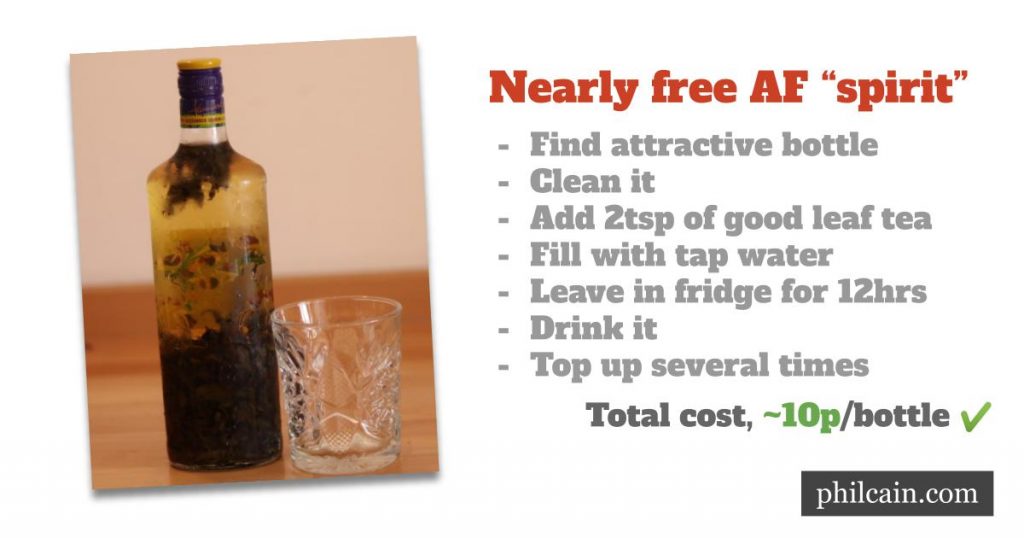
Nearly free “spirit”

January 10, 2024

  • « Go to Previous Page
  • Page 1
  • Interim pages omitted …
  • Page 6
  • Page 7
  • Page 8
  • Page 9
  • Page 10
  • Interim pages omitted …
  • Page 44
  • Go to Next Page »

Copyright © 2026 · Phil Cain Impressum