• Skip to main content

Alcohol Review

Alcohol understanding for all

  • Highlights
  • AR2026
    • AR2025
    • Earlier events
  • Register
  • About
    • Organisers
    • Contact
  • Log In

alcohol

Brits back youth alcohol ad ban amid record deaths

January 10, 2024

Over three-quarters of Brits want laws to limit the exposure of children and young people to alcohol advertising amid record alcohol deaths across the country.

The alcohol death toll is highest among older, heavier drinkers whose intake increased under the strain of the covid-19 crisis. Stopping alcohol marketing to under-18s could help curb future problems.

Alcohol is not part of the government’s plans to stop junk food advertising online and stop TV ads for it before 9pm in 2023, despite killing record numbers of British people in 2020.

“If alcohol is not included in the plans, we risk alcohol advertising filling the void that is left behind,” said Professor Sir Ian Gilmore, head of the Alcohol Health Alliance, of the survey done by YouGov for Action on Smoking and Health.

The survey found 77% support a ban on advertising alcohol to children and young people, with 70% supporting a ban on TV ads before 9pm, and 72% a ban on cinema ads for films for under 18s, the legal drinking age.

Another 57% of the 12,000 surveyed support a ban on alcohol advertising in public spaces such as streets, parks and on public transport. Parents have little control of the messages their children see outside the house.

Advertising is done to make products as desirable as possible to maximise sales. Consequently alcohol advertising is causally linked to earlier and riskier alcohol use among young people, with the vast majority seeing it.

Alcohol marketing in the UK is informally overseen by the alcohol and advertising industries themselves, and in special cases Ofcom, a government body. The alcohol industry says genuine regulation is unnecessary.

Others disagree. “Limits on the marketing can help prevent young people’s relationship with alcohol being influenced by advertising,” said Richard McVey of Aquarius, which helps young people with alcohol and other drug problems.

“We need comprehensive restrictions on alcohol advertising across multiple media, including restrictions on sponsorships and activities targeting young people,” said the Alcohol Health Alliance.

The placement of alcohol brands in nominally non-commercial content of TV and films raises yet more complex issues. This may lie beyond the scope of even a legally-empowered advertising regulator. ■

Note: You can explore this topic through the Alcohol in the Media event, with expert presentations from researchers Alex Barker and Amanda Atkinson, and Alison Douglas, head of the charity Alcohol Focus Scotland.

Alcohol: Go easy on the amygdala🗼

January 10, 2024

Fear is often our friend, but alcohol makes it more difficult to quash unhelpful worries and so prolongs the ill-effects of our misfortunes.

Our sophisticated brains learn to make us wary of many things: speeding cars, public speeches, deadlines, double-dip recessions, emails from the HR department and letters delivered in brown window envelopes.

These connections are sometimes born of painful first-hand experience, but our intelligence also allows us to skip personal demonstrations and pick up our fears second-hand, from stories and images.

This pairing seems to happen in the amygdala, two almond-shaped structures buried deep in our brains (pictured). They specialise in linking emotions to memories, so informing our impressions and decisions.

Combining feelings with rational thoughts allows us to navigate the world better. Nervousness will tend to make us shy away from things which might harm us, while good vibes will attract us to positive things.

This interplay allows us to adapt to the demands of our surroundings. In the Australian outback it makes sense to fear spiders more than brown envelopes. In others places it makes more sense the other way round.

Activating our alarm bells helps us heed good advice, find objects and social connections which might benefit us, or give appropriate weight to warnings or more complex arguments.

But sometimes it goes wrong and we can be fearful of things which we needn’t be, like European spiders or clowns. A mixed up amygdala may underlie many of our most common mental discomforts.

Sometimes these are merely an inconvenience, but they can also undermine our lives by making us feel generally anxious about things, feel the after-effects of a troubling experience long after, limit our range of choices or underlie poor decisions.

Managing our fears productively is not a sign of “character”, as we have often been brought up think, based on traditional ways of looking at ourselves. It has more to do with the way our amygdala are working. 

Taking care of our amygdala rather than our characters is a better way to benefit from the emotional aspect of our thinking. Doing so is a choice which benefits us and others besides.

Looking out for amygdala
We might look at ways to look after our amygdala. We can recognise the burden they take and allow them to adapt and recover, like emotional limbs, with their strengths and limits.

Alcohol drinking is no help to them, though long used to allay anxieties, from snarling pitch battles, to interview rooms and first dates. We have often used it to get over the aftereffects of stresses too, a hard week at work, defeat or nasty shock.

But, while drinking alcohol provides almost immediate relief from feelings of tension, it prolongs the nagging emotions we might feel after. It seems to hinder our amygdala in attaching the right feelings to stressful experiences.

Nevertheless, perhaps three quarters of Brits over 30 use alcohol to relieve stress with those of us who do being more likely to drink every day. If we keep it up for long enough we will develop a dependency, which shows itself in a range of ill-effects when we are not drinking, a long list which ironically includes anxiety.

Alcohol is no better when we encounter big problems than routine ones either, although we are often tempted to drink more than normal after a job loss, accident, breakup or some other unusual trauma.

But heavy alcohol use has been linked to post-traumatic stress disorder (PTSD), where our fear response does not turn off after a fearful event. Rats plied with alcohol continue to flinch longer after a threat is gone.

Rats made alcohol dependent in the lab tend to be more timid than ones which have not, preferring to stay in less-expose parts of their environment. This anxiety might also give former dependents a motive to go back to drinking.

As with rats some of us seem to be more prone to drinking in response to stress than others. We might look at our relatives for a hint on this, but it is not uncommon. A more easily identifiable high-risk genetic group for drinking to alleviate stress is men.

Enduring stress, particularly the intense discomforts of trauma is difficult, even agonising, but it seems our amygdala have evolved to recover better if we do so without looking for temporary relief from alcohol.

Laying off alcohol can leave our amygdala working better. For those of us who have developed a dependency it might take between three months and a year, although there are benefits along the way and after. In the end there is less to be afraid of. ■

Cognition decline again linked to drinking alcohol above low level

January 10, 2024

Drinking more than a small amount of alcohol can cause cognitive decline in middle and old age a new study has confirmed.
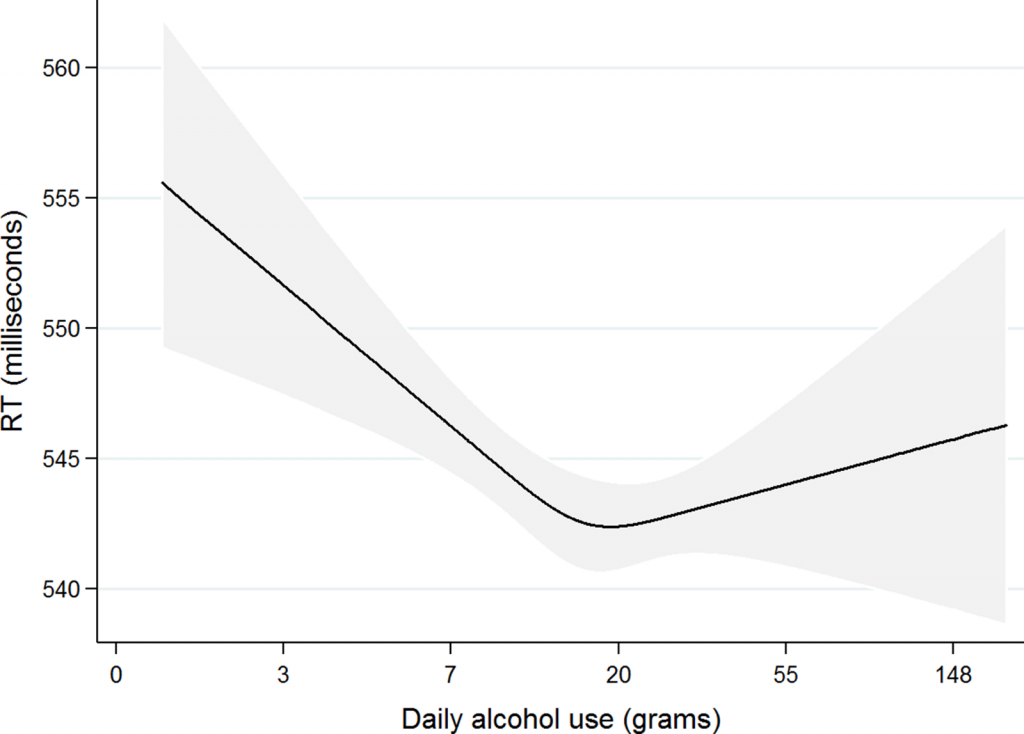

The decline increases with the amount of alcohol we drink above a low threshold and rises with age. The UK guidelines suggest no more than 14 units (140ml) of alcohol a week.

The new study, however, caused a stir because it found the negative effects begin above 9 units a week, five units below the current guidelines.

Professor David Spiegelhalter, a statistician and communicator at Cambridge University says a graph in the study simply confirms 14 units a week, or 16g a day, is where decline is least (see chart). 

“It’s not as straightforward as looking at the graph,” says Professor Simon Moore, one of the study’s authors, who says its lower threshold comes from the calculation involved in fitting the curve to the data.

The debate was fueled by Sun newspaper coverage of the study which came under a headline saying a pint a day might increase our risk of dementia. It seems to be correct:

A daily pint of 5% lager comes to a total of 16 units of alcohol a week, above both the official low-risk limit as well as the lower one suggested by the new study. ■

Children of alcohol dependents lose Tory champion | philcain.com

January 10, 2024

Blackwood in February ►

Conservative MP Nicola Blackwood, who as health minister ordered a strategy to help the children of alcohol dependent people, narrowly lost her Oxfordshire seat to a Lib Dem in last week’s parliamentary election.

There is no mention of the strategy in the Conservative or LibDem manifestos, while an explicit commitment to it appears in Labour’s. Labour champions of developing a strategy, Jonathan Ashworth and Liam Byrne, were re-elected.

Blackwood’s replacement as minister with responsibility for public health has yet to be named. Ashworth was re-appointed Shadow Minister for Health on Wednesday.  ■

Alcohol labellers face legal “domino effect”

January 10, 2024

Jurisdictions trying to introduce health warning labels on alcoholic drinks face a daunting battery of legal challenges intended to discourage them and others, say experts.
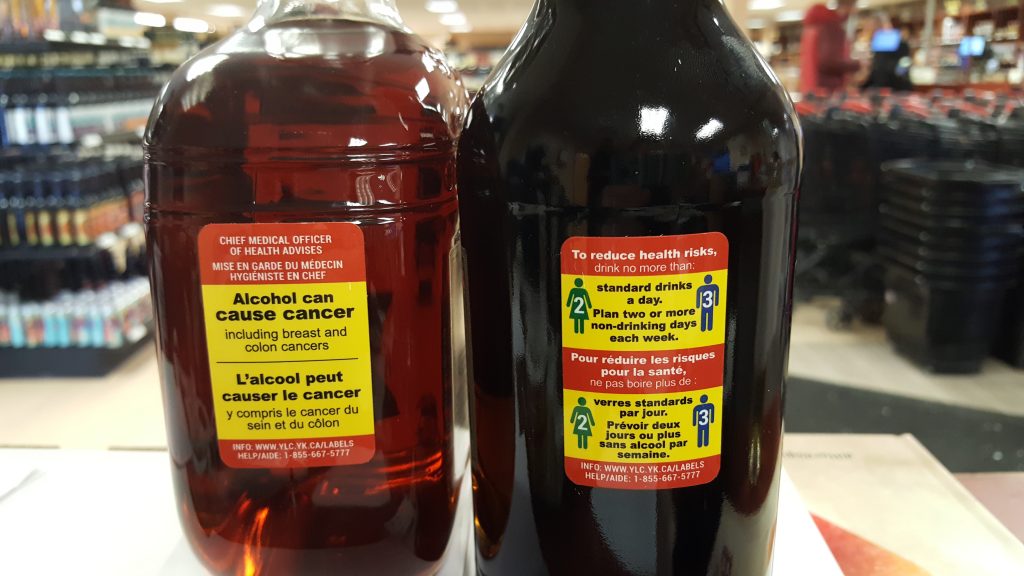
Hardly any country or province currently provides labels warning people that drinking alcohol increases the risk of a range of mental, physical and social problems, including cancer, heart disease, birth defects, anxiety and depression.

Jurisdictions which try to change this face the threat of being hit by “legal big guns”, according to analysis published last week.* The most recent case was in the sparsely-populated Yukon territory in Canada which halted a trial in December after receiving worrisome legal warnings.

“The raising of legal doubts, threats of litigation and the actual commencement of litigation have the potential to sway all but the most resolute and well-resourced governments from prioritising public health over industry interests,” the paper says.

The law allows the alcohol industry to make legal challenges at the national, supranational or international courts, as well as tribunals. Australia’s defence of plain tobacco packaging, the paper says, drawing a comparison, has been costly and time-consuming, although it seems set to be successful.

Thailand was the first to hear the drumbeat of possible litigation from the alcohol industry after proposing graphic warning labels in 2010. It planned to introduce labels warning that drinking alcohol causes liver cirrhosis and can undermine sexual performance.

But Thailand’s labels never appeared after they were discussed in the World Trade Organisation’s Technical Barriers to Trade Committee, a diplomatic forum. Concerns raised by the EU, US, Australia and New Zealand may have been taken as the signs of impending legal action.

Jurisdictions can have some confidence courts will take their side when their labels are designed to reflect “good scientific evidence”, the paper explains, but opponents can play on nagging doubts by introducing the prospect of long and expensive litigation.

The alcohol industry may, the paper argues, be looking for a “domino effect” in which governments lose their resolve to introduce alcohol labels. Dr Margaret Chan, a former director-general of the World Health Organisation, described the tobacco industry using this strategy in 2015.

The alcohol industry will be “extremely pleased” to halt the Yukon trial (pictured), says Professor Robin Room of Melbourne University, one of the authors of the paper. It also saw the disappearance of a label in place for 27 years warning that drinking while pregnant can cause birth defects.

“We are still a little hopeful that our study may resume in some capacity,” Erin Hobin, a researcher on the trial, told Alcohol Companion. Supporters of plans for health labels in Australia and Ireland, meanwhile, say they are undaunted by Yukon’s legal difficulties.

Continuing to use trade and investment treaties to launch legal action, the paper says, would be “substantially against the public interest and public health”. With overwhelming public support for health labels, the dominos could yet fall the other way. ■

*Paula O’Brien, Deborah Gleeson, Robin Room, Claire Wilkinson; Commentary on ‘Communicating Messages About Drinking’: Using the ‘Big Legal Guns’ to Block Alcohol Health Warning Labels, Alcohol and Alcoholism, https://doi.org/10.1093/alcalc/agx124

UK alcohol rehabs let down older people

January 10, 2024

Three out of four residential alcohol treatment facilities exclude older adults by imposing an age limit, while lack of disabled access often creates physical barriers.

Some older adults found living with younger residents was enriching, while others found the “generation gap” more of a challenge, according to the study by Alcohol Research UK.

Some felt bullied, intimidated or upset by ageist language and attitudes. At the same time “age blindness” sometimes means needs are not met.

  • « Go to Previous Page
  • Page 1
  • Interim pages omitted …
  • Page 15
  • Page 16
  • Page 17
  • Page 18
  • Page 19
  • Interim pages omitted …
  • Page 22
  • Go to Next Page »

Copyright © 2026 · Phil Cain Impressum