• Skip to main content

Alcohol Review

Alcohol understanding for all

  • Highlights
  • AR2026
    • AR2025
    • Earlier events
  • Register
  • About
    • Organisers
    • Contact
  • Log In

philcain

US alcohol-induced deaths post pandemic

January 10, 2024

Alcohol induced deaths in each US state, in descending order of the percentage increase since the pandemic based on provisional figure for 2022.

20192022*Change, %
1Mississippi24044384.6
2Delaware10617464.2
3South Dakota19130760.7
4Alaska18528654.6
5South Carolina62095453.9
6Maine20831752.4
7Missouri60891149.8
8Indiana7911,15145.5
9Rhode Island13920245.3
10New Hampshire20329545.3
11Iowa40859144.9
12Tennessee9361,32841.9
13Minnesota8281,17141.4
14Illinois1,1371,60140.8
15Maryland43060139.8
16Montana24634339.4
17Nevada54675939.0
18Kansas35348738.0
19Ohio1,2421,70737.4
20District of Columbia709637.1
21Nebraska27137136.9
22Wisconsin8651,18336.8
23Pennsylvania1,0471,41935.5
24Georgia9401,27335.4
25Oregon9381,26434.8
26Michigan1,1931,59833.9
27Louisiana36849133.4
28Colorado1,1981,58132.0
29Washington1,2641,65831.2
30North Dakota14919530.9
31North Carolina1,1761,53030.1
32Massachusetts73895929.9
33Idaho29037529.3
34Utah29037228.3
35New Mexico72992827.3
36New York1,5812,00927.1
37Oklahoma65983626.9
38Arizona1,2861,62326.2
39California5,3456,73826.1
40Hawaii9612126.0
41Virginia77396524.8
42Connecticut40950924.4
43Texas2,6563,28523.7
44West Virginia25230420.6
45Florida2,7223,27220.2
46Alabama42550218.1
47Kentucky55364616.8
48Wyoming17820615.7
49Vermont12514415.2
50Arkansas34238612.9
51New Jersey69877711.3
Total39,04351,24431.3
*Provisional
Source: CDC

The nanny private sector

January 10, 2024

Alcohol Review – issue 97, November 24th 2023

January 10, 2024

Find this service useful?
Please join the Alcohol Review‘s supporters who make it possible

*Get Alcohol books
*Join Whatsapp group
*Follow live on Twitter, LinkedIn

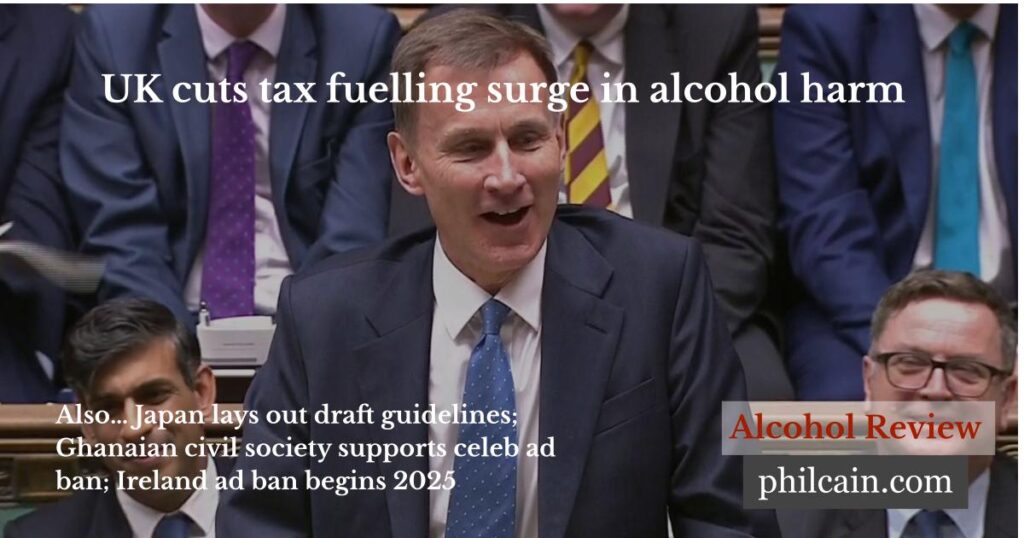
In this issue: UK cuts taxes fuelling alcohol harm; Japan lays out draft guidelines; Ghanaian civil society supports celeb ad ban; Ireland’s 9pm ad ban begins 2025

UK cuts tax fuelling surge in alcohol harm: The UK government this week made another real terms cut in alcohol tax, despite surging alcohol harm, with alcohol deaths last year 27% above pre-pandemic levels in 2021. It is “utterly frustrating news”, said Professor Sir Ian Gilmore, chair of the UK Alcohol Health Alliance. An early tip-off of the decision to the Sun tabloid and alcohol industry meant almost no criticism was heard.

Japan lays out draft guidelines: Japan set out a draft for its first low risk alcohol guidelines of 50ml a day for men and 225ml for women. They also say, “It is important to keep alcohol intake as low as possible.” The UK guidelines are 20ml a day for both men and women. More research is needed on risk acceptability, said a new commentary.

Ghanaian civil society supports celeb ad ban: Civil society actors in Ghana support the Food and Drugs Authority’s position to ban alcohol advertisements by celebrities which is currently being challenged in court.

Ireland’s 9pm ad ban begins 2025: A ban on alcohol ads appearing on TV in Ireland before 9pm will come into effect on January 10th 2025, the Department of Health said.

Alcohol Review – issue 93, July 22nd 2023

January 10, 2024

Find this service useful?
Please join the Alcohol Review‘s supporters who make it possible

*For alcohol books and resources, visit the homepage*

This week: US alcohol death surge rolled on; More US states allow teenage bartenders; Alice Springs’ restrictions prolonged; French tax tweak; Rwanda’s “Let’s drink less” campaign. Discussion: We should look more at the big picture.

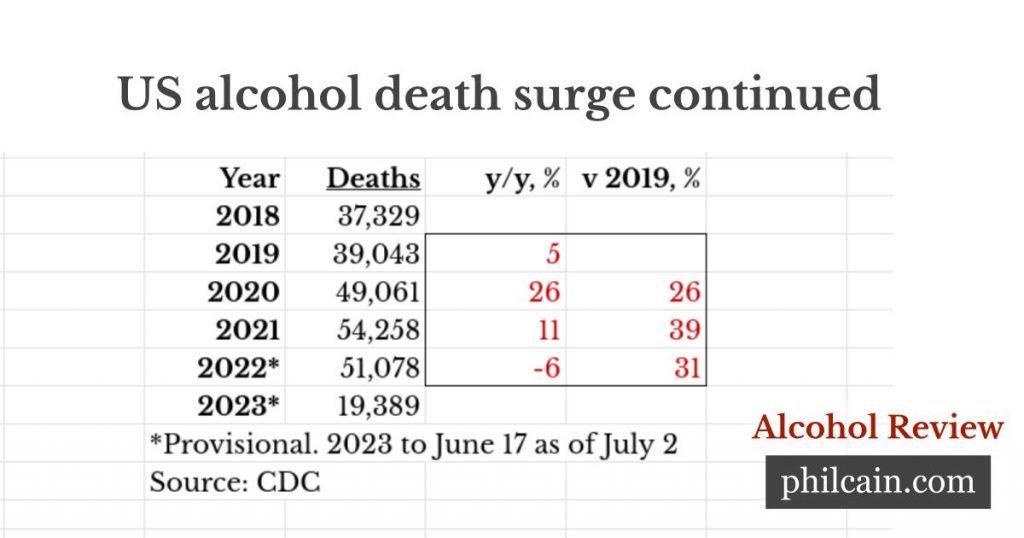
US alcohol death surge rolled on: The surge in US alcohol deaths continued last year with alcohol-induced fatalities at least 31% above pre-pandemic levels, according to the latest CDC estimates. The previous year saw a death toll 39% above pre-pandemic levels. The figure is only likely to increase as new cases are added to the CDC’s tally. It is already 6,000 higher than its February estimate.

More US states allow teenage bartenders: Nine US states have introduced bills to lower the minimum age for serving alcohol since 2021, according to a report by the Economic Policy Institute.

Alice Springs’ restrictions prolonged: Australia’s Northern Territory government will extended takeaway liquor restrictions in Alice Springs for at least the next 12 months, citing a dramatic reduction in harm to the community since their introduction. The local mayor and others, including the alcohol interests, are unhappy with the decision.

French tax tweak: France’s minister of economy told Le Figaro newspaper the government plans to increase alcohol taxes to curb excessive consumption. It appears to be considering a subtle change, indexing alcohol tax to last year’s inflation rather than that of the year before that.

“Let’s drink less” campaign: The Rwandan government this week launched the “TunyweLess”, or “Let’s Drink Less”, campaign in response to a survey showing a significant increase in alcohol consumption.

FASD nightmares: 60% of the children with foetal alcohol spectrum disorder experienced nightmares, while 44% exhibited frequent insomnia symptoms, according to a new study.

Discussion

Let’s look big picture: “It’s pretty clear why people don’t drink–the real question is why do people continue to drink when they don’t want to?” asked journalist Moya Lothian-McLean in a recent Guardian opinion piece. Alcohol Review suggests we should look more at the bigger picture and ways politicians can make healthier choices easier for us.

*For alcohol books and resources, see the homepage*

Cannabis: Let’s learn from alcohol

January 10, 2024

Cannabis is beginning to reach large commercial scale, with all the extra challenges that this brings. We should not let it become alcohol and tobacco 3.0.

THC Review has begun following global cannabis news, a foundation for in-depth reporting and discussion to come. It also has a nascent newsletter and LinkedIn page.

It will borrow heavily from the open format of Alcohol Review which unearthed numerous important stories and hosted a range of informed discussions since it began in 2016.

The coverage will again come from a public-interest perspective, centred on health and wellbeing. It also again does it acknowledging it always has much more to learn.

Why cover cannabis?
The reason for the crossover is that cannabis is beginning to gain the global scale of alcohol and tobacco, which have harms that reflect their enormous customer base.

There is little reason to think that commercialising cannabis will not have similar effects, with marketing, availability and product development, so boosting consumption. 

The duty to deliver shareholder returns means downplaying risk, promoting purported benefits, fighting regulation, often in the guise of a fight for individual freedoms.

THC Review will be vigilant in ensuring the motives and methods of economic interests are known. Cannabis is an unusual product but the business fundamentals apply.

Cannabis interests will increasingly impact public health, science, politics, law, media and public discussion. Those already in business are already making inroads.

Business interests, associates and enthusiasts widely downplay health concerns, berate any critics, and laud their potential economic contributions and cannabis’s ported medicinal use.

If thousands of prescriptions are being written for cannabis to treat someone’s low mood or frayed nerves, say, then why not make it available over-the-counter to everyone?

The US drug’s administrator, the FDA, has not licensed cannabis to treat any disease or condition. This should surely give non-experts some pause for thought, as should many reports of serious health risks.

Alcohol and tobacco trod a similarly confused scientific no-man’s land. Offering them the benefit of the doubt did not work out well. Let’s not do that again.

On legalisation
THC Review is not fundamentally opposed legalisation. Regulation seems better aimed at producers than consumers. But legalisation is not one thing either and all its forms cannot be given uncritical approval.

It is still an enormous job to police illegal alcohol and tobacco. And we are far from always successful in combating the problems created by large legitimate industries. The risk of repetition is real.

But it is too soon to get into all this now. It will unfold more naturally over time. The price of freedom is eternal vigilance, a task that is both stimulating and enlightening.

I hope you will join and look forward to hearing your news, views and ideas.

You can follow on THC Review on Twitter, LinkedIn and get the newsletter.

Try out some alcohol policies at home

January 10, 2024

Policies and individual choices are normally seen as completely separate, but in reality they merge. So why not ring in the New Year by road-testing some effective alcohol strategies at home?

We all set some rules, or policies, for our homes, for example. Few let outdoor shoes go beyond a certain threshold. Weaponry, road vehicles, fire, smoke and harmful chemicals also typically have their perimeters.

These are not prohibitions. They are regulations. By crossing borders we can have access to all of the things verboten in some places. Out there is a target-shooting, tanker driver who only smokes when scrubbed up, unarmed on the veranda.

The regulatory systems of our private lives often operate on the basis of unwritten policies picked up from parents, partners, and common sense. They offer an easy way to keep a safe, livable and inexpensive environment. 

These policies are typically adopted and applied without any democratic mandate. But we will also, sometimes, decide to set new policies, often through a process of thought, negotiation and compromise.

So why not consider adding evidence-based alcohol policies to the mix. We might take, for instance, government policies reckoned to curb harm at a population level as a starting point: increase the price, and reduce availability and marketing.

A few calculations might allow us to set a minimum unit price. This we might do by identifying products which are below it. Or we might levy a alcohol per unit “tax”, setting aside revenue for household running costs and infrastructure.

Implementation of these might be complicated. Perhaps an easier option would be reducing alcohol availability. We might bar keeping alcohol at home; Or to limit the stockpile; Or not put what we have in the fridge; Or, maybe, not to buy online. 

Limiting home availability would have a knock-on effect. It bumps up the price of alcohol at home, imposing on inhabitants the cost of leaving the house to buy it. This also gives us a chance for second thoughts. 

Reducing marketing exposure is trickier, because alcohol advertising targets us without our consent. But we can reduce it, by putting alcohol brands out of sight at home. We can also filter some online ads. And we can try to avoid alcohol retail.

Harmful levels of drinking are best addressed with the aid of medical advice. But making our own environments less alcohol loaded makes low-risk drinking the easy option. And home drinking is the source of the bulk of alcohol harm.

We all set and live by policies to create environments which are safe and best serve our needs. We need politicians to do this for us in environments we share. ■

  • « Go to Previous Page
  • Page 1
  • Interim pages omitted …
  • Page 17
  • Page 18
  • Page 19
  • Page 20
  • Page 21
  • Interim pages omitted …
  • Page 50
  • Go to Next Page »

Copyright © 2026 · Phil Cain Impressum