• Skip to main content

Alcohol Review

Alcohol understanding for all

  • Highlights
  • AR2026
    • AR2025
    • Earlier events
  • Register
  • About
    • Organisers
    • Contact
  • Log In

philcain

Visualising alcohol’s calories

January 10, 2024

One way to visualise alcohol calories is to see it has has roughly the same amount as oil 5-9cal/ml. So 500ml of 5% lager alcohol contributes roughly the same as 25ml of oil, ~200 calories. And in a 75ml bottle of, say, 12% wine alcohol contribute about as much as 90ml of oil, 700 calories.

This high level should not be too surprising, given that alcohol is manufactured from sugar, again roughly the same order of calorie density. Part of Victorian doctors’ mistaken enthusiasm for prescribing alcohol was it provided weakened invalids with a “clean” source of energy.

It’s by no means perfectly accurate, but it is a reasonable way to get a feel for it, in the absence of clear labelling. ■

Recovery Channel Podcast: interview

January 10, 2024

On a virtual trip to San Antonio, Texas recording a chat about alcohol’s lack of utility, national drinking patterns, Dry January, the stress of political division and the merits of podcasting while standing. ■

Forging language for change

January 10, 2024

Creating change around alcohol and elsewhere requires us to describe dynamic situations accurately, an area where English could be improved.

Our language often ties us to a static picture of situations more usefully seen as being in dynamic change, so blinding us to possibilities.

We are not, for instance, smokers in the same way we are right-handed, brown-eyed, male or female.

Being a smoker is a status we acquire as a result of what we consume and something we can change by making different choices.

English we say, “I am a smoker,” in the same way as, “I am from Manchester,” or “I am human.” But they are not the same.

In this way, as my brilliant friend and first giveaway book recipient pointed out,  we English-speakers have made a hash of it.

“There is no escape save by stepping out of it into another [language],” as Enlightenment polymath Alexander von Humboldt put it.

Not “to be”
If we are serious about change we should distinguish between inherent states and transient ones.

Making the distinction clear would  help us all see better where fruitful change is possible.

Portuguese and Spanish—and other Iberian languages—have a way to do this built in, using the word “estar” for potentially passing states.

Mixing it into English unforgivably, “I estar alcohol dependent,” would mean we are currently alcohol dependent, but not always and forever.

Using estar like this would convey a sense of changeability to a state of illness, boredom, sadness, or being a smoker too.

I am told estar is not often used to emphasise that substance use problems are shifting and dynamic, but doing so would be easy.

In English it is more difficult. A new word, an English estar, has only a very remote chance of catching on.

Emphasising change
Given introducing a new English verb is impossible we could still make better use of the language we already have.

“Now” is, perhaps, useful: I am now a smoker; I now have a cold; I am now alcohol dependent; I am now not alcohol dependent.

Yes, it is clunky, but perhaps we should accept some clunk if it means we avoid binding ourselves to things which we can change.

It offers the potential to soften and shift our outlook and allows, if we wish, our self-image to adapt to new circumstances.

Routinely acknowledging change is possible, in alcohol consumption, smoking and much else, can surely help us realise our choices. ■

#Lifehack health advice | philcain.com

January 10, 2024

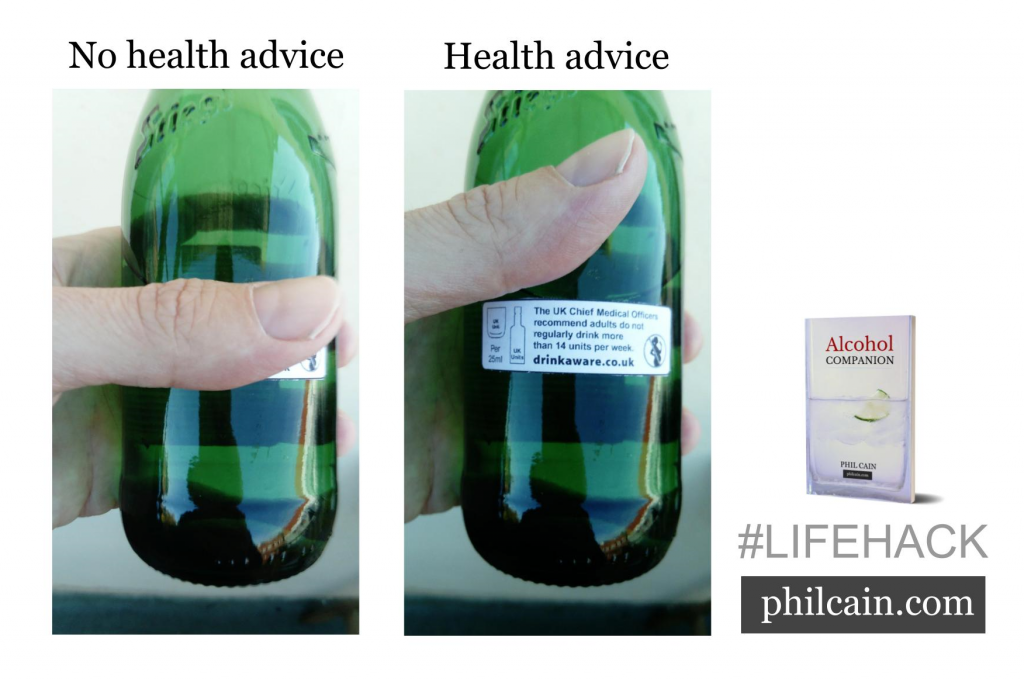
It is surprisingly easy to miss public health information on bottles and cans, like: “The UK Chief Medical Officers recommend adults do not regularly drink more than 14 units per week.” ■


Note: Read here why the label used in the demonstration is currently set to be a rare sight in the UK. ■

#brainawarenessweek, consider Alcohol Companion

January 10, 2024

Alcohol has a profound impact on our brains and consequently our well-being. Understanding this more fully provides a powerful way to help us improve our lives, letting our brains to look after us better. So, to coincide with #brainawarenessweek, there is a 50% off Alcohol Companion using code FT6RK7J9 redeemable at the philcain.com bookshop. ■

Sobriety sizzles

January 10, 2024

Any takers?

There are signs sobriety is creating the “sizzle” it needs to achieve the popularity it deserves.

Low-risk drinking is, on the face of it, the stuff of marketing executives’ dreams, a robust product with undisputed benefits, available to all at negative cost.

Yes, negative cost. It is not some something-for-nothing deal. This is a something-for-money-back deal. It is both beneficial and profitable for its adopters.

While easing the load on our wallets, it improves our sleep, relieves depression and anxiety, promotes clearer thinking, boosts resilience, reduces mistakes and accidents, and avoids disease.

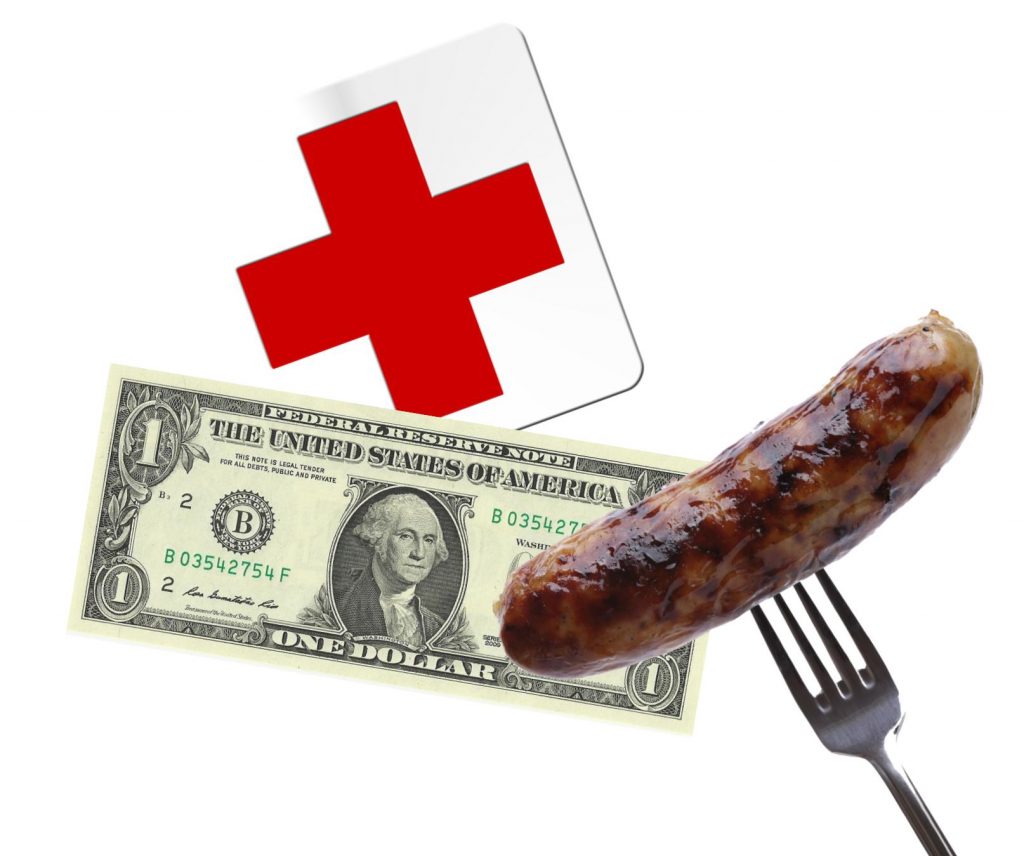
Drinking rates, nevertheless, barely budge from year to year. Imagine it: health payoffs and dollar bills lying around across the globe and yet few of us trouble to pick them up.

Is this a rational choice? Is heavy drinking really worth the price we pay? It seems doubtful. So, then, what is going wrong?

Knowledge and desire
It is partly misunderstanding. The scientific findings around alcohol are counterintuitive and constantly undermined, as I found while writing my book Alcohol Companion.

A stats-fest tickles our cortices but does not push the buttons which guide our humdrum choices.

Everyday decisions are rarely made through agonising rational computation. Think of a trip to a supermarket. We lob things in our trolleys mostly to answer emotional and sensory appeals.

We need to connect with choices on a non-intellectual level for them to be easy and enjoyable. This applies to rational choices as much as self-defeating ones.

Marketing people know this. Winning our decisions is about “selling the sizzle, not the sausage”.

It is not just meat though. We prefer crisped rice with added Snap, Crackle and Pop too. An iPhone is no better, yet is still more desirable.

Better health labelling, though important to have, will not be enough to provide the sizzle that makes low-risk alcohol choices desirable in the way which shifts our behaviour.

Low-risk drinking needs sizzle to turn its stock of wholesome statistical sausagemeat into a tempting consumer choice.

Turning up the gas
It is starting to happen. The online world is fulfilling our need for superficial socialising, an area where alcohol once reigned supreme. Psychology, meanwhile, is giving more insight into happiness.

These developments are being met by the arrival of a new generation of alcohol-free alternatives allowing us low-hassle alcohol opt-outs, with a positive placebo-effect thrown in.

The contribution of public health professionals, counsellors, treatment providers, campaigners and help groups, meanwhile, are being supplemented by fresh new communities like Club Soda and Soberistas.

The payoff is potentially huge. Globally alcohol is among the top four reasons for us to lose healthy years of life and a major contributor to crime rates and countless lesser cock-ups.

Reducing the impact by any significant amount would deliver benefits across society, particularly for poorer people. It would also free resources to tackle other problems.

Putting reasonable choices in attractive packages is as essential as the science they are composed of. Sobriety is becoming increasingly tempting and this is worth celebrating. ■

  • « Go to Previous Page
  • Page 1
  • Interim pages omitted …
  • Page 31
  • Page 32
  • Page 33
  • Page 34
  • Page 35
  • Interim pages omitted …
  • Page 50
  • Go to Next Page »

Copyright © 2026 · Phil Cain Impressum