Limited Edition | New Year inspiration

Fighting addiction on Pine Ridge Indian Reservation
Liquid genocide: alcohol destroyed Pine Ridge reservation â then they fought back
Source: www.theguardian.com/society/2017/sep/29/pine-ridge-indian-reservation-south-dakota
Alcohol producers quietly lower health labelling standard
 Alcohol producers have quietly adopted a lower standard for consumer health information on labels, no longer committing to mention the official weekly guidelines for low-risk consumption.
“We are greatly disappointed that the British alcohol industry is setting their bar lower and lower,” says Mariann Skar of Eurocare, a European consortium hoping to cut alcohol harm. But she says it is “not surprising” given its stiff resistance to minimum pricing and other measures.
The low-key move was coordinated by Portman Group, which coordinates the UK alcohol industry’s efforts to minimise problems. Skar says it should follow the lead of Brewers of Europe, a European beer suppliers consortium implementing a voluntary health labelling scheme.
It is a “massive policy change”, according to another seasoned observer. In practice, however, alcohol producers have long ignored their undertaking to include the guideline maximum, with only one label in 300 including it earlier this year.
The lower standard emerged from consultation with four industry bodies: the British Beer and Pub Association (BBPA), the National Association of Cider Makers (NACM), the Scotch Whisky Association (SWA), and the Wine and Spirit Trade Association (WSTA).
The problem is that cider labels are too small to include the official recommendation of keeping under 14 units a week to minimise risk, said the NACM. An optional label which mentions it contains 17 words compared to the six words used in ones which do not.
“We feel this is a balanced approach that gives producers the option of printing the guidelines on product labels or signalling ongoing support for health and lifestyle information by directing consumers to the Drinkaware website,” said the BBPA. Drinkaware is funded by alcohol producers and criticised for downplaying risks.
“Labelling remains an important way to sign-post consumers to a greater variety information in a way that is fit for purpose and relevant to how people now consume information,” said Miles Beale, chief executive of the WSTA, explaining the move online.
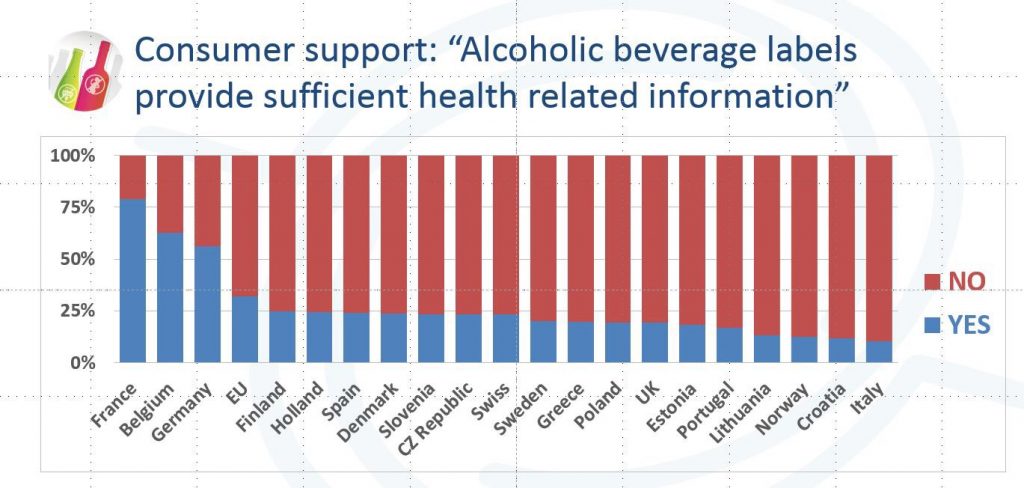 Around 80% of UK consumers are dissatisfied with the amount of information provided on the labels of alcoholic drinks according to the World Health Organisation (see chart). ■
Alcohol-free beer accepted in beer-drinking Germany
Relatively few people think it is embarrassing to drink alcohol-free beer in beer-drinking Germany compared to France, Italy, Poland and Spain, where wine and spirits are more popular.
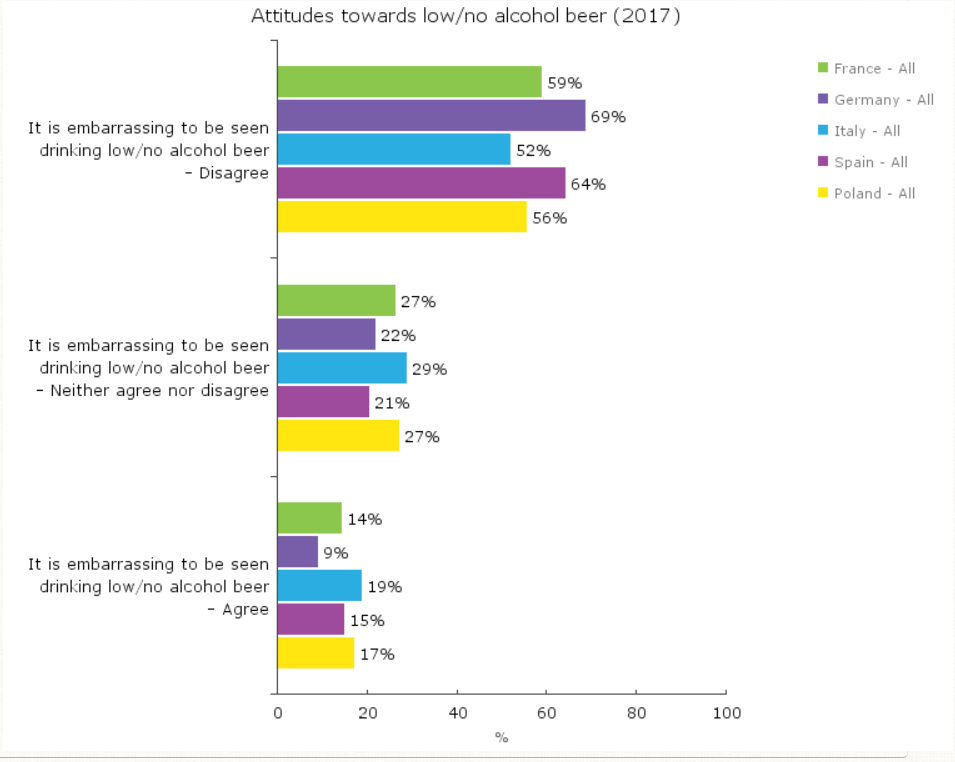
Only 9% of Germans thought it was embarrassing to be caught in possession of an alcohol-free beer, compared to 14% of French, 19% of Italians, 15% of Spanish and 17% of Poles, according to the survey (see chart).
The majority of people did not think it was embarrassing in all five countries, and more than one-in-five had no opinion either way. There are currently no equivalent figures for English-speaking countries.
Discreetly drinking alcohol-free beer, or other lookalike drinks, can be a good way to avoid social pressure to drink alcohol. ■
CAMRA leaders to discuss minimum alcohol pricing
The leaders of a traditional pub campaign group are set to discuss a call for it to support the “urgent introduction” of minimum alcohol pricing in England later this month.
The move comes in response to a motion passed at the Campaign for Real Ale (CAMRA) annual conference in Dundee earlier this month, which saw the arrival of a new chairman Nik Antona.
Alcohol has retailed for more than 50p ($0.66) per 10ml UK unit in Scotland since May last year. Supporters hope it will curtail the drinking of very heavy drinkers who gravitate towards cheap sources of alcohol. In England the price per unit starts at 16p.
The price of beer sold in pubs is unaffected by minimum pricing, typically being more than three times the 50p minimum price. Supporters within CAMRA argue minimum pricing may help counter the decline of British pubs by narrowing the price gap with supermarkets.
Others do not see it this way, saying on social media the pro-minimum price motion panders to “anti-alcohol” forces, threatening to cancel their CAMRA memberships. Some, however, wonder if an appreciation of untainted liberal economics is a necessary part of appreciating traditional beer.
The tension is not new. CAMRA’s former chairman Colin Valentine, who stood down last year, is said to have spoken in support of the minimum price motion. Yet, under Valentine’s chairmanship, CAMRA also echoed alcohol industry opposition to it.
Help may be at hand. An initial evaluation of the short-term economic impact of minimum pricing in Scotland is due later this year. And some insight into its effectiveness in achieving its goal of reducing harmful drinking is expected next year. ■