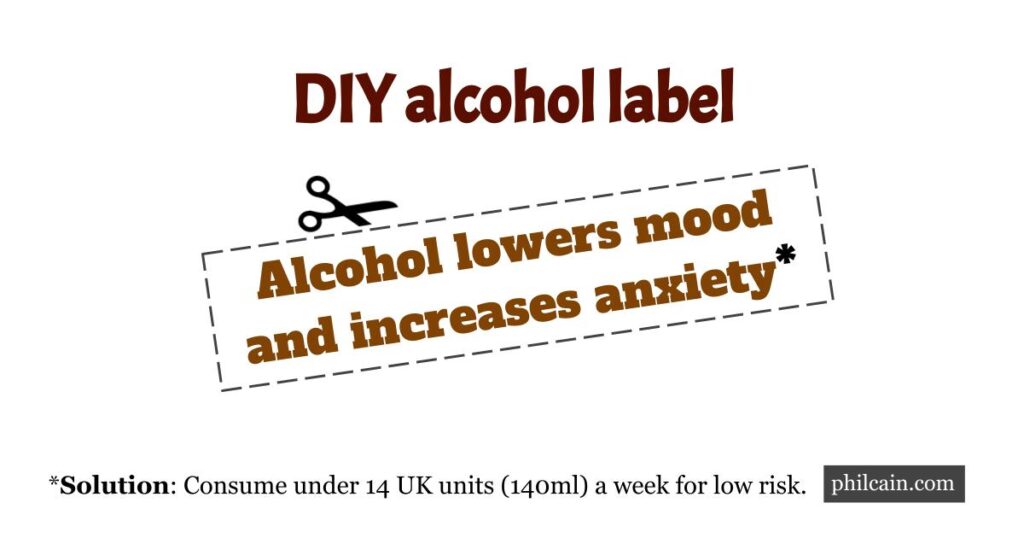
Alcohol can cause and worsen the common mental health problems anxiety and depression. Drinking little or no alcohol may help relieve these problems. For more alcohol understanding, please join the supporters. ■
Alcohol understanding for all
Alcohol can cause and worsen the common mental health problems anxiety and depression. Drinking little or no alcohol may help relieve these problems. For more alcohol understanding, please join the supporters. ■
An apparent forward step on alcohol safety labelling last week may, in fact, signal that it is about to get worse.
The alcohol industry Portman Group (PG) says it agreed with the health department “for the removal of out-of-date information” by September 1st. But it does not mention adding current low-risk guideline amounts.
Adding the weekly guidelines is not among the minimum “best practice options”. Instead, PG offers advice on how to “reflect” weekly consumption guidelines it refers to as “revised” though current since January 2016.
PG emphasises it offers advice while ignoring the fact that none of its members are committed to follow it. So years of foot-dragging on safety labelling may yet morph into a full-blown reverse.
The health department agreed a September 1st deadline for the alcohol industry action in March 2017. The existence of the “grace period” was unknown until a speech by then junior minister Steven Brine in January.
Few may yet realise it, but the grace period may have just been quietly extended and also expanded to green-light alcohol suppliers to offer no weekly consumption guidelines at all. ■
by Ian Hamilton, University of York
Increased drinking during the pandemic has created a group of people who don’t see themselves as alcoholics but have difficulty abstaining from alcohol for any length of time. This group, starting to be called grey-area drinkers, are at risk of alcohol-related health problems.
The relatively new term “grey-area drinking” describes people who consume more than a moderate amount of alcohol but don’t meet the criteria for dependence. Although they might not drink every day or have a drink first thing in the morning (the widely held view of an alcoholic) they are likely to be preoccupied with alcohol and have difficulty giving up. Many of these people don’t view themselves as in need of help.
Any widespread increase in levels of alcohol consumption matters. While most people are familiar with the risk of dependence there are a range of severe physical health problems associated with increased alcohol consumption that they are not so aware of. These include heart disease and a range of cancers, including bowel and breast.
Litres of alcohol bought in shops from April 2018 to 1 March 2021
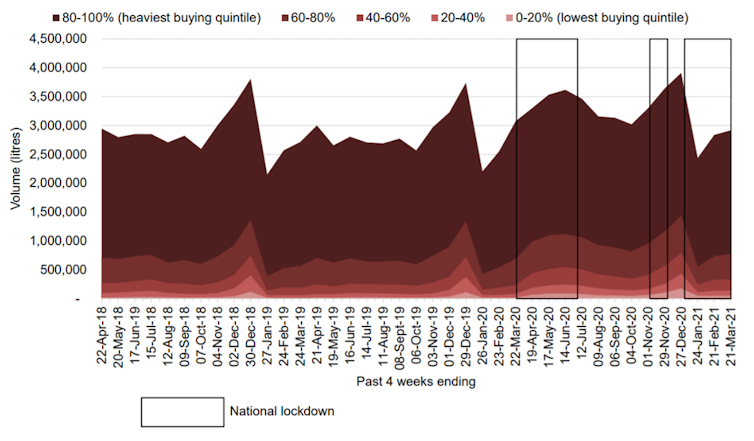
Although overall consumption of alcohol has been slowly declining in recent years there is emerging evidence that some people have increased their consumption. The heaviest-buying segment of the population increased their purchasing by 5.3 million litres of alcohol (+14.3%) from 2019 to 2021. At the same time physical harm from alcohol has been increasing, with a significant rise in hospital admissions and alcohol-related deaths.
Public Health England collated the results of 18 surveys of self-reported alcohol consumption during the pandemic. Between 11% and 37% reported drinking less but between 14% and 26% of people reported drinking more than usual. This is especially concerning given that we know most people underestimate how much they drink by up to 40% in these surveys.
Pubs were closed during the pandemic, so drinking at home increased. This may have encouraged drinking in large quantities as people tend to pour larger measures of alcohol when drinking at home compared to the measures they are given in bars.
Evidence found that those who experienced stress during the pandemic increased the amount of alcohol they drank and how often. One international study exploring alcohol consumption during periods of self-isolation found that it was British drinkers who were most likely to increase the amount of alcohol they consumed – which they say was due to elevated levels of COVID-related stress.
These surveys found a noticeable increase in consumption for some once the pandemic began. Those who were drinking below the governments recommended weekly limits, continued to stay within these limits. However those who were already drinking above the 14 units a week increased their consumption.
Current UK guidance suggests no more than 14 units of alcohol should be consumed in a week (see illustration).
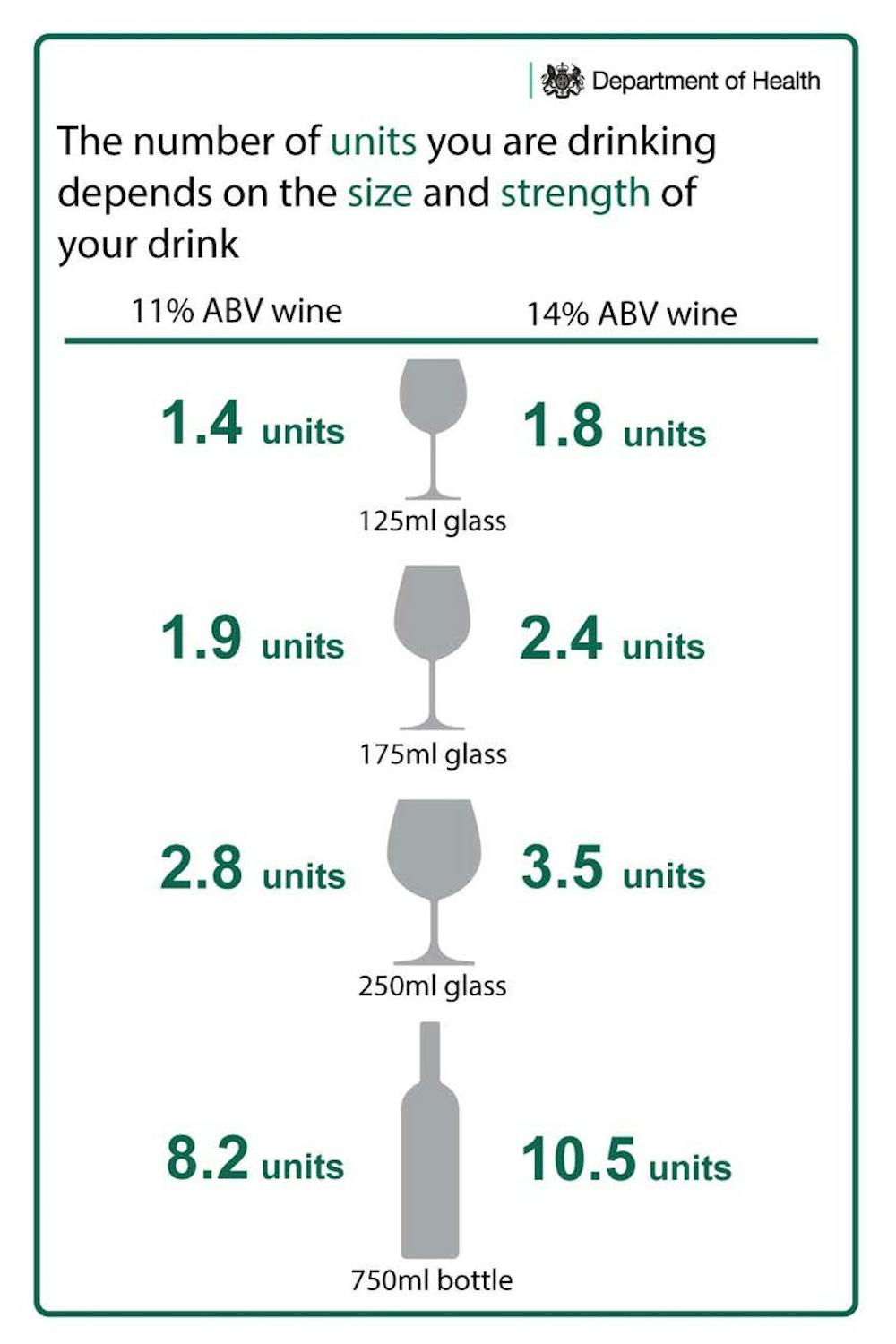
Levels of hazardous drinking are considered to be more than 50 units a week for men and 35 units for women. Evidence suggests that there was a 59% increase in those reporting drinking at these levels compared to before the pandemic.
Some argue that the alcohol industry embraces the perception that the majority of people drink responsibly. This has been one of the industry’s main arguments for resisting greater regulation. The industry points to the need for personal responsibility rather than corporate responsibility, although they fail to define what responsible drinking is. This shifts the onus onto the individual to make a change to their drinking habits rather than requiring the industry to make changes to its marketing or promotion techniques.
At a time when there is a clear need to tackle increased alcohol consumption, funding for specialist treatment and support has been withering. Some sections of the alcohol industry were encouraged to increase marketing spend as it would be more effective than ever. Some analysis shows that alcohol companies have also used lockdown for targeted social media activity. And the alcohol industry’s multi-million pound spend on marketing is huge, compared with the budget for public health messages, a truly David and Goliath struggle.
There has been little mention of alcohol or our unhealthy relationship with it during the pandemic by the government. For instance, off-licences were deemed to be essential services and stayed open during lockdown. The alcohol industry has proved to be adept at influencing government policy in its favour.
As treatment budgets are cut industry marketing increases and there is nothing to suggest that there will be any reduction in demand for hospital treatment due to alcohol or, sadly, coroners recording yet more alcohol-related deaths. ■
■
Ian Hamilton, Associate Professor of Addiction, University of York This article is republished from The Conversation under a Creative Commons license.
by Cameron Shackell, Queensland University of Technology
Dry July, an Australian fundraising campaign to support people affected by cancer, is almost here again. The premise is that abstaining from booze and hangovers for a month frees up money to donate.
But with prices in the booming alcohol-free drinks category often rivalling those of regular tipples, participants this year might find they have less spare cash than they anticipate.
Traditional alcohol producers, who have expanded into the US$11 billion non-alcoholic drinks industry, have helped make the high prices charged seem acceptable to consumers by using a marketing tactic called price-anchoring.
When we encounter a new product, we latch onto whatever seems relevant in the immediate environment to estimate its value. Sellers often exploit this by staging information at purchase points. The classic is a price tag with $99 struck out and $79 written in. Whether it’s accurate or not, the $99 reference point shapes our perception of value and price.
This so-called “price anchoring”, is just one example of the broader anchoring cognitive bias described by psychologists Amos Tversky and Daniel Kahneman.
The essence of anchoring is that we tend to rely too heavily on an initial piece of information (the “anchor”) when making decisions. This can lead to skewed judgements and poor decisions in everything from deciding whether to have surgery to buying real estate.
Anchoring has been used to reinvent and elevate the virgin drinks category by exploiting the fact we are used to paying high prices for alcohol in bottles, cans or glasses of a certain size, shape and sophistication. When alcohol-free versions with similar labels appear beside them on the shelf, website or menu, we tacitly accept they should command roughly the same prices.
It’s not just that the next bottle along provides a suggestive price. Our brains, steeped in marketing, know that alcohol prices can range far upwards from “normal”, making them not just comparison points but the proverbial $99 scratched out. So even if we spend a lot on non-alcoholic wine, we feel like we have scored compared with what we might have dropped on a bottle of Grange.
The effect is strongest in bottle shops and bars, where the glitz of alcohol marketing, social pressure and the sheer number of expensive items overwhelms our rational thinking. But it also works on websites of the national liquor outlets where special zero-alcohol categories have been established beside the traditional beer, wine and spirits listings.
It doesn’t take much browsing to confirm that prices are similar. Currently, on one of the big retailers’ websites, a case of 330ml bottles of Heineken Lager (5% alcohol) is $55, Heineken 3 (3.3% alcohol) is $50, and Heineken Zero (less than 0.5% alcohol) is $49. Among the non-alcoholic spirits, 700ml of Lyre’s Dry London Spirit – “crafted to capture the essence of a classic gin” – is $51 at another outlet while the same size bottle of 37% alcohol Gordon’s London Dry Gin is $45. Gordon’s own non-alcoholic offering – Gordon’s 0.0 Alcohol Free – is listed at $38.
Price anchoring in the alcohol-free market comes with an extra twist of lemon.
Brands will encourage you to think their investment in developing “healthier options” using “high-quality ingredients” means high prices are fair enough, and that a non-alcoholic drink made with arcane “botanicals” and “adaptogens” in a nice bottle is worth a splurge.
But look at what makes up the price. All processed drinks incur a Goods and Services Tax (GST). And drinks that contain alcohol are hit with a heavy additional excise. The exact percentage is difficult to calculate, but the alcohol-related tax on a bottle of full-strength beer can exceed 30%.
Industry players don’t pay that tax on non-alcoholic drinks. So, in a sense, they are pocketing a hefty bonus that well-anchored customers forget is not being passed on to the government. Ouch.
Seemingly at odds with price anchoring is the appearance of non-alcoholic versions of some famous brands in supermarkets.
An incentive for names like Heineken, Coopers and Gordon’s to be in supermarkets is visibility in a family-friendly environment. Their brand becomes recognisable to customers who are underage now, but will soon be ready to buy alcohol for their 18th birthday bash.
It’s a risky strategy, however, and can attract adverse publicity . In fact, to protect their reputations, several supermarket chains in New Zealand require customers to show ID when purchasing non-alcoholic lookalike drinks.
The Australian government’s Behavioural Economics Team (BETA) has an informative blog post on minimising the impact of price anchors. But research suggests even experts are susceptible.
Besides awareness, you can reduce the effect by curating your exposure to price information. If you need non-alcoholic drinks for home or an event, visit the supermarket before the bottle shop. The range may not be as big, the drinks may not be any cheaper, and you may need to go to the bottle shop anyway. But the experience will put the untaxed non-alcoholic products in a fairer context – the soft drink aisle. Comparing prices under those sober lights, you might suddenly feel like picking up a bottle of ginger ale instead.
In bars and clubs, you can try to flip the script. Ask for your soda water in a fancy glass with lots of ice and slices of lemon or lime. This anchors what’s in your hand to high-priced cocktails.
Of course, if you embrace the life of a true ascetic, H₂O is a zero-dollar option that, as Nietzsche said always suffices. In Dry July, you might even join the hype and call it non-alcoholic vodka.
*Cameron Shackell is Visiting Fellow at Queensland University of Technology This article is republished from The Conversation under a Creative Commons license. Read the original article.

Increasing our exposure to an activity, like say playing piano, typically increases our skills in that activity, but the opposite is the case with alcohol drinking because it is an addictive psychoactive. The negative effects of exposure are greatest when we are still young and our brains are still forming. Find out more. ■
Drinking more than a small amount of alcohol increases the risk of developing dementia in later life and can cause early-onset dementia and brain damage. ■
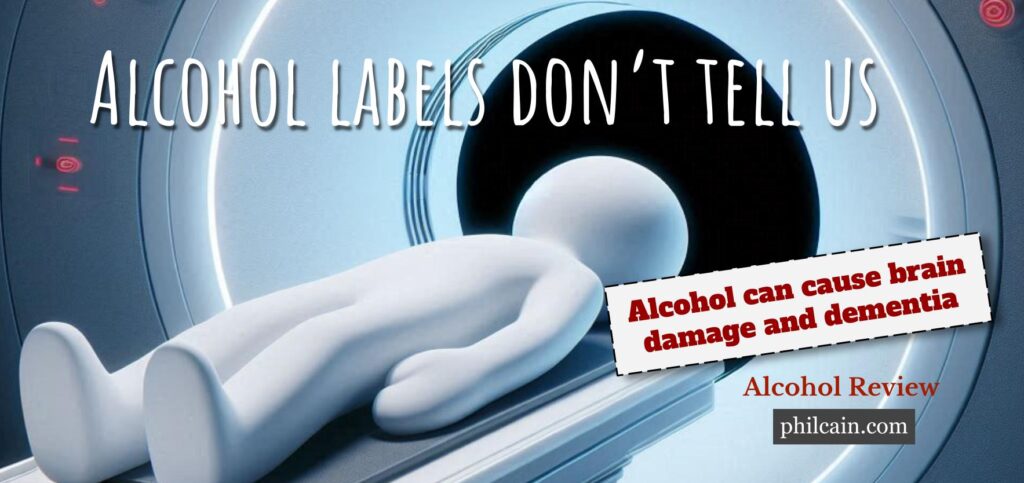
This is one of a collection of shareable alcohol messages. If you think more people should know, please share and join the supporters.