story
UK Election 2017: Manifesto pledges on alcohol
[listed alphabetically]
Conservatives
“We will widen the role of police and crime commissioners to help them cut crime for their local communities. We will ensure that commissioners sit on local health and wellbeing boards, enabling better co-ordination of crime prevention with local drug and alcohol and mental health services. … So we will create a national community sentencing framework that punishes offenders and focuses on the measures that have a better chance of turning people around and preventing crime, such as curfews and orders that tackle drug and alcohol abuse. … We will improve the co-ordination of mental health services with other local services, including police forces and drug and alcohol rehabilitation services.” Last month a Conservative health minister ordered the development of a health strategy for the children of alcohol dependents.”
Labour
“We will implement a strategy for the children of alcoholics based on recommendations drawn up by independent experts,” (p68), in line with the consensus at a cross-party debate on the issue in February which led a Conservative health minister to order a strategy to be drawn up last month, as mentioned above.
LibDems
“We need to do more to promote healthy eating and exercise, making people aware of the dangers of smoking and excessive consumption of alcohol and other drugs, and helping to improve mental health and wellbeing. We will: … Introduce minimum unit pricing for alcohol, subject to the final outcome of the legal challenge in Scotland.”
Plaid Cymru
The manifesto does not mention of alcohol or drugs.
Scottish National Party (SNP)
“Given the Scotch Whisky industry is a key sector of Scotland’s economy, SNP MPs will continue to advocate a review of alcohol taxation to better reflect alcohol content, while supporting health benefits through minimum unit pricing.”
Sources: http://www.labour.org.uk/page/-/Images/manifesto-2017/Labour%20Manifesto%202017.pdf
http://d3n8a8pro7vhmx.cloudfront.net/themes/5909d4366ad575794c000000/attachments/original/1495020157/Manifesto-Final.pdf?1495020157 (LibDems)
https://www.scribd.com/document/348387609/Plaid-Cymru-Defending-Wales-2017-Action-Plan
https://s3.eu-west-2.amazonaws.com/manifesto2017/Manifesto2017.pdf (Conservatives)
https://d3n8a8pro7vhmx.cloudfront.net/thesnp/pages/9544/attachments/original/1496139998/Manifesto_2017.pdf?1496139998 ■
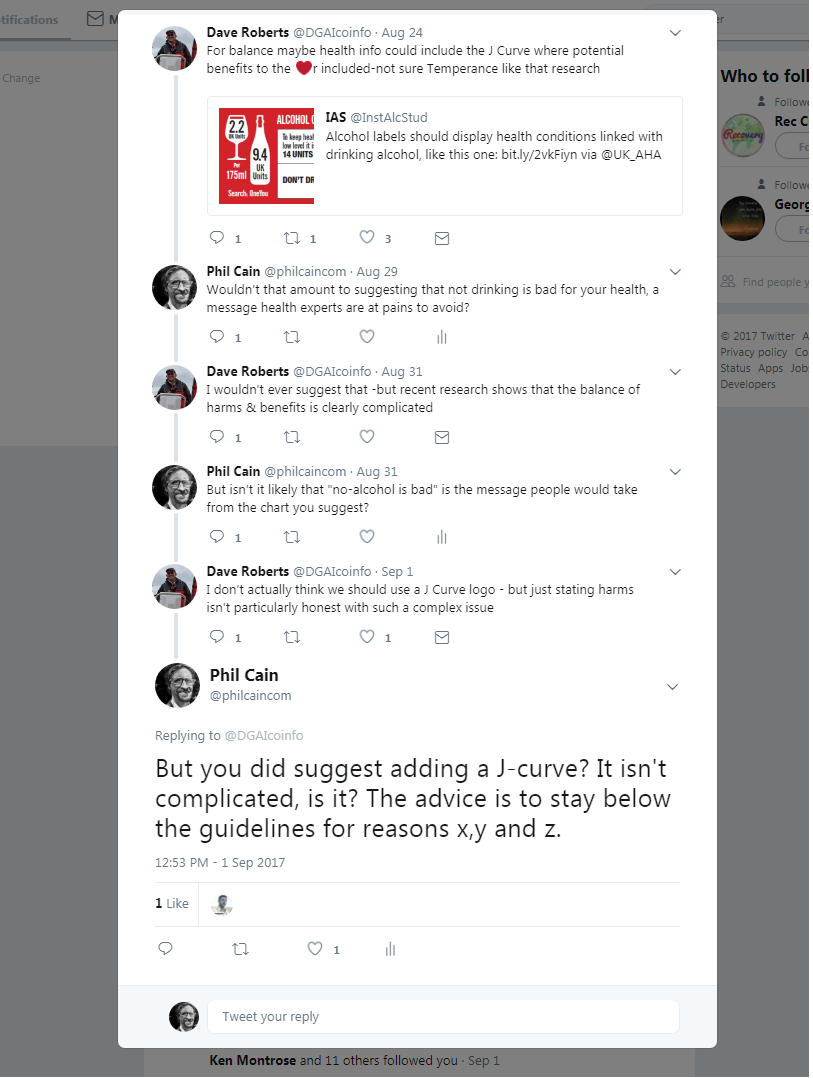
Discussing the Alcohol Health Aliance’s proposed labels on twitter
Scotland’s pioneering minimum pricing to start on May 1st
 Minimum unit pricing for alcohol will come into force on May 1st 2018.
Health Secretary Shona Robison today updated members of the Scottish parliament on the plans and confirmed a consultation on the preferred minimum unit price of 50p will be published next week.
“I anticipate setting the minimum unit price at 50 pence per unit. We now want to hear from retailers, representative bodies and Licensing Standards Officers about the practicalities of implementation.”
[summary] Australia’s draft alcohol strategy proposes minimum pricing
Draft National Alcohol Strategy 2018-2026, key proposals:
- Introduce a minimum price for alcohol
- Volumetric taxation of alcohol, as recommended by the Henry Tax Review in 2010
- “Readable, impactful” health-related warning labels
- A single national advertising code protecting children from exposure
- Reduce young people’s alcohol advertising exposure, including in sport and on the internet
- Control alcohol promotion to protect at-risk groups, including youth and dependent drinkers
- Increase screening, assessment, referral and treatment
UPDATE: Ireland: WTO alcohol labelling trade obligations met
Ireland’s health department says it has met all its obligations under World Trade Organisation rules over the health labelling requirements of its alcohol bill.
The US government’s trade agency recently said it had asked Ireland to notify the World Trade Organisation about its health labelling plans so as to comply with the organisation’s Technical Barriers to Trade Agreement.
“We can confirm that all obligations under WTO in relation to the Public Health (Alcohol) Bill have been met by the Department of Health,” the department told Alcohol Companion.
“Ireland intends to notify WTO Members of all amendments made to the Bill at the earliest opportunity, ie once all amendments have been made.” ■