• Skip to main content

Alcohol Review

Alcohol understanding for all

  • Highlights
  • AR2026
    • AR2025
    • Earlier events
  • Register
  • About
    • Organisers
    • Contact
  • Log In

story

Legal threats scupper Canadian alcohol cancer warning trial

January 10, 2024

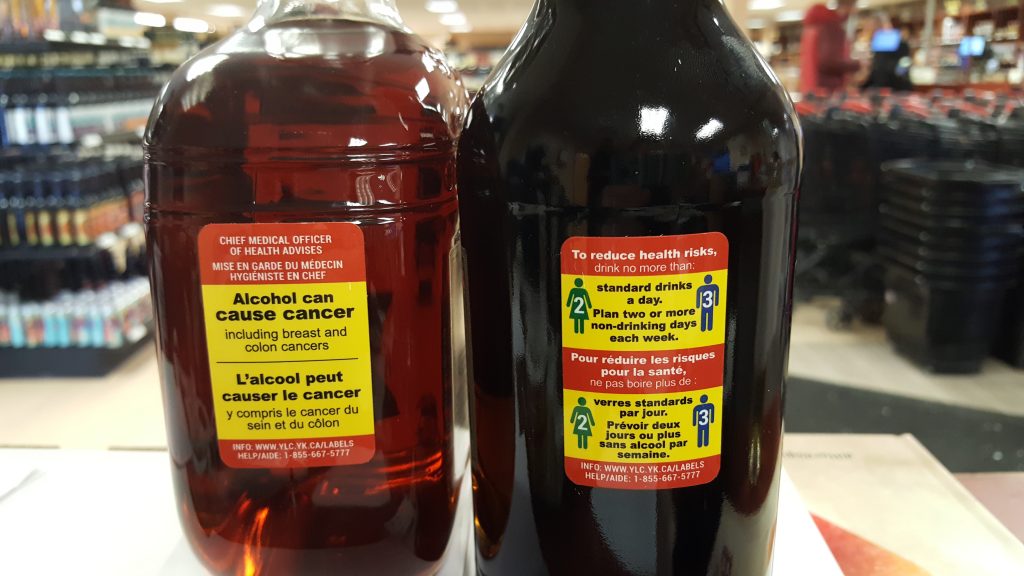
Yukon’s abandoned labels

Legal threats have scuppered hopes for the resumption of a Canadian trial of labels warning that drinking alcohol increases the risk of cancer, putting a question mark over plans to inform consumers elsewhere.

Ireland and Australia are both considering labels warning that alcohol increases the risk of cancer, with Ireland’s lower house debating the move this week.
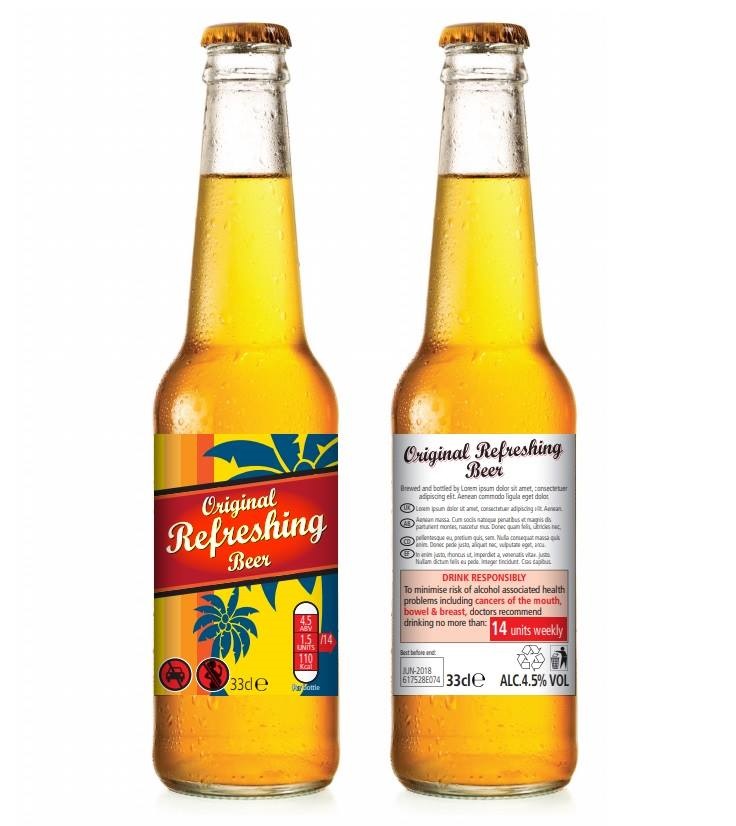
The UK’s Royal Society for Public Health proposed labels last month which include a warning that alcohol is proven to increase the risk of cancer (left). Alcohol producers quietly lowered their voluntary labelling standard last year.

The Canadian study was abruptly halted at the end of December after receiving a range of legal threats, including that it might be guilty of defamation and trademark infringement. Experts say those seeking to obstruct cancer labelling have a wide range of legal options.

The legal threats have not stopped the evaluation of labels not mentioning the increased cancer risk of drinking alcohol: one showing a standard drink size and another the low-risk drinking guidelines. Results are expected in June.

The trial is part of the second phase of the Northern Territories Alcohol Study led by researchers from Public Health Ontario and the Canadian Institute for Substance Use Research at the University of Victoria.

Yukon’s 34,000 people have the highest alcohol sales per head in Canada. ■

The key alcohol theme of 2018: dementia

January 10, 2024

Dear Reader

This year offered a steady stream of confirmation of the merits of low-risk alcohol drinking, reckoned to be less than 14 UK units (140ml) a week.

There was also welcome reassurance that not drinking alcohol at all, which many find the easiest form of low-risk drinking, comes with no added risk.

But the biggest news was confirmation of a massive underestimate of alcohol as a factor in dementia. This too was followed by confirmation that low-risk drinking should spare us from it.

It is a discomforting finding, no doubt. But it also offers hope that changes to our drinking habits can spare millions from mental health problems, as I wrote here.

Thank you for your support over the last year. I wish you a happy New Year’s Eve and a great start to 2019.

Yours faithfully
Phil

[research, comment] Responsibility without blame for addiction | Neuroethics

January 10, 2024

I offer a “responsibility without blame” framework that derives from reflection on forms of clinical practice that support change and recovery in patients who cause harm to themselves and others. This framework can be used to interrogate our own attitudes and responses, so that we can better see how to acknowledge the truth about choice and agency in addiction, while avoiding stigma and blame, and instead maintaining care and compassion alongside a commitment to working for social justice and good—Hanna Pickard, Reader in Philosophy, Birmingham University, UK

Source: link.springer.com/article/10.1007/s12152-016-9295-2


Note: This suggestion tallies closely with the compromise reached in Alcohol Companion. As is pointed out in this paper, it is important for our well-being to acknowledge that we continue to make choices after exposure to alcohol. But it is also important to acknowledge that alcohol exposure means, for a variety of reasons, our subsequent choices often become unreliable, often being heavily biased in favour of consuming more alcohol. Choices made when we are being coerced, disabled, bribed or deceived cannot be given the same treatment as ones we make without interference. In such circumstances it can be helpful to ignore the question of whether a choice is morally right or wrong, because there can be no reliable answer when our judgment is impaired. And moral answers rarely provide a solution for the person being judged. Luckily, however, it is often both possible and helpful to look at the factors which led to a choice and ask whether it was a good or bad one purely in terms of our happiness and well-being. ■

[highlights] 2017 Drug Strategy | UK Government

January 10, 2024

  • While the focus of this strategy is on drugs, we recognise the importance of joined-up action on alcohol and drugs, and many areas of the strategy apply to both, particularly our resilience-based approach to preventing misuse and facilitating recovery.
  • Public Health England will review the evidence and provide advice on the estimated number of children likely to be affected by the drug and/or alcohol use of their parents, and provide advice to national and local government on where action could have the greatest impact on improving children’s outcomes.
  • We will also appoint a national Recovery Champion. This individual will report back on their role to: provide a national leadership role around key aspects of the recovery agenda that support sustained recovery.

Source: https://www.gov.uk/government/uploads/system/uploads/attachment_data/file/628148/Drug_strategy_2017.PDF


Note: Alcohol Health Alliance UK, which campaigns to reduce alcohol harm, said there should be a dedicated alcohol strategy. ■

[summary] Health at a Glance 2017 | OECD iLibrary

January 10, 2024

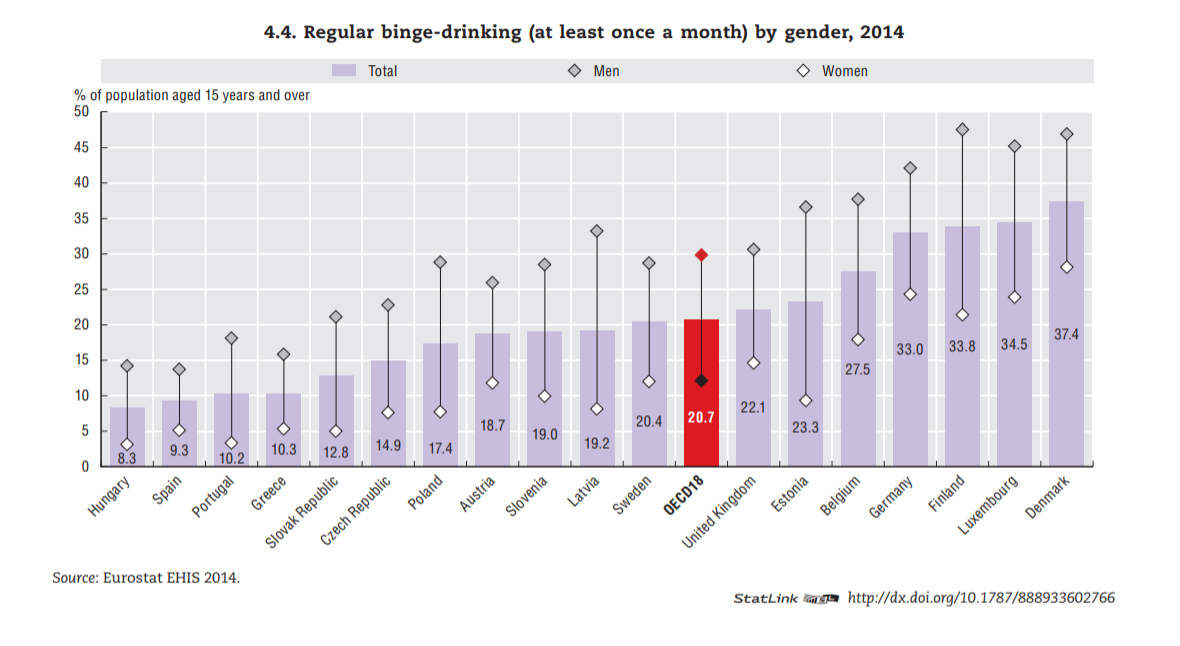
  • Alcohol consumption in the OECD averaged 9 litres of pure alcohol per person per year, equivalent to almost 100 bottles of wine. This figure is driven by the sizeable share of heavy drinkers: 30% of men and 12% of women binge-drink at least once per month.
  • In 13 OECD countries alcohol consumption has increased since 2000, most notably in Belgium, Iceland, Latvia and Poland.
  • Excessive alcohol consumption is also a considerable health burden, associated to increased risk for a range of illnesses, including cancer, stroke, liver disease, as well as social problems, with an estimated 2.3m deaths per year.
  • A recent OECD report found that in general better educated women were more likely to drink excessively, though the opposite held true for men. At the same time, alcohol-related harm is more prevalent among less educated and low-income groups, partly because of multiple comorbidities (coexisting risk factors) and lower access to health care.
  • International comparison of adults:


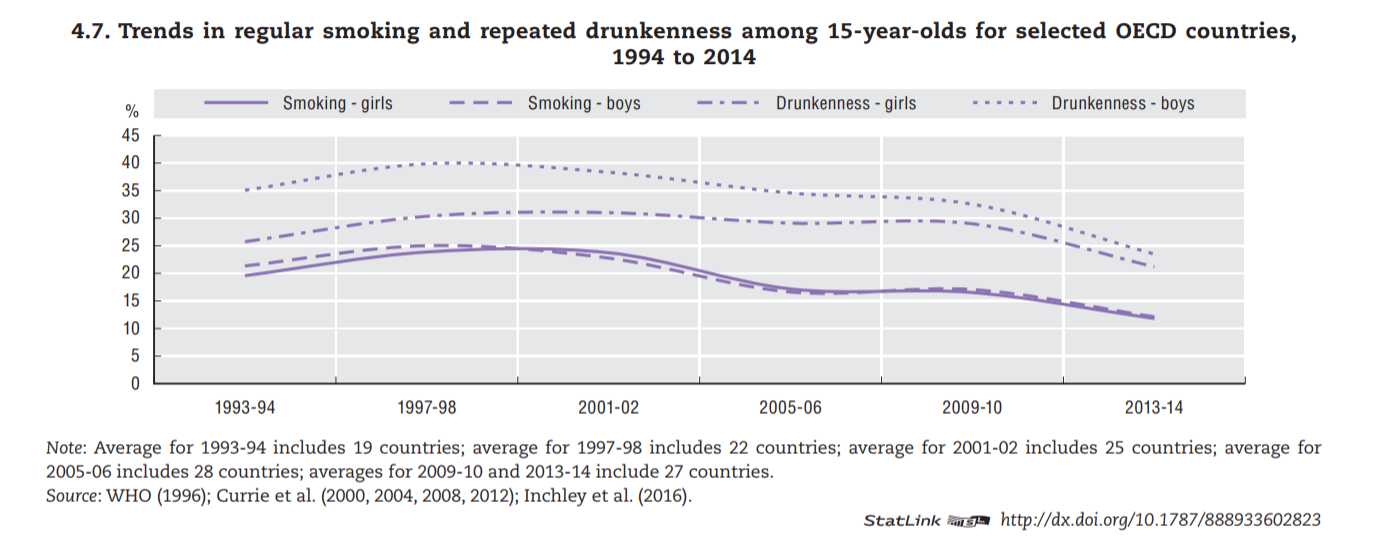
  • International comparison of teenagers:


Source: www.oecd-ilibrary.org/docserver/download/8117301e.pdf?expires=1510318090

Millions to zero alcohol levels this New Year

January 10, 2024

More than 3m people in the UK plan to turn their alcohol clocks to zero for a month from January 1st,  joining an increasingly popular annual initiative to realise the multiple benefits of lower levels of drinking.

Alcohol Concern’s Dry January provides information, support and extra motivation for those taking a break. There is a free app to track our progress and the chance to raise money for charity. 

The popularity of the annual lay-off is easily explained, says the charity’s chief executive Richard Piper: “The benefits are astounding”. Around half of those who take part find they lose weight, two-thirds sleep better and over three-quarters save money. It may also lift depression and anxiety.

Parents and the middle-aged were the most likely to be joining in this year, according to a survey of 2,000 people, with parents of more than two children particularly keen, as are people in full-time employment and those from the North East and Northern Ireland.

“Alcohol is the biggest cause of death, ill-health and disability for people aged 15-49 in the UK–but these tragedies are all totally avoidable,” says Piper. It is among the reasons the annual reset has the support of Public Health England.

The benefits of a mass alcohol reset can add up. It contributes significantly to an annual cost to the NHS or around £3.5bn, or £120 per taxpayer. The burden reaches its peak in December as Christmas parties end in injury, alcohol poisoning and violence.

Success is not uniform, although we can still benefit even if we do not make it to the end. In the past around two-thirds of participants made it through January without drinking any alcohol, while nearly three-quarters were sticking to lower levels of harmful drinking six months later.

Realising the full benefits of not drinking much alcohol can often take longer. Typically getting rid of withdrawal symptoms like emotional instability and memory issues takes between three months and a year. ■

  • « Go to Previous Page
  • Page 1
  • Interim pages omitted …
  • Page 37
  • Page 38
  • Page 39
  • Page 40
  • Page 41
  • Interim pages omitted …
  • Page 44
  • Go to Next Page »

Copyright © 2026 · Phil Cain Impressum