• Skip to main content

Alcohol Review

Alcohol understanding for all

  • Highlights
  • AR2026
    • AR2025
    • Earlier events
  • Register
  • About
    • Organisers
    • Contact
  • Log In

alcohol

World champion alcohol-free beers 2021

January 10, 2024

The UK took a narrow victory in this year’s World Beer Awards alcohol-free medals league table, bagging 23 of the 110 awards, two more than second-placed Germany. Canada took third, with 14 gongs, southern neighbour hot on its heels with ten. Brazil managed four, while Estonia, China, Japan and Russia also brought home honours. ■

Style/breweryNameCountryAward
Dark
Athletic Brewing CoAll OutUSWorld’s Best No & Low Alcohol Dark
Super BockFree PretaPortugalCountry Winner
La Voie MalteeLa Raisonnable RousseCanadaSilver
Big DropWoodcutter Brown AleUKSilver
LeffeBrown 0.0%BelgiumSilver
Super BockNegra SínPortugalSilver
WälsVienna FreeBrazilBronze
Flavoured
KarlsbergGrapefruit AlkoholfreiGermanyWorld’s Best No & Low Alcohol Flavoured
Athletic Brewing CoDownwinder GoseUSCountry Winner
KarlsbergGrapefruit AlkoholfreiGermanyCountry Winner
Sleeman PointFive Non-Alcoholic Citrus LagerCanadaCountry Winner
Lösch-ZwergWeizen Zitrone AlkoholfreiGermanySilver
KarlsbergFresh AlkoholfreiGermanySilver
KarlsbergRadler AlkoholfreiGermanySilver
Yanjing BeerNo Alcohol WeissbierChinaSilver
FentimansLemon ShandyUKSilver
MönchshofNatur Radler 0,0%GermanyBronze
BernardFree Sour CherryCzech RepublicBronze
San Miguel0,0 RadlerSpainBronze
LeffeRuby 0.0%BelgiumBronze
SchützengartenGinger Beer AlkoholfreiSwitzerlandBronze
IPA
Samuel AdamsJust The HazeUSWorld’s Best No & Low Alcohol IPA
Small BeerIPAUKCountry Winner
Twisted CatAlcohol Free IPALuxembourgCountry Winner
FrogBeerIncroyable IpaFranceCountry Winner
CampinasIpa ZeroBrazilCountry Winner
ÕllenautKainekenEstoniaSilver
Drop Bear Beer Co.Tropical IPAUKSilver
BrandIPA 0.0NetherlandsSilver
ThornbridgeZero FiveUKSilver
Samuel AdamsJust The HazeUSSilver
Goose Island Brewhouse São PauloLittle IpaBrazilSilver
Rügener Insel-BrauereiSnorkelers Sea Salt IpaGermanySilver
SiboireDisciplineCanadaBronze
UNLTD.IPAUKBronze
Partake BrewingIPACanadaBronze
Microbrasserie Le Trou du diableNano Perroquet IPACanadaBronze
InfiniteIPAUKBronze
Lager
Jump ShipYardarmUKWorld’s Best No & Low Alcohol Lager
Mahou0,0 TostadaSpainCountry Winner
Athletic Brewing CoAthletic Brewing CompanyUSCountry Winner
Greif BräuLeichtGermanyCountry Winner
Pito1St Czech Non Alcoholic BeerCzech RepublicCountry Winner
Jump ShipYardarmUKCountry Winner
Stella Artois0.0%BelgiumCountry Winner
B&BCelestial Sin Hoppy LagerSpainGold
SvyturysGo PilsnerLithuaniaSilver
WaldhausDiplom Pils AlkoholfreiGermanySilver
Drop Bear Beer Co.New World LagerUKSilver
ClausthalerOriginalGermanySilver
San MiguelMagna Roja 0,0%SpainSilver
Ambar0,0 TostadaSpainSilver
Partake BrewingBlondeCanadaSilver
SchützengartenAlkoholfreiSwitzerlandSilver
Maes0.0%BelgiumBronze
SpatenAlkoholfreiGermanyBronze
Swinckels’0.0%NetherlandsBronze
EngelKellerbier Hell AlkoholfreiGermanyBronze
Days BrewingLagerUKBronze
HofmeisterUltra LowGermanyBronze
Fortitude DrinksEveryday LagerUKBronze
KarlsbergPils AlkoholfreiGermanyBronze
WälsSession FreeBrazilBronze
Pale
Iwate Kura BeerHeel In The Prohibition EraJapanWorld’s Best No & Low Alcohol Pale
La Voie MalteeLa Raisonnable IPACanadaCountry Winner
Iwate Kura BeerHeel In The Prohibition EraJapanCountry Winner
Jupiler0.0%BelgiumCountry Winner
Heaps NormalQuiet XpaAustraliaCountry Winner
Rügener Insel-BrauereiSurfers Summer AleGermanyCountry Winner
Maisel & FriendsAlkoholfreiGermanyGold
AffligemBlond 0.0%BelgiumSilver
SvyturysGo Pale AleLithuaniaSilver
Palm0.0%BelgiumSilver
Wold TopIntuitionUKSilver
Surreal Brewing CompanyNatural Bridges Kolsch StyleUSSilver
San Miguel0,0%SpainSilver
Hawkesbury Brewing CoProhibitionAustraliaSilver
FrogBeerIncroyable BlondeFranceSilver
Big DropPine Trail Pale AleUKSilver
Störtebeker BrauspezialitätenAtlantik-Ale AlkoholfreiGermanySilver
Partake BrewingPaleCanadaSilver
TinniesUltra Low AlcoholAustraliaSilver
Mornington Peninsula BreweryMornington FreeAustraliaBronze
Drop Bear Beer Co.Yuzu Pale AleUKBronze
UweSummer AleGermanyBronze
Bowness Bay BrewingSwan FreeUKBronze
LibraPale AleCanadaBronze
Sour & wild
Microbrasserie Le BockaleAuroraCanadaWorld’s Best No & Low Alcohol Sour & Wild
Microbrasserie Le BockaleAuroraCanadaCountry Winner
Big DropDouble Strike SourUKBronze
Speciality
Big DropParadiso Citra IPAUKWorld’s Best No & Low Alcohol Speciality
Big DropParadiso Citra IPAUKCountry Winner
The Flying Dutchman Nomad Brewing CompanyFreak Kriek Zero Point Three Feel Free Merry Cherry BeerBelgiumSilver
Stout and porter
Big DropGalactic Milk StoutUKWorld’s Best No & Low Alcohol
Big DropGalactic Milk StoutUKWorld’s Best No & Low Alcohol Stout & Porter
Athletic Brewing CoAll OutUSCountry Winner
DeschutesNon-Alcoholic Irish Style DarkUSCountry Winner
Big DropGalactic Milk StoutUKCountry Winner
Surreal Brewing Company17 Mile PorterUSSilver
Drop Bear Beer Co.Bonfire StoutUKSilver
Wheet beer
FranziskanerAlcoholfree Wheat BeerGermanyWorld’s Best No & Low Alcohol Wheat
FranziskanerAlcoholfree Wheat BeerGermanyCountry Winner
Microbrasserie Le BockaleMeteoriteCanadaCountry Winner
SvyturysGo BaltasLithuaniaSilver
Athletic Brewing CoWit’s PeakUSSilver
Maisel’S WeisseAlkoholfreiGermanySilver
Sober CarpenterCanadaSilver
Bavaria0.0% WitNetherlandsSilver
Baltika0.0% Wheat UnfilteredRussian FederationSilver
FrogBeerIncroyable BlancheFranceSilver
La Voie MalteeLa Raisonnable Wheat BeerCanadaBronze
GrolschWeizen 0.0%NetherlandsBronze
Source: World Beer Awards

Brits want alcohol-industry-protected policy

January 10, 2024

Seven in ten Brits want government policy to be protected from alcohol industry interference and a majority want a ban on alcohol advertising, says a survey for the Alcohol Health Alliance (which launches its manifesto in Parliament today.

“With a general election due to take place next year, our message to all political parties is that with the right political will there is a significant opportunity here to turn the tide on alcohol harm and drastically improve the lives of generations to come,” said Professor Sir Ian Gilmore, chair of the alliance.

The findings accompany the launch of a report and manifesto today in Parliament. The alliance points to National Audit Office figures showing alcohol deaths directly attributable to alcohol rose by 89% between 2001 and 2021, while alcohol harms cost the NHS £3.5bn a year.

The Yougov survey also found that 60% of people think alcohol displays and promotions in shops should only be visible to people who intend to browse or buy alcohol. They also showed strong support for making it mandatory to put basic information on alcohol product labels.

76% of respondents said the alcohol content of alcohol products should be required on labels, not just the alcohol percentage as is the case now, forcing consumers to work out how much alcohol a drink contains. Over half supported mandatory pregnancy warnings and nutritional information.

Alcohol products are exempt from laws requiring all other types of food and drink to include nutritional information on labels, despite alcohol being linked to seven types of cancer and over 200 other illnesses. The only requirement is for alcohol product labels to include volume, alcohol percentage and common allergens.

The UK government promised a consultation on alcohol labelling in 2020, but it did not deliver on its promise. ■

Twittersphere:

Report and manifesto here.: "70% of people surveyed support protecting Government policy from the influence of the alcohol industry and its representatives." (p3). Ad ban support below (p17). There were 12,000 on Yougov's panel.https://t.co/MWq2WAIxS5 pic.twitter.com/IB66MAQhKC

— Alcohol Review (@alcohol_review) July 11, 2023

Avoid pressuring people

January 10, 2024

Labels don’t tell us to avoid pressuring other people to drink alcohol. But there are many good reasons to avoid alcohol, not least avoiding harm to our physical and mental health. Please join the supporters. ■

Six recovery recommendations

January 10, 2024

Recommendations for alcohol and other drugs from Professor David Best of Derby University based on evidence he outlined at yesterday’s NHS Addictions Provider Alliance conference:

  1. Get specialist help if you need it, including to deal with any trauma or long-term psychological health problems
  2. You can rely on peer support. It can be but it doesn’t have to be mutual aid groups like AA or NA [Narcotics Anonymous]
  3. Move away from using friends and find social groups that do not include alcohol
  4. Do things—sport, education, hobbies—they build your social networks and your self-esteem 
  5. You can help yourself a lot by helping others 
  6. Be optimistic—you will get there—most people do

Grey-area drinking: pandemic’s heavy drinkers are ignoring the health risks

January 10, 2024

by Ian Hamilton, University of York

Increased drinking during the pandemic has created a group of people who don’t see themselves as alcoholics but have difficulty abstaining from alcohol for any length of time. This group, starting to be called grey-area drinkers, are at risk of alcohol-related health problems.

The relatively new term “grey-area drinking” describes people who consume more than a moderate amount of alcohol but don’t meet the criteria for dependence. Although they might not drink every day or have a drink first thing in the morning (the widely held view of an alcoholic) they are likely to be preoccupied with alcohol and have difficulty giving up. Many of these people don’t view themselves as in need of help.

Any widespread increase in levels of alcohol consumption matters. While most people are familiar with the risk of dependence there are a range of severe physical health problems associated with increased alcohol consumption that they are not so aware of. These include heart disease and a range of cancers, including bowel and breast.

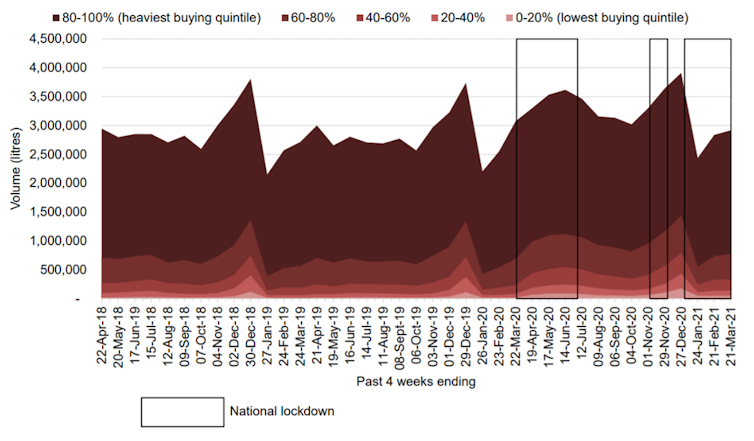
Litres of alcohol bought in shops from April 2018 to 1 March 2021

Source: Public Health England

Although overall consumption of alcohol has been slowly declining in recent years there is emerging evidence that some people have increased their consumption. The heaviest-buying segment of the population increased their purchasing by 5.3 million litres of alcohol (+14.3%) from 2019 to 2021. At the same time physical harm from alcohol has been increasing, with a significant rise in hospital admissions and alcohol-related deaths.

Public Health England collated the results of 18 surveys of self-reported alcohol consumption during the pandemic. Between 11% and 37% reported drinking less but between 14% and 26% of people reported drinking more than usual. This is especially concerning given that we know most people underestimate how much they drink by up to 40% in these surveys.

Pubs were closed during the pandemic, so drinking at home increased. This may have encouraged drinking in large quantities as people tend to pour larger measures of alcohol when drinking at home compared to the measures they are given in bars.

Evidence found that those who experienced stress during the pandemic increased the amount of alcohol they drank and how often. One international study exploring alcohol consumption during periods of self-isolation found that it was British drinkers who were most likely to increase the amount of alcohol they consumed – which they say was due to elevated levels of COVID-related stress.

These surveys found a noticeable increase in consumption for some once the pandemic began. Those who were drinking below the governments recommended weekly limits, continued to stay within these limits. However those who were already drinking above the 14 units a week increased their consumption.

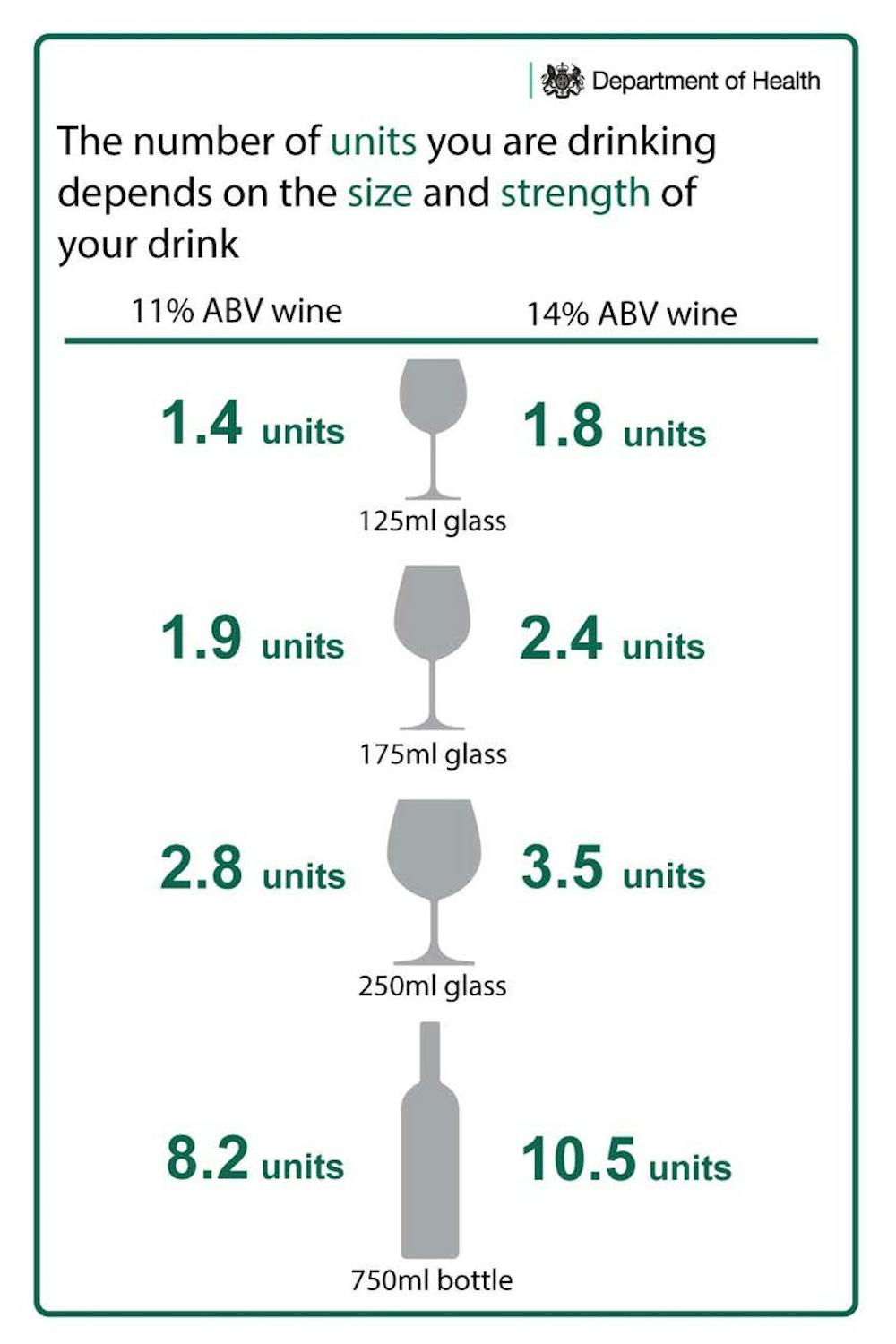
Current UK guidance suggests no more than 14 units of alcohol should be consumed in a week (see illustration).

UK guidance on alcohol units.
Department of Health

Levels of hazardous drinking are considered to be more than 50 units a week for men and 35 units for women. Evidence suggests that there was a 59% increase in those reporting drinking at these levels compared to before the pandemic.

Some argue that the alcohol industry embraces the perception that the majority of people drink responsibly. This has been one of the industry’s main arguments for resisting greater regulation. The industry points to the need for personal responsibility rather than corporate responsibility, although they fail to define what responsible drinking is. This shifts the onus onto the individual to make a change to their drinking habits rather than requiring the industry to make changes to its marketing or promotion techniques.

At a time when there is a clear need to tackle increased alcohol consumption, funding for specialist treatment and support has been withering. Some sections of the alcohol industry were encouraged to increase marketing spend as it would be more effective than ever. Some analysis shows that alcohol companies have also used lockdown for targeted social media activity. And the alcohol industry’s multi-million pound spend on marketing is huge, compared with the budget for public health messages, a truly David and Goliath struggle.

There has been little mention of alcohol or our unhealthy relationship with it during the pandemic by the government. For instance, off-licences were deemed to be essential services and stayed open during lockdown. The alcohol industry has proved to be adept at influencing government policy in its favour.

As treatment budgets are cut industry marketing increases and there is nothing to suggest that there will be any reduction in demand for hospital treatment due to alcohol or, sadly, coroners recording yet more alcohol-related deaths.The Conversation ■

Ian Hamilton, Associate Professor of Addiction, University of York This article is republished from The Conversation under a Creative Commons license.

UPDATE: Olympic beer promotion deal includes all AB InBev brands

January 10, 2024

A heavily-criticised deal to promote beer brands at the next two Olympics covers all brands in AB InBev’s portfolio, Alcohol Review has learned.

The deal shows a “disgraceful disregard for the health and wellbeing of the millions of children” said the UK Association of Directors of Public Health on Monday, with Scottish health NGO SHAAP saying it is “very disappointing”,

The agreement between the International Olympic Committee (IOC) and AB InBev will cover “all the brands within AB InBev’s portfolio”, a spokesperson told Alcohol Review today, adding that there will be “a global focus on non-alcoholic beer products”. 

The deal includes “increased prominence and availability of these products for fans and athletes across the world to celebrate and encourage responsible drinking”, the IOC said. It said the  partnership will be “led globally” by AB InBev’s new no-alcohol brand Corona Cero. Olympic sponsors’ brands are not seen on the field of play as they would be in football.

“The proposed marketing activities are focussed on an adult audience only with a strong responsible drinking message as a key component. We are confident that this partnership will meet all appropriate industry standards in relation to its positioning and messaging,” said a British Olympic Association spokesperson.

Critics say the purpose of promoting a zero alcohol brand like this one is to simultaneously promote a near-identical alcoholic brand, hoping to sides-step advertising restrictions like those in France, which hosts the games this year. 

The IOC’s statement on Friday said AB InBev’s 3.5% Michelob Ultra brand will take the lead at the Los Angeles games in 2028. One of its selling points is being relatively low in calories. The Olympics have featured some alcohol sponsorship before but this is the first time an alcohol company has been a worldwide partner. ■

  • « Go to Previous Page
  • Page 1
  • Interim pages omitted …
  • Page 4
  • Page 5
  • Page 6
  • Page 7
  • Page 8
  • Interim pages omitted …
  • Page 22
  • Go to Next Page »

Copyright © 2026 · Phil Cain Impressum