• Skip to main content
  • Skip to primary sidebar

Alcohol Review

Alcohol understanding for all

  • Highlights
    • Messages
    • Newsletters
    • AR Live
  • Events
    • AR2026
    • AR2025
    • Next year’s event
    • Earlier events
  • Join
  • About
    • Organisers
    • Contact
  • Log In

philcain

Alcohol Review – issue 95, September 29th 2023

January 10, 2024

Find this service useful?
Please join the Alcohol Review‘s supporters who make it possible

In this issue: Australian alcohol deaths accelerate; Scotland plans minimum price adjustment; UK labelling relaxation; US costs to climb; TV shots off target; Dutch wariness rises

Australian alcohol deaths up 30% since pandemic
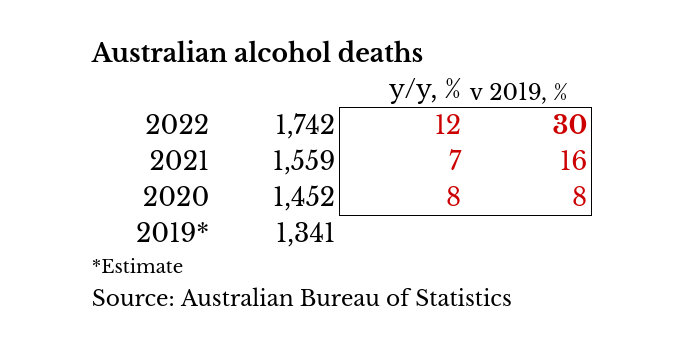
The number of alcohol-induced deaths in Australia increased to around 30% above pre-pandemic levels in 2022. They rose 11% year on year, on top of a 7% rise in 2021 and around 8% in 2020.

They are at their highest level for over a decade, a pattern seen in other anglophone countries, which are among the most scrupulous in reporting figures.

“It is absolutely devastating to see the ways that alcoholic products cause so much harm to so many families and communities across Australia. Every person that dies because of alcohol is a life cut tragically short…,” said Caterina Giorgi of alcohol harm NGO FARE Australia.

America’s alcohol death rates were up 31% on pre-pandemic levels in 2022, falling back from 38% above in 2021. Canada’s alcohol deaths were up a fifth during the pandemic, as were the UK’s. Comment/sources

Scotland plans minimum price adjustment

The Scottish Government published plans to increase the minimum unit price of alcohol from 50p to 65p to catch up with inflation since its introduction in 2018.

A study released in parallel said an increase to 60p would reduce the number of harmful drinkers by well over 26,000, while removing the minimum price would increase their number by about the same.

The industry response has so far been muted, focussing on the fact the increase would mean the price of some budget drinks goes up. Comment/sources

UK labelling relaxation

Drinks containing up to 0.5% alcohol could be labelled as “alcohol free” in the UK, as in Australia, Germany, New Zealand and the US. Some wonder if the rule may also allow them to be used to bypass alcohol advertising rules as 0.0 brews now do. Comment/sources

US costs to climb

The annual cost of alcoholic liver disease is expected to more than double to $66bn in the US by 2040. It is projected to cost a total $880bn between now and 2040, $355bn in direct healthcare-related costs, and $525bn in lost labour and economic consumption. Comment/sources

Shots off target

Broadcasters providing coverage of sporting events should avoid ‘problematic’ shots of fans drinking alcohol, a team of researchers said Thursday. The study’s observations were based on watching the Women’s World Cup. Comment/source 

Dutch wariness rises

Some 40% of the 10- 17-year-old in the Netherlands said alcohol was unhealthy, compared with 27% of adults. Those saying alcohol drinking was fun rose from 13% among 10-11-year-olds to over half of those aged 16 and 17. Comment/sources

US insurance denial down

18 US states still have laws allowing companies to deny insurance payments for treatment to people inebriated with alcohol when they were injured, down from 37 in 2004. The number of states explicitly banning the practice increased from three to 15. Comment/sources
Alcohol Review – issue 93, July 22nd 2023

January 10, 2024

Find this service useful?
Please join the Alcohol Review‘s supporters who make it possible

*For alcohol books and resources, visit the homepage*

This week: US alcohol death surge rolled on; More US states allow teenage bartenders; Alice Springs’ restrictions prolonged; French tax tweak; Rwanda’s “Let’s drink less” campaign. Discussion: We should look more at the big picture.

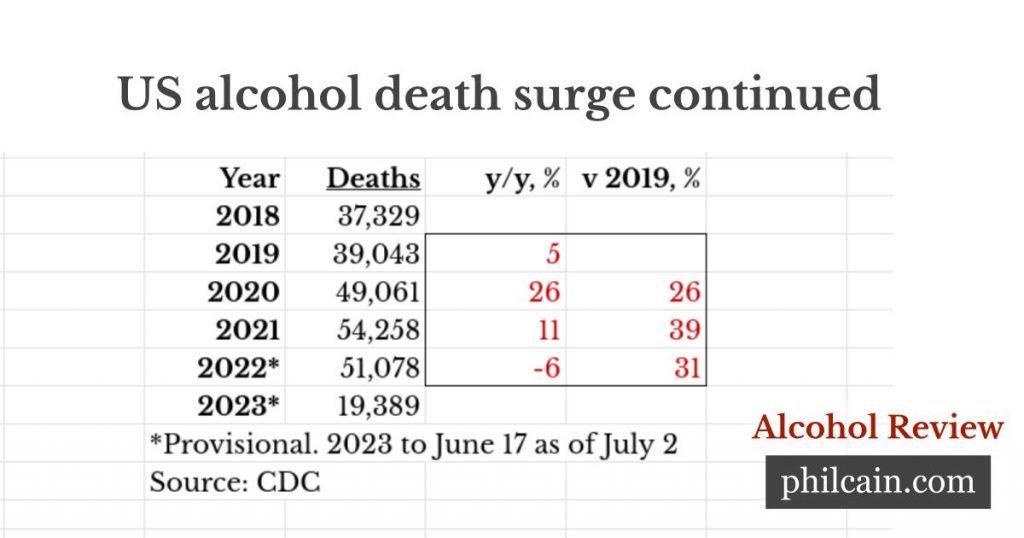
US alcohol death surge rolled on: The surge in US alcohol deaths continued last year with alcohol-induced fatalities at least 31% above pre-pandemic levels, according to the latest CDC estimates. The previous year saw a death toll 39% above pre-pandemic levels. The figure is only likely to increase as new cases are added to the CDC’s tally. It is already 6,000 higher than its February estimate.

More US states allow teenage bartenders: Nine US states have introduced bills to lower the minimum age for serving alcohol since 2021, according to a report by the Economic Policy Institute.

Alice Springs’ restrictions prolonged: Australia’s Northern Territory government will extended takeaway liquor restrictions in Alice Springs for at least the next 12 months, citing a dramatic reduction in harm to the community since their introduction. The local mayor and others, including the alcohol interests, are unhappy with the decision.

French tax tweak: France’s minister of economy told Le Figaro newspaper the government plans to increase alcohol taxes to curb excessive consumption. It appears to be considering a subtle change, indexing alcohol tax to last year’s inflation rather than that of the year before that.

“Let’s drink less” campaign: The Rwandan government this week launched the “TunyweLess”, or “Let’s Drink Less”, campaign in response to a survey showing a significant increase in alcohol consumption.

FASD nightmares: 60% of the children with foetal alcohol spectrum disorder experienced nightmares, while 44% exhibited frequent insomnia symptoms, according to a new study.

Discussion

Let’s look big picture: “It’s pretty clear why people don’t drink–the real question is why do people continue to drink when they don’t want to?” asked journalist Moya Lothian-McLean in a recent Guardian opinion piece. Alcohol Review suggests we should look more at the bigger picture and ways politicians can make healthier choices easier for us.

*For alcohol books and resources, see the homepage*

Guideline labelling’s welcome return leaves open question

January 10, 2024

Health minister gives UK the alcohol industry until September to introduce health guideline labelling

So it is welcome news that the government is pressing for the official guidelines to return in September (see video), albeit two years after they were quietly dropped.

I have joined calls for official health guidelines to appear on all alcoholic drinks labels since revealing that they had been dropped from the UK’s voluntary code in my reporting in late 2017.

It seems extraordinary that robust, scientific information about the safe consumption of a product could ever omitted from packaging, so undermining our right to make informed choices as consumers.

If official health guidelines do reappear on labels in September, as the government hopes, some can be forgiven for looking back and wondering whether self-regulation is an effective way to safeguard consumers?

The responsibility for such concerns about the current system of regulation lies with the alcohol industry. ■

The unique challenge of alcohol’s popularity

January 10, 2024

“If you are trying to change your approach alcohol and feel a bit out of place in the world, little wonder. It isn’t just you. This is alcohol’s unique challenge, which is not matched by other drugs, which do not stir such near-universal affection.”

https://www.smartrecovery.org/embedded-alcohol/

Alcohol Review – issue 92, July 14th 2023

January 10, 2024

Find this service useful?
Please join the Alcohol Review‘s supporters who make it possible

This week: Brits want alcohol-protected policy; CBT may help people with alcohol afflicted people sleep; Court ruling undermines Swedish alcohol monopoly

*Join the WhatsApp Group*

Seven in ten Brits want government policy to be protected from alcohol industry interference and a majority want a ban on alcohol advertising, says a survey for the Alcohol Health Alliance which launched its manifesto in Parliament this week.
https://twitter.com/alcohol_review/status/1678539848272187392

“Cognitive behavioural therapy (CBT) is an effective first-line treatment for insomnia among individuals with alcohol use disorder, regardless of abstinence from alcohol.”
https://twitter.com/alcohol_review/status/1679151249306820613

“Our research confirms that substance use induces long-lasting changes in the inhibitory communication between dMSNs and CINs [neurons], consequently dampening cognitive flexibility.”
https://twitter.com/alcohol_review/status/1679028325946105858

“Sweden’s Supreme Court on Friday said a Danish online wine retailer has the right to sell directly to Swedish households and businesses, in a ruling that could challenge the Nordic state’s alcohol retail monopoly.”
https://twitter.com/alcohol_review/status/1677312959297515521

“The percentage of [Kenyan] men who consume alcohol every day or almost every day decreases from 19% among men in the lowest quintile to 9% among those in the highest wealth quintile.”
https://twitter.com/alcohol_review/status/1676487967781662720

Brits want alcohol-industry-protected policy

January 10, 2024

Seven in ten Brits want government policy to be protected from alcohol industry interference and a majority want a ban on alcohol advertising, says a survey for the Alcohol Health Alliance (which launches its manifesto in Parliament today.

“With a general election due to take place next year, our message to all political parties is that with the right political will there is a significant opportunity here to turn the tide on alcohol harm and drastically improve the lives of generations to come,” said Professor Sir Ian Gilmore, chair of the alliance.

The findings accompany the launch of a report and manifesto today in Parliament. The alliance points to National Audit Office figures showing alcohol deaths directly attributable to alcohol rose by 89% between 2001 and 2021, while alcohol harms cost the NHS £3.5bn a year.

The Yougov survey also found that 60% of people think alcohol displays and promotions in shops should only be visible to people who intend to browse or buy alcohol. They also showed strong support for making it mandatory to put basic information on alcohol product labels.

76% of respondents said the alcohol content of alcohol products should be required on labels, not just the alcohol percentage as is the case now, forcing consumers to work out how much alcohol a drink contains. Over half supported mandatory pregnancy warnings and nutritional information.

Alcohol products are exempt from laws requiring all other types of food and drink to include nutritional information on labels, despite alcohol being linked to seven types of cancer and over 200 other illnesses. The only requirement is for alcohol product labels to include volume, alcohol percentage and common allergens.

The UK government promised a consultation on alcohol labelling in 2020, but it did not deliver on its promise. ■

Twittersphere:

Report and manifesto here.: "70% of people surveyed support protecting Government policy from the influence of the alcohol industry and its representatives." (p3). Ad ban support below (p17). There were 12,000 on Yougov's panel.https://t.co/MWq2WAIxS5 pic.twitter.com/IB66MAQhKC

— Alcohol Review (@alcohol_review) July 11, 2023
  • « Go to Previous Page
  • Page 1
  • Interim pages omitted …
  • Page 27
  • Page 28
  • Page 29
  • Page 30
  • Page 31
  • Interim pages omitted …
  • Page 57
  • Go to Next Page »

Primary Sidebar

  • Bluesky
  • Instagram
  • LinkedIn
  • Twitter
  • WhatsApp

Copyright © 2026 · Phil Cain Impressum

Manage Consent
To provide the best experiences, we use technologies like cookies to store and/or access device information. Consenting to these technologies will allow us to process data such as browsing behaviour or unique IDs on this site. Not consenting or withdrawing consent, may adversely affect certain features and functions.
Functional Always active
The technical storage or access is strictly necessary for the legitimate purpose of enabling the use of a specific service explicitly requested by the subscriber or user, or for the sole purpose of carrying out the transmission of a communication over an electronic communications network.
Preferences
The technical storage or access is necessary for the legitimate purpose of storing preferences that are not requested by the subscriber or user.
Statistics
The technical storage or access that is used exclusively for statistical purposes. The technical storage or access that is used exclusively for anonymous statistical purposes. Without a subpoena, voluntary compliance on the part of your Internet Service Provider, or additional records from a third party, information stored or retrieved for this purpose alone cannot usually be used to identify you.
Marketing
The technical storage or access is required to create user profiles to send advertising, or to track the user on a website or across several websites for similar marketing purposes.
  • Manage options
  • Manage services
  • Manage {vendor_count} vendors
  • Read more about these purposes
View preferences
  • {title}
  • {title}
  • {title}
Loading Comments...