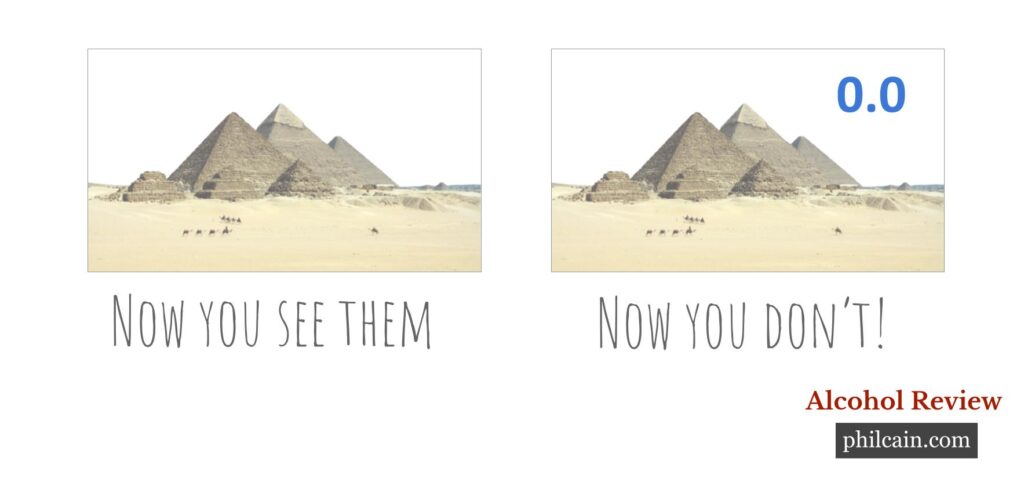
The “great pyramid illusion” is a classic illustration of a stunning optical phenomenon where even very large solid objects and symbols are rendered completely invisible when positioned next to the characters “0.0”. ■
Alcohol understanding for all
Find this service useful?
Please join the Alcohol Review‘s supporters who make it possible
In this issue
News: Industry education opposed; UK deaths surged on; Youth drinking survey; Alcohol-free beer goes country…
Feature: A health conscious life should be more carefree, argues editor Phil Cain
Memes: Some serious points made digestible
This newsletter continues for logged in supporters from any platform. You can retrieve your password using the form below. It is also on Substack.
As someone writing about alcohol I am often asked to tell my own story. I find it very difficult to know how to respond.
It is not that I don’t have one. I do. I even wrote it down once. But it is never the right moment to tell it.
Lived experiences make a huge contribution to the discussion around alcohol, giving us the insider perspectives we need.
The openness of Labour MPs Jonathan Ashcroft, Liam Byrne and Caroline Flint has had an enormous positive impact.
At the same time adding one’s own tale into the mix can, in some circumstances, have significant drawbacks.
Not being the story
Journalists of all kinds typically avoid talking about themselves because it obscures the broader stories they try to tell.
We would hardly tolerate a political journalist book-ending each piece with an update on which way they were leaning.
Like them, I typically cover stories involving many thousands of other people, not just me. I am just a tiny drop in this ocean.
Alcohol is odd too. There is no perfect amount of personal experience of it that make us more credible when talking about it.
Too much and some will think we are probably shaped by it. Too little and they will wonder if we can possibly know the subject.
Suffice it to say, I hope, I am somewhere in the middle, like most people, neither unaffected nor the most affected.
Researching my book shed new light my experiences, making me see them afresh, and of myself as part of a vast continuum.
This motivates me to listen to other people, and try to explore the research with imagination, empathy and critical thought.
Striking a balance
Hearing stories and ideas beyond our own experiences is a vital part in assembling the jigsaw puzzle of alcohol understanding.
That said, we can also often have good reason to keep our own experiences to ourselves. And we have every right to.
We all share things in some circumstances and not others, and the same is true here. It is up to us.
It was a decision I agonised over. While I could see some positives, I could also see downsides. Would it add or subtract value?
I concluded that telling my own story comes second to uncovering and telling stories beyond myself.
Journalists are by no means the only ones with circumstances not always wholly suited to telling their own stories.
So, if there is a story I would tell about my own alcohol experience in the hope it helps others, it is this one. ■
Remoulding our intuitions about alcohol can deliver an enriched experience requiring less effort.
Over time we can shape our unconscious as well conscious thoughts, allowing us to start to align our intuitive ideas about alcohol with scientifically establish facts.
Replacing our existing intuitions about alcohol with more reliable ones can be incredibly rewarding, allowing us to make good decisions quickly with little effort.
The intuitive responses do not necessarily come easily and, in the case of alcohol, as in other areas, can require perseverance, creativity and a wider rethink to cement them in place.
Brain training
We typically only really learn to walk, talk, eat and interact as a standard elements of our growing up curriculum. Beyond that what we learning is less uniform.
It is only thanks to years of practice and the efforts of our parents and wider society that most of us can draw, read, write and drive a car with ease. It is all down to training.
In the right circumstances we can acquire intuitive knowledge of obscure things too, like magnetic fields, like fluid mechanics, Russian irregular verbs, mitochondria, plastering or plumbing.
After years of consistent practice we all tend to become effortless performers in something that is likely to be marvelled at by people who have not had such immersion.
Similar learning process can also enable us to acquire softer skills like social skills, public speaking, or even correcting our posture.
Liquid learning
We learn about things we ingest too, like food and drink, medicines and psychoactives, with alcohol the most common and potent.
Most of us learn about alcohol much as we do riding a bike, with almost no theory and a lot of trial and error.
The fatal flaw is that hearsay and our own perceptions cannot be relied on when trying to form an understanding of a psychoactive.
Drinking alcohol leaves the overwhelming impression it eases stress, trauma, sleep and social awkwardness, but really makes them worse.
Vast advertising budgets and our need to fit in make our false first-hand impressions the easiest takeaways.
This means we can often live for years with very strong but very inaccurate intuitions about alcohol which backfire on us.
Reshaping our intuition
The good news is, however, that intuitions around alcohol are learned and can be remoulded to conform to reality.
A solid base of scientific research can be used to reshape them, allowing us to see where alcohol’s immediate impressions are misleading.
We can change our lifestyles and start gathering new impressions, so forming new intuitions, perhaps by having days and months off.
Like all learning remoulding our alcohol intuition comes most easily when seen as creative process with rewards along the way and payoffs.
There are many such payoffs: avoiding mishaps and illness, lower costs, and improved relationships, memories, mood, cognition and resilience.
Remoulding our intuition can enrich our ideas, shedding inspiring new light on psychology, relationships, lifestyle, philosophy and social goals.
Why would we not attempt to enrich our lives in this way? ■