• Skip to main content
  • Skip to primary sidebar

Alcohol Review

Alcohol understanding for all

  • Highlights
    • Messages
    • Newsletters
    • AR Live
  • Events
    • AR2026
    • AR2025
    • Next year’s event
    • Earlier events
  • Join
  • About
    • Organisers
    • Contact
  • Log In

philcain

Guest post: Most US women don’t know alcohol’s health risks

January 10, 2024

Targeted marketing may play a role in increasing alcohol consumption among women.
Lisa Schaetzle/Moment via Getty Images

By Monica Swahn, Kennesaw State University and Ritu Aneja, University of Alabama at Birmingham

Did you know that casual drinks with friends or having a “wine mom” moment to unwind could actually be nudging up your risk for breast cancer? It sounds like a buzzkill. But it’s a truth that many might not know: Alcohol actually causes breast cancer.

The World Health Organization and the National Institute on Alcohol Abuse and Alcoholism lay it out pretty clearly: Compared to those who don’t drink, just one drink a day can bump up your breast cancer risk by 5% to 9%.

As alcohol and cancer researchers, we wanted to learn more about what women actually know about the connection between alcohol and breast cancer, especially since alcohol use has been increasing among women.

Explaining the knowledge gap
For our recently published research, we asked more than 5,000 women ages 18 and older across the US in 2021 about whether they were aware of the link between alcohol consumption and breast cancer. We also asked them about their drinking habits and other health and background factors.

We were surprised to find that only one in four of these women knew that alcohol is a risk factor for breast cancer. Even more concerning, 35% didn’t think there’s any link at all. Another 40% were sitting on the fence about it.

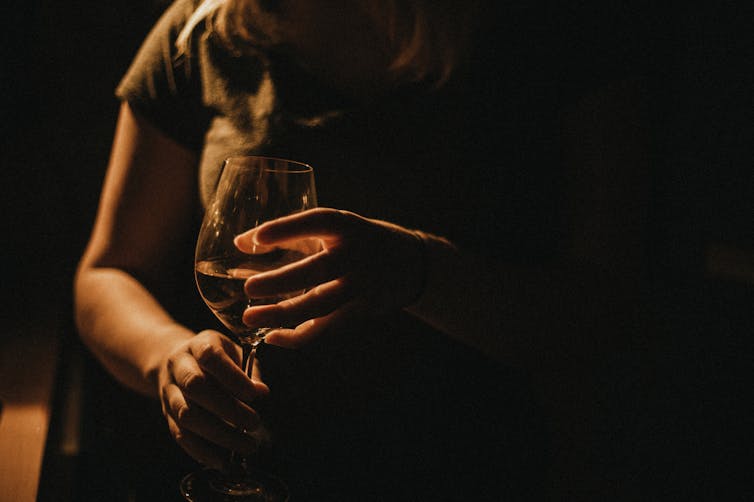
Closeup of person cupping glass of whisky in two hands
Fully understanding alcohol’s health risks can help people make more informed choices about how they consume it.
aire images/Moment via Getty Images

We also saw a knowledge gap based on age, education and race.

Younger, more educated women and those facing alcohol-related issues were more in the know about the link between alcohol and breast cancer risk than older, less educated women and those who have not drank in the past year. Black women were also less aware of the risk between alcohol and breast cancer compared to white women.

Drinking less lowers breast cancer risk
Despite the attempts of alcohol researchers, health officials and advocates to inform women about alcohol’s risks and its connection to breast cancer, our findings show that this message isn’t getting across to most people.

There are also pervasive myths about the benefits of alcohol use because some people don’t want to know that drinking can cause harm and don’t want to talk about it. As a result, many women simply don’t know or are uncertain of the health harms alcohol causes.

A comprehensive communication approach to increase awareness of alcohol’s harms and its link to cancer can help support and encourage women to make healthier choices regarding alcohol use.

Educational campaigns can help inform people from diverse backgrounds about alcohol and breast cancer risk.

Warning labels can help increase awareness of alcohol’s health risks.

Policy changes with respect to alcohol marketing, access and availability can also make a difference in people’s drinking patterns.

These policies may also address the “feminization” of alcohol marketing, which intentionally entices women to drink and purchase alcohol by normalizing or glamorizing heavy alcohol use and ignoring the health risks and harm caused. The World Health Organization recommends stricter rules on alcohol advertising and marketing along with higher taxes on alcohol to reduce alcohol-related harm.

Today’s culture may normalize dealing with life’s stresses by popping the cork.

But cutting down on alcohol is something that can make a difference in breast cancer risk. Stepping back and thinking about alcohol’s effects on your health can help you make informed choices about whether to drink or not.The Conversation ■

Monica Swahn, Dean of the Wellstar College of Health and Human Services, Kennesaw State University and Ritu Aneja, Professor of Clinical and Diagnostic Sciences, Associate Dean of Research and Innovation in the School of Health Professions, University of Alabama at Birmingham. This article is republished from The Conversation under a Creative Commons license. Read the original article.
Alcohol Review – issue 99, January 29th 2024

January 10, 2024

Find this service useful?
Please join the Alcohol Review‘s supporters who make it possible

*Subscribe *Books *Whatsapp *Twitter, LinkedIn *ARchive

In this issue: Olympics strikes first global beer deal; Local alcohol levies mooted; Pope issues wine reminder; Smaller glasses cut drinking; US alcohol deaths state-by-state; and more

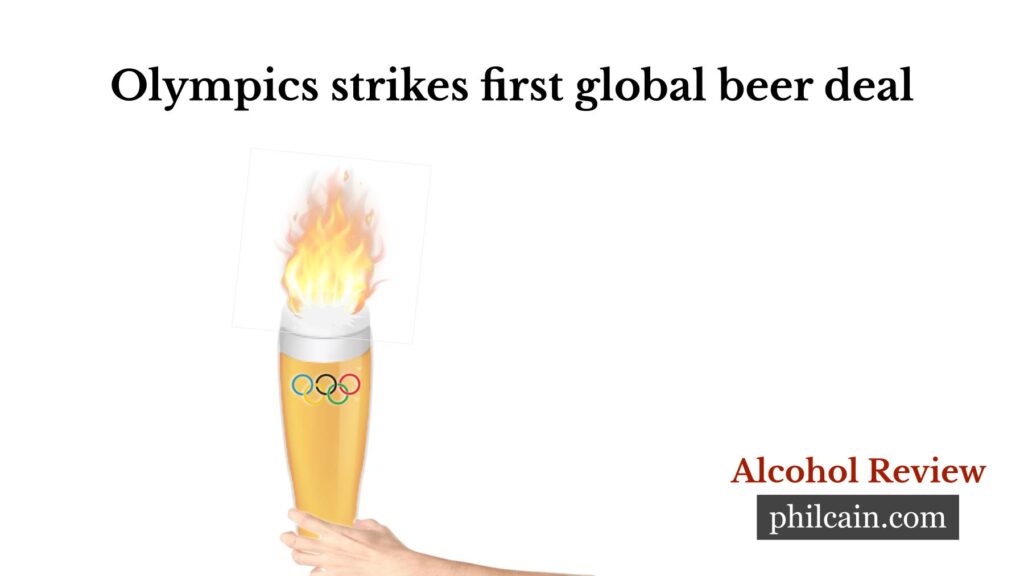
Olympic beer deal: The Olympics’ first ever global beer promotion deal drew sharp criticism from a range of UK health advocates, including the Association of Directors of Public Health. The deal to promote beer brands at the next two Olympics covers all brands in AB InBev’s portfolio, Alcohol Review was told. The Olympics organiser said the beer branding will not be seen in the field of play and will initially revolve around the Corona Cero alcohol-free brand, a modified version of the 4.5% brand. At the LA games in 2028 the emphasis will switch to the 3.5% Michelob Ultra brand, marketed as low calorie.

Local levies: Local levies on alcohol and other unhealthy products could raise funds and reduce inequality, said the left-leaning UK think tank IPPR in a new report. Such levies would top up £3bn funding from a Health Creation Fund, with poorer areas where unhealthy outlets cluster able to raise more money. Scottish Labour said earlier in the month that it is backing an alcohol levy.

Papal whine: Pope Francis was reported to have reminded Italian wine producers of their moral and ethical responsibilities, while reassuring them their product is a “gift from God”. His reminder may relate to the Italian industry being at the vanguard of resistance to nutrition and ingredients labels.

Glass ceiling: A study removing the largest glass of wine from sale in pubs cut the total amount of alcohol consumed by 7.6%, while income remained the same. One commentator suggested huge glasses are naff anyway, while another felt the discussion was a sure sign a full ban on alcohol is nigh.

US deaths state-by-state: Alcohol Review published a table of rises in US alcohol-induced deaths by state, using provisional CDC figures. They range from Mississippi with an 85% rise and New Jersey with 11%. PBS this month talked to the author of a new four-part series in the Denver Post on how alcohol has not been treated with the same urgency as opioids. Colorado, the CDC data says, is in the middle with a 32% in deaths.

Conflicted again: The US organisation assembling a committee to assess evidence for an update to alcohol guidelines has picked a Harvard professor with financial ties to the alcohol industry, having recently backtracked on the appointment of two people with such ties.

AI ageing: The UK government is considering the use of age assurance technologies, including age estimation to decide  if an individual is old enough to purchase age restricted products like alcohol.

*Subscribe *Books *Whatsapp *Twitter, LinkedIn *ARchive

The personal story conundrum

January 10, 2024

As someone writing about alcohol I am often asked to tell my own story. I find it very difficult to know how to respond.

It is not that I don’t have one. I do. I even wrote it down once. But it is never the right moment to tell it.

Lived experiences make a huge contribution to the discussion around alcohol, giving us the insider perspectives we need.

The openness of Labour MPs Jonathan Ashcroft, Liam Byrne and Caroline Flint has had an enormous positive impact.

At the same time adding one’s own tale into the mix can, in some circumstances, have significant drawbacks.

Not being the story
Journalists of all kinds typically avoid talking about themselves because it obscures the broader stories they try to tell.

We would hardly tolerate a political journalist book-ending each piece with an update on which way they were leaning.

Like them, I typically cover stories involving many thousands of other people, not just me. I am just a tiny drop in this ocean.

Alcohol is odd too. There is no perfect amount of personal experience of it that make us more credible when talking about it.

Too much and some will think we are probably shaped by it. Too little and they will wonder if we can possibly know the subject.

Suffice it to say, I hope, I am somewhere in the middle, like most people, neither unaffected nor the most affected.

Researching my book shed new light my experiences, making me see them afresh, and of myself as part of a vast continuum.

This motivates me to listen to other people, and try to explore the research with imagination, empathy and critical thought.

Striking a balance
Hearing stories and ideas beyond our own experiences is a vital part in assembling the jigsaw puzzle of alcohol understanding.

That said, we can also often have good reason to keep our own experiences to ourselves. And we have every right to.

We all share things in some circumstances and not others, and the same is true here. It is up to us.

It was a decision I agonised over. While I could see some positives, I could also see downsides. Would it add or subtract value?

I concluded that telling my own story comes second to uncovering and telling stories beyond myself.

Journalists are by no means the only ones with circumstances not always wholly suited to telling their own stories.

So, if there is a story I would tell about my own alcohol experience in the hope it helps others, it is this one. ■

Enhance your alcohol intuition

January 10, 2024

Remoulding our intuitions about alcohol can deliver an enriched experience requiring less effort.

Over time we can shape our unconscious as well conscious thoughts, allowing us to start to align our intuitive ideas about alcohol with scientifically establish facts.

Replacing our existing intuitions about alcohol with more reliable ones can be incredibly rewarding, allowing us to make good decisions quickly with little effort.

The intuitive responses do not necessarily come easily and, in the case of alcohol, as in other areas, can require perseverance, creativity and a wider rethink to cement them in place.

Brain training
We typically only really learn to walk, talk, eat and interact as a standard elements of our growing up curriculum. Beyond that what we learning is less uniform.

It is only thanks to years of practice and the efforts of our parents and wider society that most of us can draw, read, write and drive a car with ease. It is all down to training.

In the right circumstances we can acquire intuitive knowledge of obscure things too, like magnetic fields, like fluid mechanics, Russian irregular verbs, mitochondria, plastering or plumbing.

After years of consistent practice we all tend to become effortless performers in something that is likely to be marvelled at by people who have not had such immersion.

Similar learning process can also enable us to acquire softer skills like social skills, public speaking, or even correcting our posture.

Liquid learning
We learn about things we ingest too, like food and drink, medicines and psychoactives, with alcohol the most common and potent.

Most of us learn about alcohol much as we do riding a bike, with almost no theory and a lot of trial and error.

The fatal flaw is that hearsay and our own perceptions cannot be relied on when trying to form an understanding of a psychoactive.

Drinking alcohol leaves the overwhelming impression it eases stress, trauma, sleep and social awkwardness, but really makes them worse.

Vast advertising budgets and our need to fit in make our false first-hand impressions the easiest takeaways.

This means we can often live for years with very strong but very inaccurate intuitions about alcohol which backfire on us.

Reshaping our intuition
The good news is, however, that intuitions around alcohol are learned and can be remoulded to conform to reality.

A solid base of scientific research can be used to reshape them, allowing us to see where alcohol’s immediate impressions are misleading.

We can change our lifestyles and start gathering new impressions, so forming new intuitions, perhaps by having days and months off.

Like all learning remoulding our alcohol intuition comes most easily when seen as creative process with rewards along the way and payoffs.

There are many such payoffs: avoiding mishaps and illness, lower costs, and improved relationships, memories, mood, cognition and resilience.

Remoulding our intuition can enrich our ideas, shedding inspiring new light on psychology, relationships, lifestyle, philosophy and social goals.

Why would we not attempt to enrich our lives in this way? ■

Compounding unfairness

January 10, 2024

Visit the story

Alcohol is not useful

January 10, 2024

Alcohol is not useful, with all of its purported benefits achievable by other means which are not hazardous to health or well-being. ■

  • « Go to Previous Page
  • Page 1
  • Interim pages omitted …
  • Page 23
  • Page 24
  • Page 25
  • Page 26
  • Page 27
  • Interim pages omitted …
  • Page 57
  • Go to Next Page »

Primary Sidebar

  • Bluesky
  • Instagram
  • LinkedIn
  • Twitter
  • WhatsApp

Copyright © 2026 · Phil Cain Impressum

Manage Consent
To provide the best experiences, we use technologies like cookies to store and/or access device information. Consenting to these technologies will allow us to process data such as browsing behaviour or unique IDs on this site. Not consenting or withdrawing consent, may adversely affect certain features and functions.
Functional Always active
The technical storage or access is strictly necessary for the legitimate purpose of enabling the use of a specific service explicitly requested by the subscriber or user, or for the sole purpose of carrying out the transmission of a communication over an electronic communications network.
Preferences
The technical storage or access is necessary for the legitimate purpose of storing preferences that are not requested by the subscriber or user.
Statistics
The technical storage or access that is used exclusively for statistical purposes. The technical storage or access that is used exclusively for anonymous statistical purposes. Without a subpoena, voluntary compliance on the part of your Internet Service Provider, or additional records from a third party, information stored or retrieved for this purpose alone cannot usually be used to identify you.
Marketing
The technical storage or access is required to create user profiles to send advertising, or to track the user on a website or across several websites for similar marketing purposes.
  • Manage options
  • Manage services
  • Manage {vendor_count} vendors
  • Read more about these purposes
View preferences
  • {title}
  • {title}
  • {title}
Loading Comments...