• Skip to main content
  • Skip to primary sidebar

Alcohol Review

Alcohol understanding for all

  • Highlights
    • Messages
    • Newsletters
    • AR Live
  • Events
    • AR2026
    • AR2025
    • Next year’s event
    • Earlier events
  • Join
  • About
    • Organisers
    • Contact
  • Log In

philcain

Minimal alcohol drinking linked to longer life

January 10, 2024

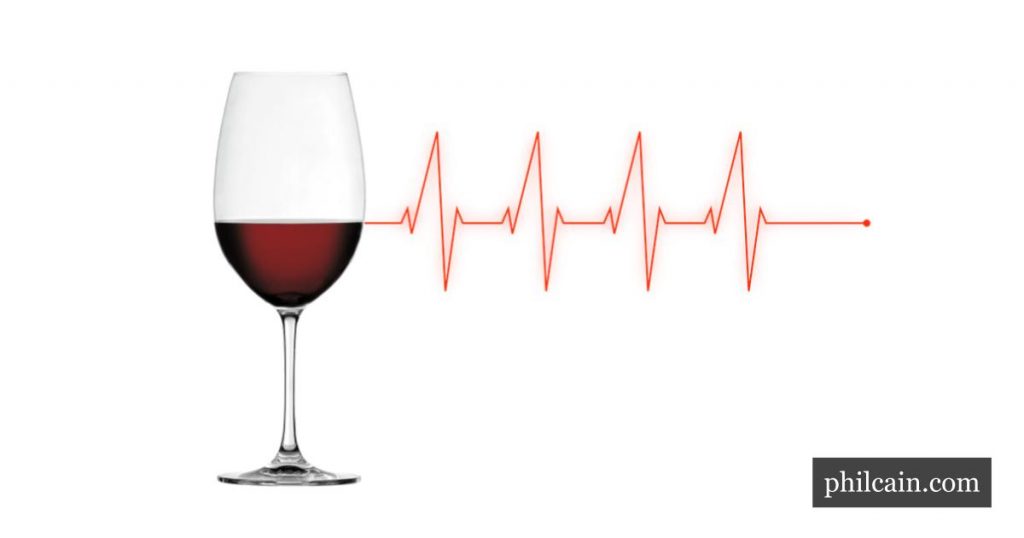
Our life expectancy is lower if we drink more than 125ml of alcohol a week, according to new research.

“Drinking alcohol at levels which were believed to be safe is actually linked with lower life expectancy and several adverse health outcomes,” says Dr Dan Blazer from Duke University, a co-author of the Lancet study.

The decline in life expectancy was found to start slightly below the UK’s guideline maximum amount of 140ml, or 14 UK units, a week. Guideline maximums in Italy, Portugal and Spain are almost 50% higher, while the US one for men is nearly double.

The lives of those who drank 125-250ml a week were shorter by around six months over the age of 40. Those who drank 250-438ml lived between one and two years less, while drinking beyond the top end of the range typically cut lifetimes by between four and five years.

It strengthens evidence, the authors say, that “total cardiovascular disease risk is actually comprised of several distinct and opposite dose–response curves rather than a single J-shaped association”.
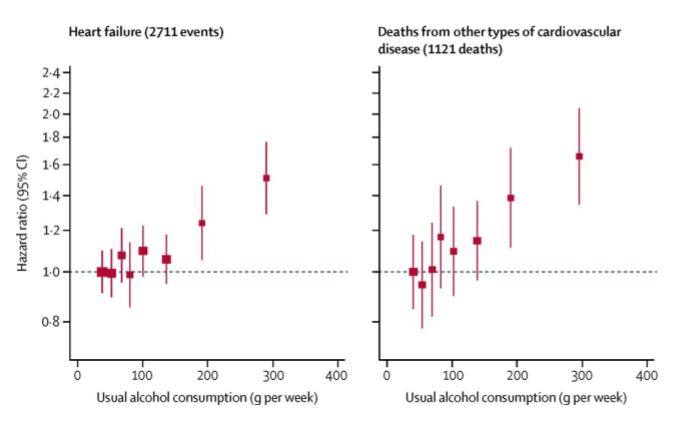
Higher alcohol consumption was associated with a higher risk of stroke, heart failure, fatal hypertensive disease, and fatal aortic aneurysm, with no thresholds below which lower alcohol consumption stopped reducing risk (see chart).

But higher consumption was also associated with a lower risk of non-fatal heart attacks, or “myocardial infarctions”. The authors say, however, that the increased risk of having fatal heart problems means we are likely to lose years of life if we were to drink alcohol to ward off non-fatal problems.

“The key message of this research for public health is that, if you already drink alcohol, drinking less may help you live longer and lower your risk of several cardiovascular conditions,” said Dr Angela Wood, lead author of the study from Cambridge University.

Non-drinkers were excluded from the study, because we often stop drinking when we develop health problems, so skewing the numbers. The study also excluded people with pre-existing heart conditions. ■

UPDATE: Ireland: WTO alcohol labelling trade obligations met

January 10, 2024

Ireland’s health department says it has met all its obligations under World Trade Organisation rules over the health labelling requirements of its alcohol bill.

The US government’s trade agency recently said it had asked Ireland to notify the World Trade Organisation about its health labelling plans so as to comply with the organisation’s Technical Barriers to Trade Agreement.

“We can confirm that all obligations under WTO in relation to the Public Health (Alcohol) Bill have been met by the Department of Health,” the department told Alcohol Companion.

“Ireland intends to notify WTO Members of all amendments made to the Bill at the earliest opportunity, ie once all amendments have been made.” ■

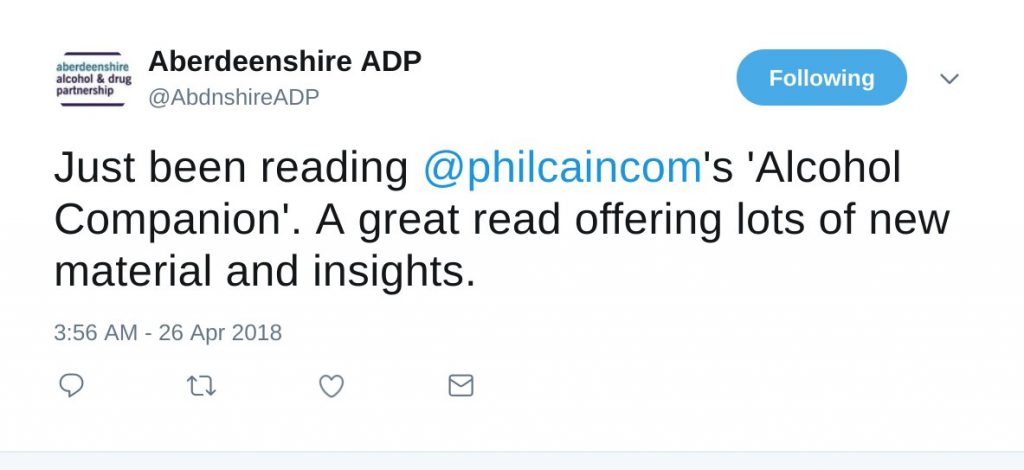
Alcohol Companion: “A great read offering lots of new materials and insights.”

January 10, 2024

Alcohol Companion, Bollywood

January 10, 2024

… Never say never.

January 10, 2024

https://alcohol-review.com/story/alcohol-affects-us-all-the-more-we-understand-it-the-better/

Alcohol: Take courage from competence

January 10, 2024

Like England’s footballers, who overcame a decades-long inability to win on penalties, we are better off finding our courage through practice, not through alcohol.

Sports sponsorship, like Budweiser’s backing of the World Cup, and thrilling advertising images reinforce the phoney link between alcohol and courage, despite codes barring it being done explicitly.

Alcohol plays no part in the confidence of sports people, or anyone else. We all know it, but facts are not what advertising is about. Advertising connects feelings, not facts, in this case tension and alcohol relief.

Our pre-scientific alcohol lexicon provide a flimsy barrier to prevent this powerful emotional linkage. The phrase “Dutch courage” contains only an oblique reference to the Netherlands to trigger suspicion.

Own goals
Lingering misgivings about the Low Countries, alas, do little to prevent our behaviour from being influenced, so we often turn to alcohol to cocoon ourselves from anxiety and even use it to assuage our excitement.

This is doubly ironic, if not more. We watch sport stars perform feats of skill with amazing calm, focus and concentration, while consuming a substance which interferes with our ability to emulate them.

Alcohol inebriation slows our brain function, reducing our competence in activities requiring us to use our brains. This includes practically everything, even sleep.

And, of over the long term, using alcohol tends to fuel our fears and anxieties and lengthen jumpiness after stressful events, whether they end badly or well.

Practice kills nerves
The competence we developed in our jobs and sports mean we are rarely gripped by nerves. Experience teaches us, like professional sportspeople, to know our limits, estimate risk and gauge the chances of success.

Our biggest worries typically revolve around the more haphazard world of our social lives. We often worry about our ability to converse, make friends, find partners and, heaven forbid, give a speech.

We are often first faced with these types of challenges at the same time as we have our first chances to drink alcohol. And they often remain paired thereafter, seemingly inextricably linked.

Alcohol reduces our awareness of distractions which might interrupt our flow, but it does not give us any new skills. We can make fluent, jovial, spontaneous conversation just as well without alcohol. Even dancing is possible.

Social situations which do not enforce alcohol drinking are a help, though not necessary if we can slip under the radar. Like practising penalties, socialising without drinking will eventually bring results. ■

  • « Go to Previous Page
  • Page 1
  • Interim pages omitted …
  • Page 47
  • Page 48
  • Page 49
  • Page 50
  • Page 51
  • Interim pages omitted …
  • Page 57
  • Go to Next Page »

Primary Sidebar

  • Bluesky
  • Instagram
  • LinkedIn
  • Twitter
  • WhatsApp

Copyright © 2026 · Phil Cain Impressum

Manage Consent
To provide the best experiences, we use technologies like cookies to store and/or access device information. Consenting to these technologies will allow us to process data such as browsing behaviour or unique IDs on this site. Not consenting or withdrawing consent, may adversely affect certain features and functions.
Functional Always active
The technical storage or access is strictly necessary for the legitimate purpose of enabling the use of a specific service explicitly requested by the subscriber or user, or for the sole purpose of carrying out the transmission of a communication over an electronic communications network.
Preferences
The technical storage or access is necessary for the legitimate purpose of storing preferences that are not requested by the subscriber or user.
Statistics
The technical storage or access that is used exclusively for statistical purposes. The technical storage or access that is used exclusively for anonymous statistical purposes. Without a subpoena, voluntary compliance on the part of your Internet Service Provider, or additional records from a third party, information stored or retrieved for this purpose alone cannot usually be used to identify you.
Marketing
The technical storage or access is required to create user profiles to send advertising, or to track the user on a website or across several websites for similar marketing purposes.
  • Manage options
  • Manage services
  • Manage {vendor_count} vendors
  • Read more about these purposes
View preferences
  • {title}
  • {title}
  • {title}
Loading Comments...