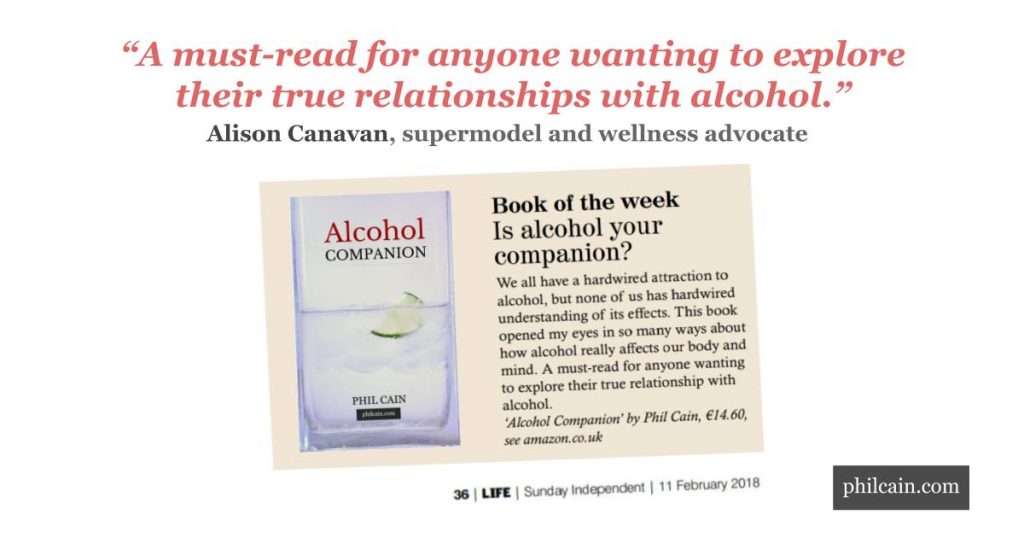
 “This book opened my eyes in so many ways about how alcohol really affects our body and mind. A must-read for anyone wanting to explore their true relationship with alcohol.”—Alison Canavan, wellness advocate and supermodel. … Get yours now
Fact-check: Support for alcohol health labelling
The alcohol industry’s Portman Group (PG) is using a study it co-funded to resist calls for providing health information on alcoholic drink labels. Here’s a look at what the study actually says.
[Read more…] about Fact-check: Support for alcohol health labelling
Minimal alcohol drinking linked to longer life
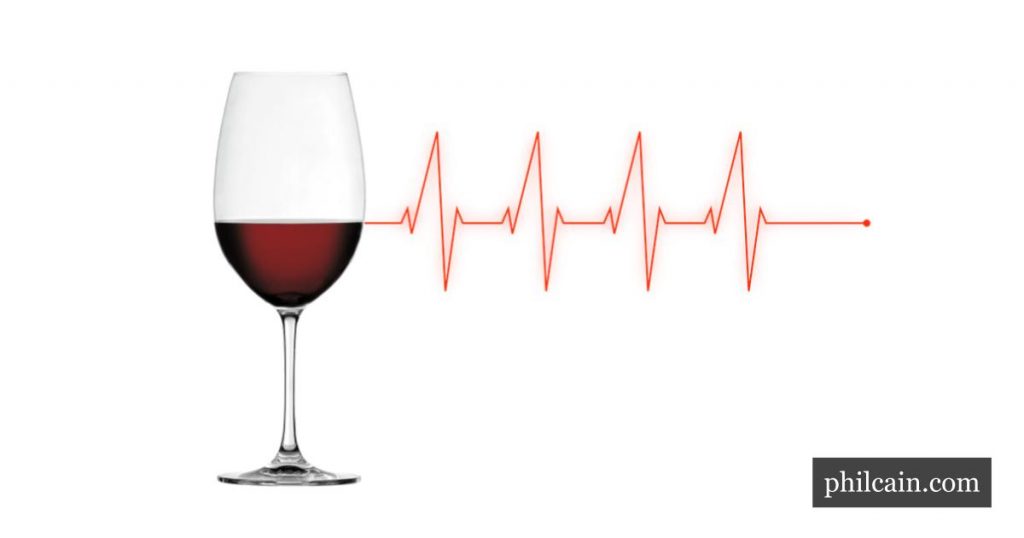
Our life expectancy is lower if we drink more than 125ml of alcohol a week, according to new research.
“Drinking alcohol at levels which were believed to be safe is actually linked with lower life expectancy and several adverse health outcomes,” says Dr Dan Blazer from Duke University, a co-author of the Lancet study.
The decline in life expectancy was found to start slightly below the UK’s guideline maximum amount of 140ml, or 14 UK units, a week. Guideline maximums in Italy, Portugal and Spain are almost 50% higher, while the US one for men is nearly double.
The lives of those who drank 125-250ml a week were shorter by around six months over the age of 40. Those who drank 250-438ml lived between one and two years less, while drinking beyond the top end of the range typically cut lifetimes by between four and five years.
It strengthens evidence, the authors say, that “total cardiovascular disease risk is actually comprised of several distinct and opposite dose–response curves rather than a single J-shaped association”.
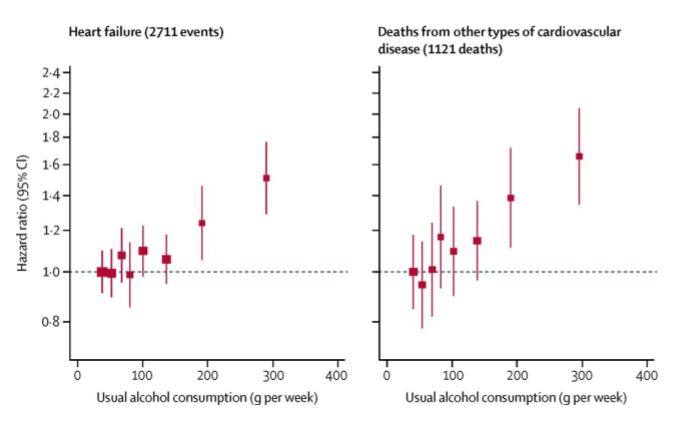 Higher alcohol consumption was associated with a higher risk of stroke, heart failure, fatal hypertensive disease, and fatal aortic aneurysm, with no thresholds below which lower alcohol consumption stopped reducing risk (see chart).
But higher consumption was also associated with a lower risk of non-fatal heart attacks, or “myocardial infarctions”. The authors say, however, that the increased risk of having fatal heart problems means we are likely to lose years of life if we were to drink alcohol to ward off non-fatal problems.
“The key message of this research for public health is that, if you already drink alcohol, drinking less may help you live longer and lower your risk of several cardiovascular conditions,” said Dr Angela Wood, lead author of the study from Cambridge University.
Non-drinkers were excluded from the study, because we often stop drinking when we develop health problems, so skewing the numbers. The study also excluded people with pre-existing heart conditions. ■
UPDATE: Ireland: WTO alcohol labelling trade obligations met
Ireland’s health department says it has met all its obligations under World Trade Organisation rules over the health labelling requirements of its alcohol bill.
The US government’s trade agency recently said it had asked Ireland to notify the World Trade Organisation about its health labelling plans so as to comply with the organisation’s Technical Barriers to Trade Agreement.
“We can confirm that all obligations under WTO in relation to the Public Health (Alcohol) Bill have been met by the Department of Health,” the department told Alcohol Companion.
“Ireland intends to notify WTO Members of all amendments made to the Bill at the earliest opportunity, ie once all amendments have been made.” ■
Gain freedom: How to escape your Facebook feed

Processing the jumbled deluge of content on the typical Facebook feed can cause distraction, cognitive overload and intermittent alarm from its cack-handed delivery of serious news. But this formidable mental challenge is made tricky to escape.
Social media’s commercial goal is to gain and hold our attention for long periods rather than efficiently inform, a role it is unable to perform. The Facebook feed is the crowning achievement of the sector, being the most effective technique ever for distracting nosy animals like us.
We find it almost impossible to stop looking at it, just as we find it hard to resist looking through an open doorway as we pass.
Facebook’s master stroke was to pump-prime our feeds by making it the default to follow people at the same time as we add them. This means it is time-consuming and (superficially) socially awkward for us to reverse the compliment, so we tend not to bother.
People even abandon Facebook as a way to avoid the dilemma, but jumping ship carries a cost because Facebook is a useful personal address book, directory and messaging service. The most targeted way to cure Facebook-feed overload is to disable the feed alone, not to desert the platform.
Thankfully, it is possible to completely disable the Facebook feed and any ill-feeling for doing so is misplaced. Outside Facebookland it has long been accepted people should opt-in for updates rather opt out of them. Facebook should be no exception.
It could take a while to readjust to a feed-free life, but Facebook is not nearly as much of a time-sponge without it. And unhooked from the feed you can also choose when to consume serious news, rather than leaving yourself open to unsettling updates from across the planet at any second.
You are not left “out in the cold” this way either. You can still visit contacts’ Facebook pages, and send and receive personal messages. Disabling your Facebook feed transforms the site from chaotic information maelstrom to convivial blog community, message service and directory.
Of course, there are billions of people who are perfectly happy with their Facebook feeds as they are and I do not begrudge them a moment of enjoyment. I had many laughs and learned a lot from mine — not least my limits — before finally finding a way to turn it off.
Instant relief
You can now instantly block the feed on a PC: in Chrome install the News Feed Eradicator or the Safari equivalent; Firefox, meanwhile, has Kill FB Feed.
On mobile phones uninstalling the app and not visiting the site seems to be the only way.
Feed freedom
Facebook makes it difficult to leave the feed more permanently, but it is possible:
(1) Unfollow contacts: You can do this in one go using this app, being careful to unfollow rather than to unfriend.
(2) Unlike pages: This is more painstaking and has to be done one like at a time. Visit your homepage and click “View activity log” at the bottom right of your cover picture and on the left-hand-side click “Likes” and go through them.
(3) Regulate groups: Some groups can be very rewarding, others less so. For the latter go to “Home”, click on “Groups” on the left-hand-side and click “Edit notification settings” or “Leave group” accordingly.
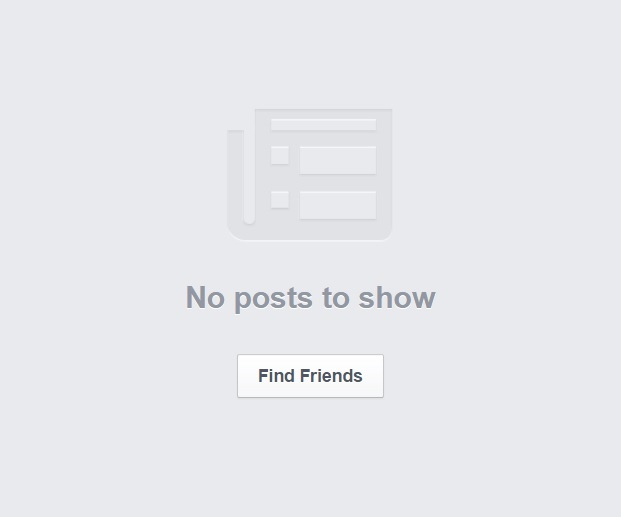
After a lot of arduous clicking, the end result should be as below, saying simply “No posts to show. Find Friends.” One last type of notification remains, most stubbornly on mobile: people’s birthdays. ■
You may also like:
Social media’s serious news problem
Alcohol Companion: “A great read offering lots of new materials and insights.”