• Skip to main content
  • Skip to primary sidebar

Alcohol Review

Alcohol understanding for all

  • Highlights
    • Messages
    • Newsletters
    • AR Live
  • Events
    • AR2026
    • AR2025
    • Next year’s event
    • Earlier events
  • Join
  • About
    • Organisers
    • Contact
  • Log In

philcain

Guest post: Why we should call time on airport drinking

January 10, 2024

by Simon C Moore, Cardiff University

As the alcohol industry continues to make healthy profits, Britain is left counting the increasing cost of its unhealthy relationship with booze. From overstretched accident and emergency departments to a steady incidence of alcohol-related disease, the cost is massive. The most recent figures reveal that alcohol-related harms cost the NHS around £3.5 billion annually.

And the problems don’t end there. Often the erratic and antisocial behaviour of intoxicated people will have an impact on others. This becomes apparent when walking down any UK high street on a Saturday night, as you dodge obstacles from aggressive drinkers to broken glass.

Alcohol issues aren’t limited to towns and cities, either. Recently, budget airline Ryanair once again called for airports to introduce “preventative measures to curb excessive drinking”, following a flight that had to land unexpectedly when three passengers became disruptive. Airports are places where high security and order are paramount to safety so, really, no alcohol should be allowed whatsoever.

Drunk on board

In recent years, there have been several high profile incidents involving drunk passengers on planes – as well as countless other unreported events. In fact, figures show 387 people were arrested for being drunk at airports between February 2016 and February 2017 – up from 255 the previous year. And a BBC Panorama investigation has found that more than half of cabin crew have seen disruptive drunken passenger behaviour at UK airports.

Problems linked to alcohol consumption in airports and on planes include passengers being too drunk to board, or being out of control on planes. Those who do not board have their bags removed, causing delays for other passengers, while those who board drunk can cause disorder and endanger passenger safety – especially pertinent in the confines of an aeroplane where other passengers can become scared.
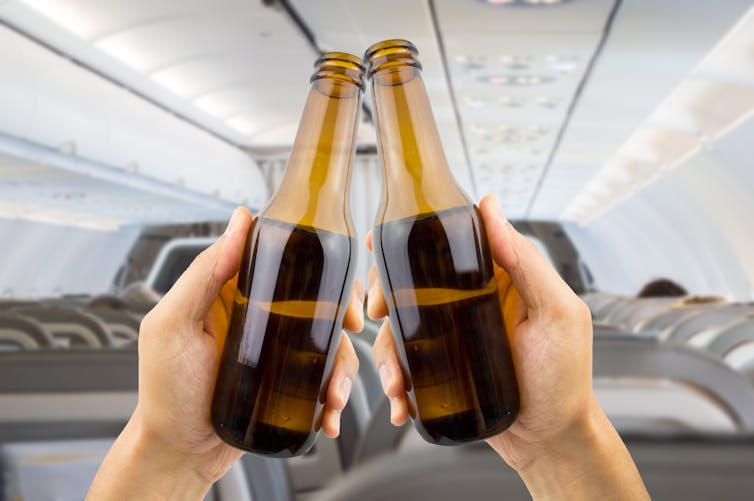
Cheers? [cunaplus/Shutterstock]

Drunk behaviour is not just disruptive to other passengers, however. Air travel involves a tightly integrated, complex set of processes and the effects of drunk passengers can impact this infrastructure. The number of professionals required for the safe management of drunks can divert resources away from normal service, potentially affecting security and the safety of other travellers.

Drunk people have reportedly tried to open plane doors and smash windows while in flight. The extent of drunkenness has caused planes in flight to divert so that the intoxicated and disorderly can be offloaded, again affecting all other passengers’ safety and convenience.

Licensing rules

The government is examining how alcohol is sold in airports, but they stop short of banning it altogether. Instead, restrictions have been proposed to end rules which allow airport bars and pubs to operate outside UK licensing laws. Limiting the number of drinks a passenger can have, both before and during flights, would almost certainly bring this number of alcohol-related incidents down, and result in fewer delays and a more secure and pleasant trip for passengers and staff.

It’s not about being puritanical. Choice is important and many choose to make alcohol an important part of many activities, including their holidays. At the same time, choices have been made to ensure the safety of air passengers and to keep flights running on time. Airport and aeroplane staff, given the choice, would probably prefer not to mop up vomit from those who have drunk too much – or worse, potentially put themselves in harm’s way to protect other passengers.

During air travel, travellers are contained in secure areas, with no choice over their fellow passengers. Removing the irrationality of intoxication from such an activity is not the tyranny of the majority, it is simply asking people to temporarily abstain until they reach their chosen destination. Many passengers choose not to drink and, given the choice, families would likely prefer that their children are not exposed to disorderly drunks.

No one has the right to cause harm to others and it is trivial to expect abstinence while passengers make their way to their destination, whether it is an alcohol-fuelled excursion, a family holiday or a business trip. For those who use alcohol to cope with anxiety, there are more effective and safer alternatives. For those who cannot go without alcohol there are many services available to help with dependence.

The ConversationUltimately, the needs of the many must outweigh the desires of a minority who want to “start their holiday early”. ■

Simon C Moore, Professor of Public Health Research, Co-Director of Crime and Security Research Institute and Director of Alcohol & Violence Research Group, Cardiff University This article was originally published on The Conversation. Read the original article.

Alcohol: Take courage from competence

January 10, 2024

Like England’s footballers, who overcame a decades-long inability to win on penalties, we are better off finding our courage through practice, not through alcohol.

Sports sponsorship, like Budweiser’s backing of the World Cup, and thrilling advertising images reinforce the phoney link between alcohol and courage, despite codes barring it being done explicitly.

Alcohol plays no part in the confidence of sports people, or anyone else. We all know it, but facts are not what advertising is about. Advertising connects feelings, not facts, in this case tension and alcohol relief.

Our pre-scientific alcohol lexicon provide a flimsy barrier to prevent this powerful emotional linkage. The phrase “Dutch courage” contains only an oblique reference to the Netherlands to trigger suspicion.

Own goals
Lingering misgivings about the Low Countries, alas, do little to prevent our behaviour from being influenced, so we often turn to alcohol to cocoon ourselves from anxiety and even use it to assuage our excitement.

This is doubly ironic, if not more. We watch sport stars perform feats of skill with amazing calm, focus and concentration, while consuming a substance which interferes with our ability to emulate them.

Alcohol inebriation slows our brain function, reducing our competence in activities requiring us to use our brains. This includes practically everything, even sleep.

And, of over the long term, using alcohol tends to fuel our fears and anxieties and lengthen jumpiness after stressful events, whether they end badly or well.

Practice kills nerves
The competence we developed in our jobs and sports mean we are rarely gripped by nerves. Experience teaches us, like professional sportspeople, to know our limits, estimate risk and gauge the chances of success.

Our biggest worries typically revolve around the more haphazard world of our social lives. We often worry about our ability to converse, make friends, find partners and, heaven forbid, give a speech.

We are often first faced with these types of challenges at the same time as we have our first chances to drink alcohol. And they often remain paired thereafter, seemingly inextricably linked.

Alcohol reduces our awareness of distractions which might interrupt our flow, but it does not give us any new skills. We can make fluent, jovial, spontaneous conversation just as well without alcohol. Even dancing is possible.

Social situations which do not enforce alcohol drinking are a help, though not necessary if we can slip under the radar. Like practising penalties, socialising without drinking will eventually bring results. ■

January 10, 2024

https://alcohol-review.com/story/alcohol-affects-us-all-the-more-we-understand-it-the-better/

Alcohol Companion, Bollywood

January 10, 2024

… Never say never.

Gain freedom: How to escape your Facebook feed

January 10, 2024

Processing the jumbled deluge of content on the typical Facebook feed can cause distraction, cognitive overload and intermittent alarm from its cack-handed delivery of serious news. But this formidable mental challenge is made tricky to escape.

Social media’s commercial goal is to gain and hold our attention for long periods rather than efficiently inform, a role it is unable to perform. The Facebook feed is the crowning achievement of the sector, being the most effective technique ever for distracting nosy animals like us.

We find it almost impossible to stop looking at it, just as we find it hard to resist looking through an open doorway as we pass.

Facebook’s master stroke was to pump-prime our feeds by making it the default to follow people at the same time as we add them. This means it is time-consuming and (superficially) socially awkward for us to reverse the compliment, so we tend not to bother.

People even abandon Facebook as a way to avoid the dilemma, but jumping ship carries a cost because Facebook is a useful personal address book, directory and messaging service. The most targeted way to cure Facebook-feed overload is to disable the feed alone, not to desert the platform.

Thankfully, it is possible to completely disable the Facebook feed and any ill-feeling for doing so is misplaced. Outside Facebookland it has long been accepted people should opt-in for updates rather opt out of them. Facebook should be no exception.

It could take a while to readjust to a feed-free life, but Facebook is not nearly as much of a time-sponge without it. And unhooked from the feed you can also choose when to consume serious news, rather than leaving yourself open to unsettling updates from across the planet at any second.

You are not left “out in the cold” this way either. You can still visit contacts’ Facebook pages, and send and receive personal messages. Disabling your Facebook feed transforms the site from chaotic information maelstrom to convivial blog community, message service and directory.

Of course, there are billions of people who are perfectly happy with their Facebook feeds as they are and I do not begrudge them a moment of enjoyment. I had many laughs and learned a lot from mine — not least my limits — before finally finding a way to turn it off.

Instant relief
You can now instantly block the feed on a PC: in Chrome install the News Feed Eradicator or the Safari equivalent; Firefox, meanwhile, has Kill FB Feed.

On mobile phones uninstalling the app and not visiting the site seems to be the only way.

Feed freedom
Facebook makes it difficult to leave the feed more permanently, but it is possible:

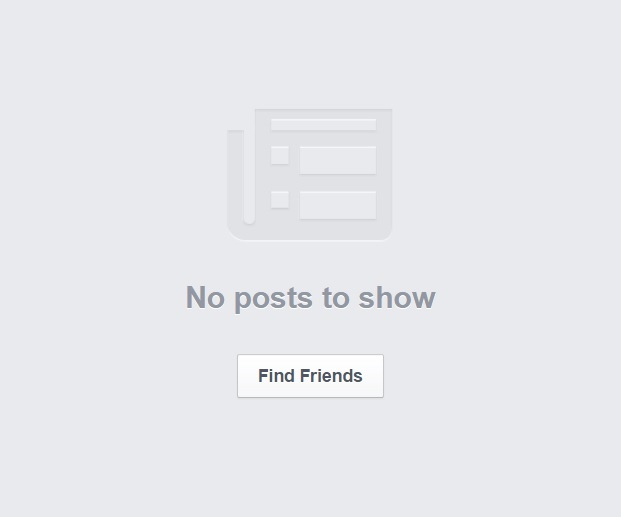
The empty stream

(1) Unfollow contacts: You can do this in one go using this app, being careful to unfollow rather than to unfriend.

(2) Unlike pages: This is more painstaking and has to be done one like at a time. Visit your homepage and click “View activity log” at the bottom right of your cover picture and on the left-hand-side click “Likes” and go through them.

(3) Regulate groups: Some groups can be very rewarding, others less so. For the latter go to “Home”, click on “Groups” on the left-hand-side and click “Edit notification settings” or “Leave group” accordingly.

After a lot of arduous clicking, the end result should be as below, saying simply “No posts to show. Find Friends.” One last type of notification remains, most stubbornly on mobile: people’s birthdays. ■

You may also like:

Alcohol, our faulty Facebook

Social media and the brain

Social media’s serious news problem

Embracing imperfection

Weaving happiness into journalism

In praise of politeness

[book] Preventing Alcohol-Related Problems: Evidence and Community-based Initiatives | APHA Press

January 10, 2024

“… The book combines the latest research on community-level alcohol problems with success stories from community practitioners. …”
ISBN: 978-0-87553-291-2

Author: Edited by: Norman Giesbrecht and Linda M. Bosma
Publisher: APHA Press
Format: Soft Cover
Pages: 623
Publishing Date: 11/17

Source: secure.apha.org/imis/ItemDetail?iProductCode=978-087553-2912

  • « Go to Previous Page
  • Page 1
  • Interim pages omitted …
  • Page 43
  • Page 44
  • Page 45
  • Page 46
  • Page 47
  • Interim pages omitted …
  • Page 57
  • Go to Next Page »

Primary Sidebar

  • Bluesky
  • Instagram
  • LinkedIn
  • Twitter
  • WhatsApp

Copyright © 2026 · Phil Cain Impressum

Manage Consent
To provide the best experiences, we use technologies like cookies to store and/or access device information. Consenting to these technologies will allow us to process data such as browsing behaviour or unique IDs on this site. Not consenting or withdrawing consent, may adversely affect certain features and functions.
Functional Always active
The technical storage or access is strictly necessary for the legitimate purpose of enabling the use of a specific service explicitly requested by the subscriber or user, or for the sole purpose of carrying out the transmission of a communication over an electronic communications network.
Preferences
The technical storage or access is necessary for the legitimate purpose of storing preferences that are not requested by the subscriber or user.
Statistics
The technical storage or access that is used exclusively for statistical purposes. The technical storage or access that is used exclusively for anonymous statistical purposes. Without a subpoena, voluntary compliance on the part of your Internet Service Provider, or additional records from a third party, information stored or retrieved for this purpose alone cannot usually be used to identify you.
Marketing
The technical storage or access is required to create user profiles to send advertising, or to track the user on a website or across several websites for similar marketing purposes.
  • Manage options
  • Manage services
  • Manage {vendor_count} vendors
  • Read more about these purposes
View preferences
  • {title}
  • {title}
  • {title}
Loading Comments...