story
[diary] UK minimum unit price (MUP) judgement: Wednesday November 15th, 2017 | The Supreme Court
A judgement will be handed down next Wednesday on whether Scotland’s minimum alcohol pricing law of 2012 is compatible with EU law. If it is, the potentially life-saving scheme can go ahead.
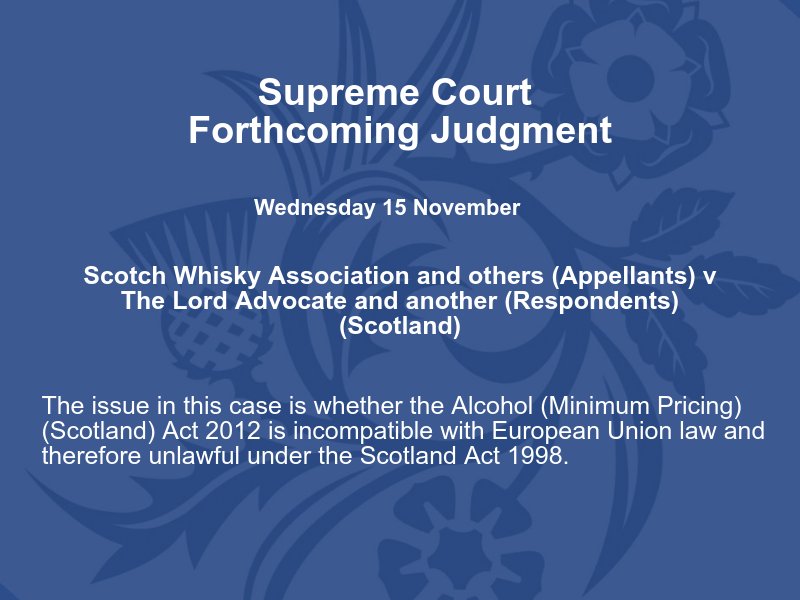
Source: https://www.supremecourt.uk/cases/uksc-2017-0025.html
One-in-six parents defies youth alcohol advice
 One-in-six British parents allows their under-15 to drink, contrary to official advice, with the educated, employed and white more likely to do so, according to a UK study.
The official guidance is that children should not drink alcohol before the age of 15, and from then up to the age of 17 only at a very low level, at most one day a week. Exposure to alcohol at any age tends to make us worse at controlling our future intake.
By the age of 14 around half of children in the UK had tried more than a few sips. Drinking below 14 is associated with greater chances of injury, involvement in violence, and suicidal thoughts and attempts.
Overall the level of drinking among children and young adults seems to be declining, perhaps because of technology. ■
Legal threats scupper Canadian alcohol cancer warning trial
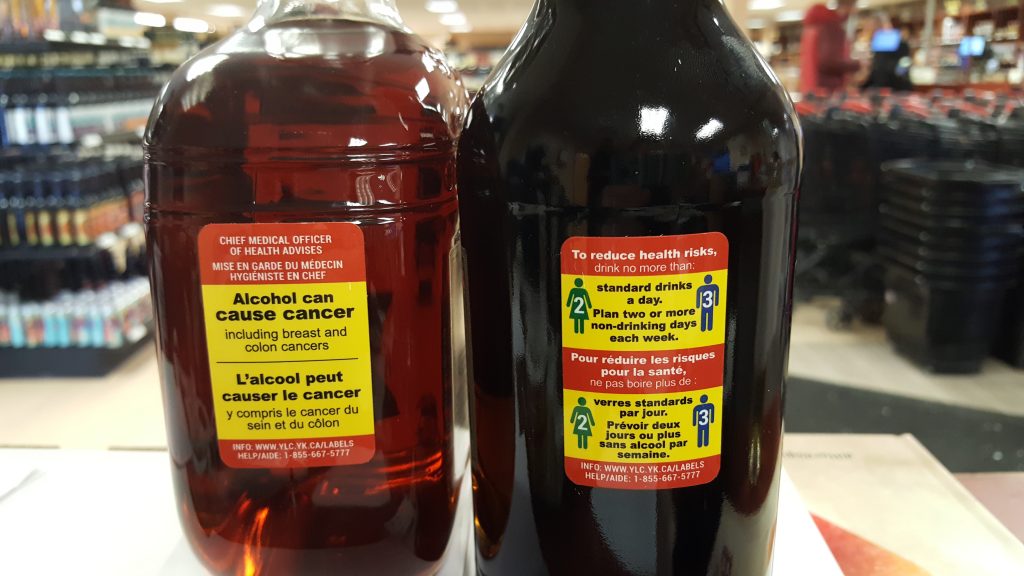
Legal threats have scuppered hopes for the resumption of a Canadian trial of labels warning that drinking alcohol increases the risk of cancer, putting a question mark over plans to inform consumers elsewhere.
Ireland and Australia are both considering labels warning that alcohol increases the risk of cancer, with Ireland’s lower house debating the move this week.
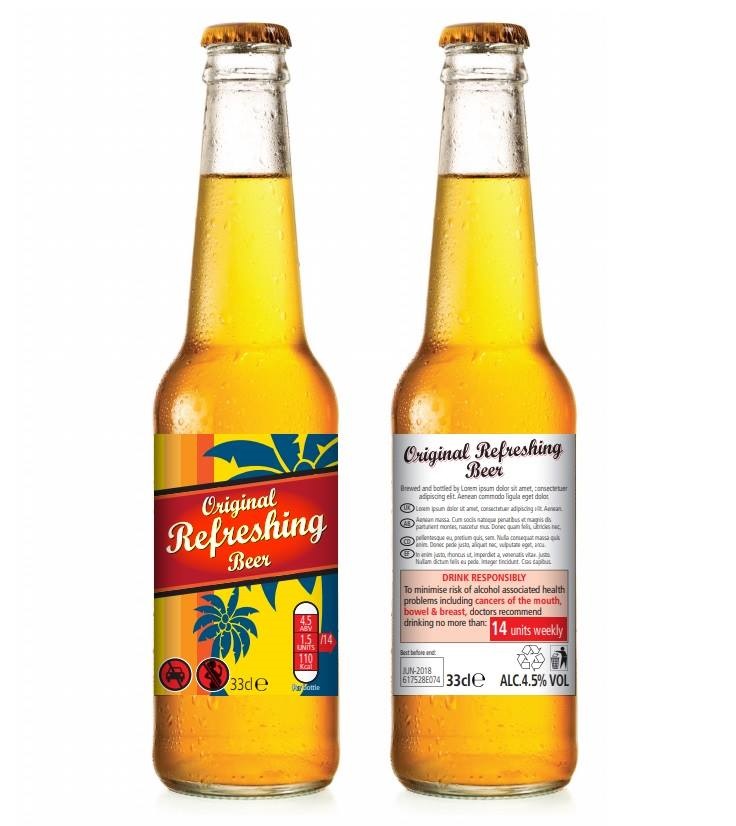 The UK’s Royal Society for Public Health proposed labels last month which include a warning that alcohol is proven to increase the risk of cancer (left). Alcohol producers quietly lowered their voluntary labelling standard last year.
The Canadian study was abruptly halted at the end of December after receiving a range of legal threats, including that it might be guilty of defamation and trademark infringement. Experts say those seeking to obstruct cancer labelling have a wide range of legal options.
The legal threats have not stopped the evaluation of labels not mentioning the increased cancer risk of drinking alcohol: one showing a standard drink size and another the low-risk drinking guidelines. Results are expected in June.
The trial is part of the second phase of the Northern Territories Alcohol Study led by researchers from Public Health Ontario and the Canadian Institute for Substance Use Research at the University of Victoria.
Yukon’s 34,000 people have the highest alcohol sales per head in Canada. ■
The key alcohol theme of 2018: dementia

Dear Reader
This year offered a steady stream of confirmation of the merits of low-risk alcohol drinking, reckoned to be less than 14 UK units (140ml) a week.
There was also welcome reassurance that not drinking alcohol at all, which many find the easiest form of low-risk drinking, comes with no added risk.
But the biggest news was confirmation of a massive underestimate of alcohol as a factor in dementia. This too was followed by confirmation that low-risk drinking should spare us from it.
It is a discomforting finding, no doubt. But it also offers hope that changes to our drinking habits can spare millions from mental health problems, as I wrote here.
Thank you for your support over the last year. I wish you a happy New Year’s Eve and a great start to 2019.
Yours faithfully
Phil
[research, comment] Responsibility without blame for addiction | Neuroethics
 I offer a “responsibility without blame” framework that derives from reflection on forms of clinical practice that support change and recovery in patients who cause harm to themselves and others. This framework can be used to interrogate our own attitudes and responses, so that we can better see how to acknowledge the truth about choice and agency in addiction, while avoiding stigma and blame, and instead maintaining care and compassion alongside a commitment to working for social justice and good—Hanna Pickard, Reader in Philosophy, Birmingham University, UK
Source: link.springer.com/article/10.1007/s12152-016-9295-2
Note: This suggestion tallies closely with the compromise reached in Alcohol Companion. As is pointed out in this paper, it is important for our well-being to acknowledge that we continue to make choices after exposure to alcohol. But it is also important to acknowledge that alcohol exposure means, for a variety of reasons, our subsequent choices often become unreliable, often being heavily biased in favour of consuming more alcohol. Choices made when we are being coerced, disabled, bribed or deceived cannot be given the same treatment as ones we make without interference. In such circumstances it can be helpful to ignore the question of whether a choice is morally right or wrong, because there can be no reliable answer when our judgment is impaired. And moral answers rarely provide a solution for the person being judged. Luckily, however, it is often both possible and helpful to look at the factors which led to a choice and ask whether it was a good or bad one purely in terms of our happiness and well-being. ■