• Skip to main content

Alcohol Review

Alcohol understanding for all

  • Highlights
  • AR2026
    • AR2025
    • Earlier events
  • Register
  • About
    • Organisers
    • Contact
  • Log In

story

US alcohol research funding cuts itemised

May 23, 2025

The Trump administration has stopped funding to at least 34 alcohol research projects awarded $31m, with 58% still to be paid out, according to statistics collated by Alcohol Review (table below). Around three-quarters involve studies of sexual and gender minorities, or SGMs.

The study losing the most is one on alcohol drinking and HIV risk among sexual minority youth underway at Nortwestern University, which is now short of 80% of its $2.4m award. The biggest award halted is one for a study looking for neurobiological susceptibility among young people to peer influence around alcohol and other drugs from the University of North Carolina. Over 60% of its $2.9m award is not yet paid.

The next biggest award suspended is a Columbia University study on the role of alcohol in domestic aggression among lesbian and bisexual women, on average bigger drinkers than heterosexual counterparts. It is missing half its grant of $2.8bn. A University of Wisconsin study of intimate partner violence among gay, lesbian and bisexual people has had the second half its $2.6m award halted.

Terminated studies of broader populations include: A $1.5m study of the use of telehealth in alcohol treatment, from Harvard Medical School; A $400,000 study from Columbia University which was going to look at the “behavioural cost of carbon”; And a $130,000 Columbia study stopped half way through examining the relationship between deforestation and alcohol and tobacco use in Indonesia. ■

Subscribe and log in for full table

US alcohol studies ended

TitleResearch organisationAward amount ($)Not yet paid ($)Not yet paid (%)
Neurobiological susceptibility to peer influence and drug use in adolescence SummaryUniversity of North Carolina2,866,8541,744,64861
Stress, hazardous drinking and intimate partner aggression in a diverse sample of women and their partners SummaryColumbia University2,750,6901,376,82850
Alcohol, minority stress, and intimate partner violence: Temporal and prospective associations in sexual minority young adults SummaryUniversity of Wisconsin2,717,1421,436,00953
Intersectional Approaches to Population-Level Health Research: Role of HIV Risk and Mental Health in Alcohol Use Disparities among Diverse Sexual Minority Youth SummaryNorthwestern University2,483,9602,010,71181
Peer Victimization and Risky Alcohol Use among Sexual Minority Youth: Understanding Mechanisms and Contexts SummaryState University of New York2,351,6071,700,02272
Long-term and Daily Associations among Intersectional Minority Stress, Structural Oppression, and Alcohol Use and Misuse among Sexual Minority Adolescents of Color SummaryUniversity of Maryland2,165,9211,525,22670
Telehealth in the Treatment of Alcohol Use Disorders: Impact on Access, Disparities, and Quality of Care SummaryHarvard Medical School1,527,269966,61163
A Randomized Controlled Trial of a Game-Based Intervention to Reduce Alcohol Use among Sexual and Gender Minority Youth SummaryUniversity of Pittsburg1,427,5571,089,87076
Feasibility and Effectiveness of Gamified Digital Intervention to Prevent Alcohol and Mental Health Risks SummaryLoyola Marymount University1,150,713641,47456
The Impact of Minority Stress on Alcohol-Related Sexual Assault among Sexual Minority College Students: An Intersectional, Mixed-Methodological Study SummaryUniversity of Wisconsin1,131,845382,96734
Sexual Fluidity and Longitudinal Changes in Alcohol Misuse and Associated Health Consequences SummaryUniversity of Michigan1,063,923727,07368
Experiences of Rural Sexual and Gender Minority Couples: Does Alcohol Use Explain the Link Between Minority Stress and Intimate Partner Discord and Violence SummaryUniversity of Nabraska1,009,033445,35944
An intersectional approach linking Minority Stressors Experienced by Transgender and Gender Diverse Adults to Alcohol and Drug Use and comorbid Mental and Physical Health Outcomes SummaryGeorgia State University991,531532,24854
A mixed-methods approach to understanding stress and hazardous drinking among same-sex female couples SummaryNorthwestern University775,522434,80356
Rising STARS (Scientific Training in Alcohol Research and other Substances) Program SummaryUniversity of Southern California736,029351,95248
Integrated Alcohol and Sexual Assault Prevention for Bisexual Women SummaryRhode Island Hospital719,424407,71057
The Role of Local Structural Stigma in Alcohol Related Inequities among SGM Young Adults SummaryPacific Institute668,532425,70564
An Online Family-based Program to Prevent Alcohol Use and Dating and Sexual Violence among Sexual and Gender Minority Youth SummaryColumbia University653,281210,02132
Alcohol-Involved Sexual Assault among Bisexual Women: Disentangling Mechanisms of Risk at Individual, Interpersonal, and Structural Levels Across the Lifespan SummaryColumbia University634,636419,25066
Reconstruction of an SGM-specific sexual violence peer support program (SSS+) SummaryUniversity of North Carolina458,26983,13018
Health Effects of Intersectional Stigma among Sexual Minority Women SummaryUniversity of California416,567363,19287
The Behavioral Cost of Carbon SummaryColumbia University411,250n/an/a
Internal Sources of Minority Stress and Alcohol Consumption SummaryTexas Tech Univesity397,892186,77747
Event-level Antecedents of Heavy Drinking Among Bisexual and Heterosexual Women with and without Histories of Sexual Assault SummaryRhode Island Hospital348,97870,96620
Stigma,Romantic Relationships, and Alcohol Use Among Transgender and Nonbinary Young Adults SummaryBoston University348,397122,33335
Daily Impact of Sexual Minority Stress on Alcohol-Related Intimate Partner Violence among Bisexual+ Young Adults: A Couples’ Daily Diary Study SummaryVirginia Polytechnic218,29317,7338
Sexual orientation, gender identity, and alcohol use: A multi-method analysis of developmental differences and key mechanisms SummaryUniversity of Maryland215,194175,78782
Spatiotemporal effects and associations between deforestation and alcohol and tobacco use in Indonesia SummaryColumbia University126,33369,36855
Examining Individuals’ Exposure to Alcohol Environments Using Novel Responsive Buffers SummaryColumbia University96,66878,51481
Examining differential effects of state equality-promoting policies on harmful alcohol use among sexual and gender minority adults in the U.S.: an econometrics approach for causal inference SummaryUniversity of California80,63256,66070
Romantic Relationships, Discrimination Stressors, and Alcohol Use among Sexual and Gender Minority Adults SummaryMontana State University80,3169,53612
Examining Proximal Associations between Minority Stress, PTSD Symptoms, and Alcohol Use among Bi+ College Students with Trauma Histories SummarySchools of Arts and Sciences48,97434,42570
Post-Traumatic Stress and Alcohol Use as Mechanisms Explaining IPV Among Bisexual Women Who Disclose Sexual Violence to Partners: Examining Minority Stress as a Moderator SummaryUniversity of Memphis40,76931,14376
Enhancing dissemination and career development in sex and gender translational science in alcohol use SummaryYale University12,50112,500100
Total31,126,50218,140,54958

Source: Alcohol Review, NIH Grant Terminations in 2025

Guest post: Addiction isn’t just about brain chemistry, nor is it just bad choices

May 8, 2025

by Matt Field

Consider someone addicted to alcohol, drugs, or a behaviour like gambling. Why do they continue, even when they say they want to stop? It’s a question that highlights a fundamental disconnect: the gap between intention and action.

This apparent contradiction aligns with clinical definitions of addiction and with brain disease models, which suggest that repeated substance use changes brain function, making drug use compulsive and automatic, bypassing conscious decision-making. These brain adaptations help explain why addiction is so hard to overcome.

But there’s another important piece to the puzzle. People often use substances for reasons that make sense to them – to feel good, to relieve stress, or to connect socially. These motivations don’t disappear just because a substance becomes harmful.

Yet, over the past few decades, this insight has been sidelined in addiction science. Some critics have jumped on this gap to argue, reductively, that addiction is simply about people choosing pleasure: nothing more than “people take drugs because they enjoy it.”

Both the brain disease model and the “just say no” view contain partial truths. But both, on their own, are fundamentally flawed.

The brain disease model gained popularity in part because it seemed to offer two things: a foundation for developing new medical treatments and a way to reduce stigma. But it’s largely failed on both fronts. Despite billions invested in neuroscience, few new medications have emerged.Meanwhile, the most effective treatments remain psychosocial: talking therapies and harm-reduction strategies that have been around for decades. Worse, describing addiction as a chronic brain disease may increase stigma and pessimism, making recovery seem unlikely or out of reach.

Additionally, research shows that addiction is not entirely beyond voluntary control. People with addiction can and do reduce or stop their drug use in response to its consequences. This can be related to meaningful life changes — such as getting married, having children, or starting a new job — which may increase the costs or reduce the perceived benefits of continued use.

These findings challenge the view that addiction is purely compulsive, highlighting that people retain a degree of agency, even under difficult circumstances.

At the same time, these observations don’t justify the cynical view that addiction is just hedonism or bad choices. A more accurate, and more helpful, framework considers how people make decisions and how their environment shapes the value of different choice options.

Neuroeconomics
This is where insights from neuroeconomics – the study of how the brain makes value-based decisions – become useful. For example, one study found that when people are hungry, they pay more attention to how food tastes and less to how healthy it is, making unhealthy choices more likely.

Similarly, alcohol users who were craving alcohol and in a negative mood were shown to value alcohol more than food, shifting their choices accordingly. Other research has found that the set of available alternatives strongly influences how appealing (or not) a choice options becomes. As applied to addiction, when healthier or more rewarding options are limited, the relative value of drugs increases.

This suggests that addiction is less about losing the ability to choose and more about how context shapes choice. When someone is in treatment, they may genuinely want to stop using because the environment emphasises recovery, support and future goals. But once they return to a setting where drugs are easy to access and attractive alternatives are few, the relative value of drug use increases – and relapse becomes more likely.

This perspective also helps reconcile the role of brain changes in addiction. Neuroadaptations still matter: they can heighten cravings or make rewards harder to experience – but they don’t eliminate the ability to choose. Instead, these brain changes interact with a person’s environment to make certain choices more likely than others.

Crucially, this view also highlights why poverty is such a powerful driver of addiction. In deprived settings, alcohol, drugs and gambling outlets are often more accessible, while opportunities for meaningful alternatives – employment, education, stable housing – are scarce. These are deep-rooted structural issues, and they’re not easily fixed. But they matter.

On a more hopeful note, this model points to new pathways out of addiction. Rather than blaming individuals or pathologising them as brain-damaged, we can focus on reshaping environments to make non-drug alternatives more visible, available and valuable. This approach carries less stigma and more optimism: it views people not as broken, but as people who can make decisions and respond rationally to difficult situations.

Yes, the psychology of decision-making makes addiction tough to overcome. But by understanding how people weigh their options, and by improving the appeal and accessibility of alternatives to substance use, we can support real, lasting change.The Conversation ■

Matt Field Professor of Psychology, University of Sheffield. This article is republished from The Conversation under a Creative Commons license.

Interview: Making alcohol okay again — rehabilitating alcohol after Prohibition

May 6, 2025

The US alcohol industry restarted from ruins in 1933 after 14 years of Prohibition, with the shattered reputation of its product being its biggest challenge. Yet by the end of WW2 alcohol had regained respectability. Cultural historian Professor Lisa Jacobson explains how, drawing on her new book “Intoxicating Pleasures”. This era of dramatic transformation offers some valuable lessons for today.

Full video

Clips [Please subscribe and log in for full video to appear on this page]

Clips

Update-2: Trump cuts expected to have “severe” alcohol harm impact

April 15, 2025

Secretary of State for Health Robert F. Kennedy Jr. announcing the cuts

UPDATED (15/4/2025): Cuts announced by the US Health and Human Services department are expected to “severely” impact efforts to reduce continued elevated levels of alcohol harm.

“Without a doubt, alcohol prevention and regulation is being severely impacted by the firing,” Mike Marshall, CEO of the Alcohol Health Policy Alliance, told Alcohol Review last week 

“My understanding is that most alcohol-specific programmes have been dismantled but we will need to see, once the dust settles, what that actually means.”

US alcohol deaths were still 17% up on pre-pandemic levels last year, according to provisional figures from the CDC, among the organisations facing job losses. At their peak deaths surged by nearly 40%.

There has so far been no reliable breakdown of the details of the cuts. The HHS said last week it expects to reduce its workforce by around a quarter to 62,000, only to later say errors would mean the closses would not be quite so big.

A court case filing on Friday from 16 Democrat-led states suing the Trump administration for what they say are unlawful research funding cuts cited two alcohol studies involving minorities. 

Trump announced $11bn cuts to health services including addiction and mental health services in late March, prompting another mult-state lawsuit. By mid-April some local providers alcohol and other drug services began warning of funding shortfalls.
It is reported that staff from the Office of Smoking and Health are among those dismissed. ■

Guest post: Alcohol causes cancer, a cancer biologist explains how

April 7, 2025

Any amount of alcohol poses health risks. Krit of Studio OMG/Moment via Getty Images

by Pranoti Mandrekar, UMass Chan Medical School

Alcohol, whether consumed regularly or only on special occasions, takes a toll on your body. From your brain and heart, to your lungs and muscles, to your gastrointestinal and immune systems, alcohol has broad harmful effects on your health – including causing cancer.

Alcohol is the third-leading preventable cause of cancer in the U.S., responsible for about 100,000 cases of cancer and 20,000 cancer deaths annually. In comparison, alcohol-related vehicle crashes cause around 13,500 deaths each year in the U.S.

As early as the 1980s, researchers suspected that alcohol can cause cancer. Epidemiological studies have shown that alcohol is causally linked to cancer of the oral cavity, throat, voice box, esophagus, liver, colon and rectum, and breast. Another study reported an association between chronic and binge drinking and pancreatic cancer.

In 2000, the U.S. National Toxicology Program concluded that consuming alcoholic beverages is a known human carcinogen. In 2012, the International Agency for Research on Cancer, which is part of the World Health Organization, classified alcohol a Group 1 carcinogen, the highest classification indicating there is enough evidence to conclude a substance causes cancer in people. Both the Centers for Disease Control and Prevention and the National Institutes of Health concur that there is conclusive evidence that alcohol causes several types of cancer.

U.S. dietary guidelines state that even low amounts of alcohol – less than a single drink a day – increase cancer risk. Despite this, many Americans are not aware that alcohol causes cancer. A 2019 survey found that less than 50% of U.S. adults are aware of the cancer risks of alcohol consumption. The 2023 National Survey on Drug Use and Health found that over 224 million Americans ages 12 and older drank alcohol at some point in their lifetime – over 79% of people in this age group. Alcohol consumption was increasing even before the COVID-19 pandemic, reflecting an alarming public health issue.

I am a researcher studying the biological effects of moderate and long-term alcohol consumption. My team is working to uncover some of the mechanisms behind how alcohol increases cancer risk, including damage to immune cells and the liver.

The U.S. surgeon general called for including cancer risk in alcohol warning labels.

How does alcohol cause cancer?
Cancer occurs when cells grow uncontrollably in the body. Alcohol may lead to tumor formation by damaging DNA, causing mutations that disrupt normal cell division and growth.

Researchers have identified several mechanisms associated with alcohol and cancer development. A 2025 report from the U.S. surgeon general highlights four distinct ways alcohol can cause cancer: alcohol metabolism, oxidative stress and inflammation, alterations in hormone levels, and interactions with other carcinogens such as tobacco smoke.

Alcohol metabolism is the process by which the body breaks down and eliminates alcohol. When alcohol breaks down, its first byproduct is acetaldehyde, a chemical that is itself classified as a carcinogen. Researchers have found that certain genetic mutations can lead the body to break down alcohol faster, resulting in increased levels of acetaldehyde.

There is also considerable evidence that alcohol can trigger the body to release harmful molecules called free radicals. These molecules can damage DNA, proteins and lipids in cells in a process called oxidative stress. My lab has found that free radicals formed from alcohol consumption can directly affect how well cells make and break down proteins, resulting in abnormal proteins that promote inflammation that favors tumor formation.

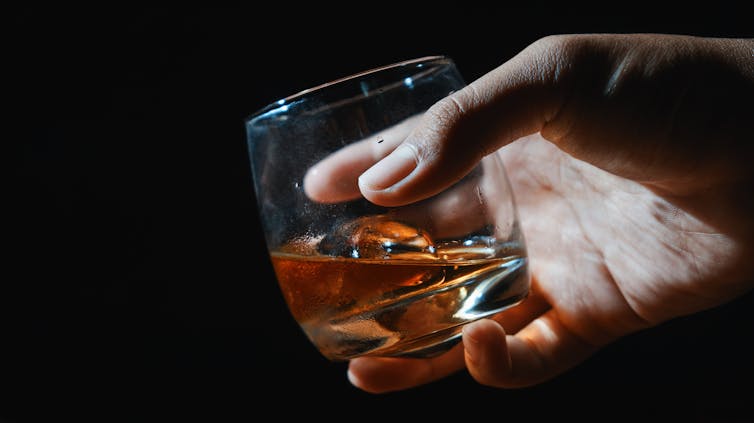
Snifter glass with amber liquid on its side against dark background
Reducing your alcohol consumption can reduce your risk of cancer. mordyashov_aleks/500px via Getty Images
Alcohol can also directly affect hormone levels in ways that increase cancer risk. For instance, estrogens can increase breast cancer risk. Moderate alcohol drinking can both elevate estrogen levels and promote further drinking. Alcohol also amplifies breast cancer risk by reducing levels of vitamin A, a compound that regulates estrogen.

People who drink and smoke have an elevated risk of developing cancer of the mouth, pharynx and larynx. Alcohol makes it easier for the body to absorb the carcinogens in cigarettes and e-vapes. Smoking by itself can also cause inflammation and induce free radicals that damage DNA.

How much alcohol is safe?
You may be wondering how much alcohol you can safely drink and avoid harm. If you ask clinicians and scientists, you might not like the answer: none.

The Centers for Disease Control and Prevention and American dietary guidelines recommend consuming no more than one drink a day for women and no more than two drinks for men. The National Institute for Alcohol Abuse and Alcoholism and the U.S. surgeon general’s recent advisory have similar recommendations to limit alcohol consumption.

Alcohol consumption is a highly preventable cause of cancer. However, there isn’t currently a way to determine someone’s personal cancer risk from alcohol. Each person’s individual genetic background, lifestyle, diet and other health factors can all influence the effects of alcohol on tumor formation. Nevertheless, rethinking your alcohol drinking habits can help protect your health and reduce your cancer risk.The Conversation ■

Note: The author of this piece Pranoti Mandrekar is Professor of Medicine, UMass Chan Medical School. This article is republished from The Conversation under a Creative Commons license. Read the original article.

US alcohol deaths remain elevated

April 7, 2025

US deaths caused entirely by alcohol were still 17% above prepandemic levels last, despite a 5% year-on-year fall, according to provisional CDC figures. The final figure is likely to be higher once additional data filters in. Such alcohol induced deaths surged to 39% percent above the pre-pandemic level in 2022. The Trump administration, meanwhile, is making cuts to public health initiatives and research intended to cut alcohol harm which critics describe as “severe”. Over 70% of alcohol deaths deaths were among men with the percentage peaking at 75% at between 65 and 74 (see table). ■

  • « Go to Previous Page
  • Page 1
  • Interim pages omitted …
  • Page 4
  • Page 5
  • Page 6
  • Page 7
  • Page 8
  • Interim pages omitted …
  • Page 44
  • Go to Next Page »

Copyright © 2026 · Phil Cain Impressum