• Skip to main content

Alcohol Review

Alcohol understanding for all

  • Highlights
  • AR2026
    • AR2025
    • Earlier events
  • Register
  • About
    • Organisers
    • Contact
  • Log In

alcohol

Exclusive: Alcohol safety labelling “grace period” kept quiet for 22 months

January 10, 2024

The UK government kept quiet for 22 months about the “grace period” it gave alcohol suppliers to omit the official safety guidelines, Alcohol Companion has discovered.

The department agreed the alcohol industry could omit the information from labels until September 1st this year in March 2017, only formally telling the public of the deal in January this year.

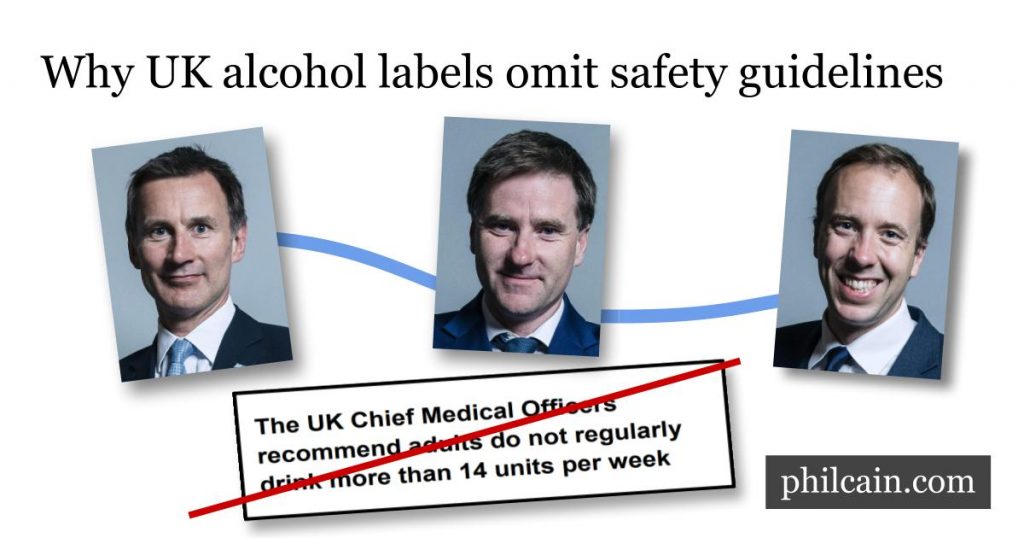
The deal was struck under Jeremy Hunt (left), who was thwarted in a bid to become prime minister this week. Hunt handed over the health department reigns to fellow would-be leader Matt Hancock (right) last summer.  

The silence meant even the most informed onlookers were taken-aback when Alcohol Companion revealed the alcohol industry had suddenly dropped the guidelines from its voluntary code in October 2017.

The grace period first became a matter of public record in January thanks to a speech to parliament by Steven Brine (below), who started as a junior minister three months after the little-known pact.

Health minister gives UK the alcohol
 industry until September to introduce health guideline labelling

The health department says an eagle-eyed observer might have inferred the industry had been offered the delay in labelling from a Food Standards Agency update issued in September 2017.

It also says it issued guidance on how to communicate the low-risk guidelines at the same time as it quietly agreed the alcohol industry could have 30 months more omitting them.

“We are starting to see more products with labels that reflect the new guidelines and the department will continue to work with industry to implement the guidance,” the department said.

Only around 14% of alcoholic drinks labels tell consumers of the 14 UK unit (140ml) a week guideline, according to a BBC Panorama investigation into the issue last month.

The guideline was first introduced in January 2016. As few as one-in-six UK consumers know it. ■
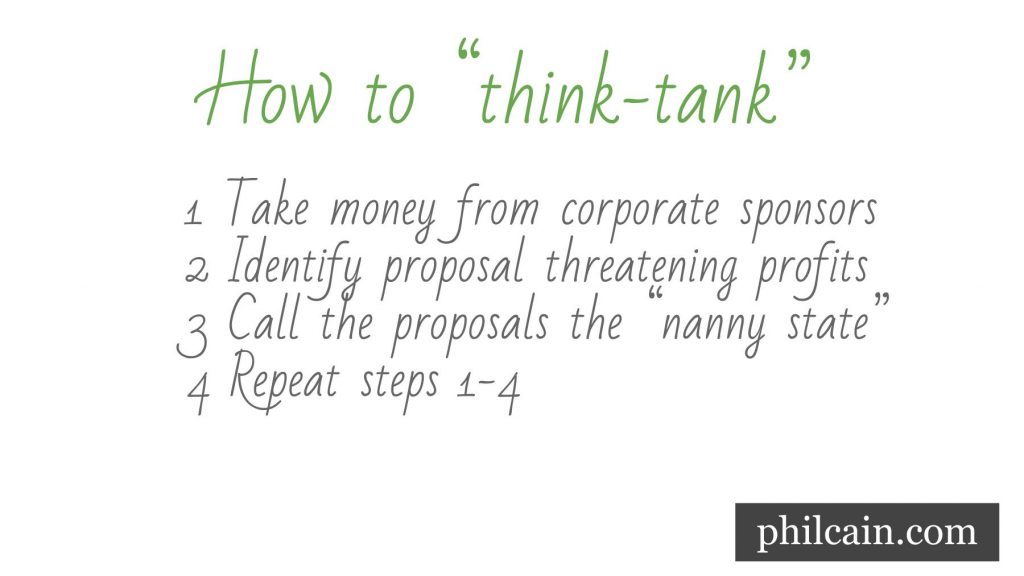
How to think-tank

January 10, 2024

DIY alcohol label idea

January 10, 2024

Why I wrote a second alcohol book

January 10, 2024

One book on alcohol is enough, surely? Well, not quite, which is the reason I recently put out Alcohol for Nerds, a slim compilation of self-contained pieces on alcohol. Here’s why.

The alcohol science presented in Alcohol Companion produced many useful answers, at least for me. But it also raised many difficult questions.“Don’t drink, don’t smoke, what do you do?” as Adam Ant neatly put it in 1982.

With Ant’s queries still echoing my mind after my first book I felt I should at least try to offer a few solid answers. There is the recreational vacuum Ant notes, but also the ingrained beliefs and ideas to re-mould.

The science makes it abundantly clear, for instance, that drinking alcohol to deal with tension, low mood, shyness or to gain inspiration is liable to backfire. But then, what do we do? In Alcohol for Nerds, I explore some alternatives, like learning improv, soothing my woes by plunging myself in icy water and taking imaginative flights of fancy through psychogeography.

It is also clear that the sense of freedom we get from alcohol has the fundamental flaw of coming with a disabled brain. But what is the alternative? There are performance skills, as I found. And we can also broaden our ideas of freedom. Freedom is not just about lowering barriers to commerce, it is also about self-realisation and an absence of dependence.

The science I explore in Alcohol Companion has universal implications, but the way we deal with these implications does not need to be universal. Alcohol for Nerds is the product of me, a nerd, wrangling with the issues it raises for the last four years. I hope the results are of some help.

There are many other perspectives on this which each chime with different people. They have one thing in common: there can be few more concrete ways to improve our mental and physical health, and our personal finances than to come to terms with consistent low-risk drinking.

With a pandemic running riot, this is, perhaps, a uniquely good time to give it a try. ■

Massive public support for alcohol labelling

January 10, 2024

The UK public overwhelmingly supports experts’ calls for consumers to be given nutritional information, alcohol content and the official low-risk guidelines on alcoholic drinks.

“Why should alcohol continue to be exempt?” asks Sir Ian Gilmore, head of the Alcohol Health Alliance (AHA), pointing out that all other forms of food and drink must offer consumers such basic information.

Three-quarters of Brits want to be told the number of units in a product, something they currently have to work out, says a Yougov survey for the AHA. Two-thirds want calorie information and half sugar levels.

Three-quarters of people also want to be told the official low-risk guidelines of 14 units (140ml) a week, according to a regional survey by AHA member Balance North East.

The alcohol industry’s marketing body Portman Group abruptly dropped the UK’s official low risk guidelines from its labelling standards in 2017. Its promises to return them to all labels have not been fulfilled

The public also said being told the official low-risk guidelines was essential if unit information is given in a Royal Society for Public Health survey in 2018. And 86% said they used labels.

The new survey forms the backbone of a letter co-signed by 94 health experts calling for better alcohol labelling. Its intended recipient is Health Secretary Matt Hancock who took over the role 2018.

The letter also points out that than only one-in-five people in the UK know the five-year-old official drinking guidelines, and only one in ten yet identify cancer as a health consequence of alcohol. ■

Some young Nigerians say heavy drinking is fun: controls must keep pace with culture

January 10, 2024

by Emeka Dumbili, Lecturer, Nnamdi Azikiwe University

Alcohol consumption has a long history in Nigeria, especially in the southern region, where it was not forbidden by religion. In the past, only adult men were culturally allowed to drink. It was taboo for young people to drink alcohol because it was generally believed that “drinking was a sign of being an elder”.

Alcohol served multiple societal functions in the past. It flowed during celebrations and significant events. These included chieftaincy enthronements, new yam festivals, child naming ceremonies, and even funerals. Although drinking was central to almost every social gathering, intoxication was forbidden. Intoxicated drinkers were punished by the community elders, as a deterrent to others.

With help from the British colonial government, Nigeria’s drinking culture changed, ditching abstinence and moderation. The British colonial government relied heavily on revenue from alcohol taxes and levies. To increase their cash-flow, the British encouraged the availability and heavy drinking of imported alcoholic beverages. When Heineken-owned Nigerian Breweries and Guinness Nigeria were established in 1946 and 1962, their marketing targeted women and young people. Their marketing departments drove sales by associating alcohol consumption with modernity and sexual enhancement.

Nigeria is a key market for competing multinational alcohol companies. To gain market share, these companies have developed sophisticated and aggressive marketing methods targeting young people, including adolescents. Alcohol availability has tripled, and so has the number of heavy drinkers. Consequently, alcohol-related problems are also rising. Alcohol is associated with problems such as cancer, violence, sexually transmitted infections and truancy.

Nigeria lacks alcohol control policies. Alcohol production and marketing are largely unregulated. Multinational alcohol producers often employed marketing strategies outlawed in their countries of origin, to sell their brands in Nigeria. The results are evident. Research has shown that abstinence and moderate drinking are now uncool, and heavy drinking and intoxication make good badges of honour in Nigeria.

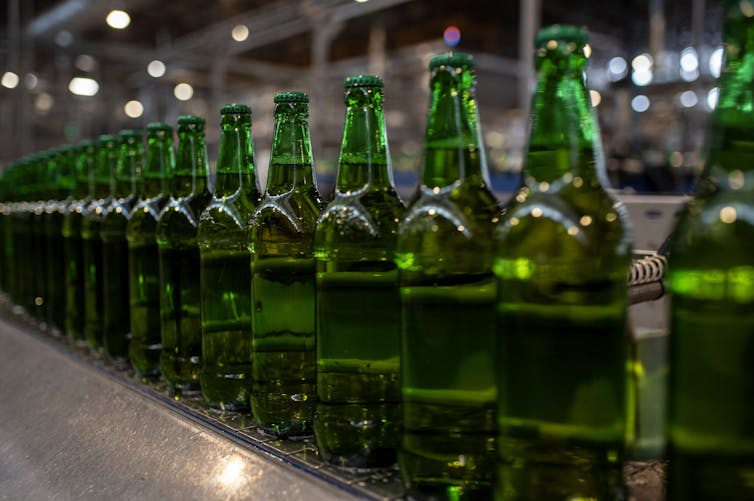
A man wearing a hat and reflector jackets in a large warehouse.
A worker monitors bottles on the production line at a beer factory, in Ogun State, Nigeria.
Stefan Heunis/AFP/Getty

In my recent research, I examined why adolescents and young adults in Nigeria drink heavily, and why they consider it a source of fun or pleasure. I also recorded whether they saw heavy drinking as rebellion against traditionalist values. My research is important because it shows treating alcohol use as pathological, and denying pleasure-seeking as a motive for drinking, is no longer tenable in contemporary Nigeria. The study also shows that understanding these changing motives for drinking could inform interventions that target harmful drinking practices.

Deliberate intoxication for fun and pleasure
I interviewed 72 young people aged 18-24 years, who live in Benin City, Nigeria, to understand their perspectives. Most of the participants were students. They all agreed that drinking alcohol was fashionable in communities of young people. Sobriety was considered obsolete, and deliberate over-consumption of alcohol was common. The reason they gave was that young people just want to feel drunk.

According to my study, fun and excitement – directly and indirectly – were acceptable reasons for heavy drinking and intoxication. Individuals didn’t consider the associated reduced mental control a big deal.

I took whisky; I wanted to drink to stupor. I wanted to see how it felt like to be really drunk and misbehaving; that was my aim of drinking that way. So I drank and drank and drank until (I became drunk).

Another added:

There was a day I took one full glass of (Johnnie Walker) Red Label (40% alcohol by volume), and in less than 10–15 min, I couldn’t feel myself again. I could barely walk, my friend took me home … To me, it was fun. I felt the way I have never felt before, so that is fun … it was exciting because friends will now remind you that this was what you did and you cannot remember.

There are also gender aspects to youth drinking culture. Female participants who were filmed while drunk considered the clips hilarious. Male participants said they took turns in providing alcohol for members of their friendship networks. This practice is generally believed to strengthen friendship bonds. Although providing alcohol may in part be a means of reenacting the male-dominated traditional drinking practice in contemporary Nigeria, it also led to heavy drinking and intoxication.

Surprisingly, these youths believed they had not breached any social norms by drinking to intoxication. But they did admit it all came at a cost. Some had experienced negative events like hangovers, injuries, violence, and missing key academic tests while passed out from alcohol consumption.

Solution to drinking problems
The current lack of alcohol policies in Nigeria only serves the interests of alcohol producers to the detriment of public health. Even though alcohol is a legal drug, increasing evidence has shown that no amount is risk-free.

Policymakers should focus on providing information on low-risk drinking measures for legal drinkers. Tailored, evidence-based interventions that discourage heavy drinking and support safe drinking norms or abstinence should be developed in Nigeria.

Interventions should draw from the elements of local drinking cultures that prohibit heavy drinking and intoxication. Given the prominent role of friendship networks, policymakers should develop interventions using such platforms to promote safe consuming cultures and other pleasurable activities with zero or low risk.

The World Health Organisation has also developed effective strategies called SAFER to reduce alcohol abuse and related harm. Nigeria could also adopt similar measures.The Conversation ■

This article is republished from The Conversation under a Creative Commons license.

  • « Go to Previous Page
  • Page 1
  • Interim pages omitted …
  • Page 11
  • Page 12
  • Page 13
  • Page 14
  • Page 15
  • Interim pages omitted …
  • Page 22
  • Go to Next Page »

Copyright © 2026 · Phil Cain Impressum