• Skip to main content
  • Skip to primary sidebar

Alcohol Review

Alcohol understanding for all

  • Highlights
    • Messages
    • Newsletters
    • AR Live
  • Events
    • AR2026
    • AR2025
    • Next year’s event
    • Earlier events
  • Join
  • About
    • Organisers
    • Contact
  • Log In

alcohol

Record alcohol deaths follow service cuts

January 10, 2024

Jonathan Ashworth, Shadow Health Secretary

Services for people with alcohol and other drug problems in England and Wales saw budgets cut 15% in the three years to last year, when associated deaths hit record numbers.

A record 7,423 people in England and Wales died from alcohol-specific causes and 4,561 people died from causes related to drug poisoning, another record.

“It is unacceptable public health services that tackle alcohol and drug addiction are left so weakened because of deep cuts when we know that they can cause huge harm and death,” said Jonathan Ashworth MP, Labour’s Shadow Health Secretary.

Council spending on services to prevent them, meanwhile, fell to £690m from £762m in 2017, 15% after inflation, says analysis by the House of Commons Library for the Labour Party.

Four councils saw real-terms cuts in alcohol and drug services of over 40%, namely Medway, namely South Tyneside, Staffordshire and Wiltshire. Only ten saw a spending rise on these services.

“Treatment is essential to help those with alcohol dependence towards recovery but has long been underfunded and inaccessible to many,” said Professor Sir Ian Gilmore, Chair of the Alcohol Health Alliance UK. ■
CAMRA launches minimum alcohol price investigation

January 10, 2024

The leaders of a UK organisation representing traditional pub and ale enthusiasts have decided to hold an investigation into the effects of minimum alcohol pricing.

The move comes in response to a motion passed at the Campaign for Real Ale (CAMRA) annual conference in Dundee last month calling for the organisation to back the “urgent introduction” of minimum pricing in England, after it was introduced in Scotland last year.

“The national executive are carrying out further investigation into the issue to determine the best way to deliver the decision taken by conference,” a CAMRA spokesperson said. “We are unlikely to have any different updates imminently.”

Alcohol has retailed for more than 50p ($0.66) per 10ml UK unit in Scotland since May last year. Supporters hope it will curtail the drinking of very heavy drinkers who gravitate towards cheap sources of alcohol. In England the price per unit starts at 16p.

The price of beer sold in pubs is unaffected by minimum pricing, typically being more than three times the 50p minimum price. Supporters within CAMRA argue minimum pricing may help counter the decline of British pubs by narrowing the price gap with supermarkets.

Others do not see it this way, saying on social media the pro-minimum price motion panders to “anti-alcohol” forces, threatening to cancel their CAMRA memberships. Some, however, wonder if an appreciation of untainted liberal economics is a necessary part of appreciating traditional beer.

Help may be at hand. An initial evaluation of the short-term economic impact of minimum pricing in Scotland is due later this year. And some insight into its effectiveness in achieving its goal of reducing harmful drinking is expected next year.

The conference also saw the arrival of a new CAMRA chairman, Nik Antona. ■

Visualising alcohol’s calories

January 10, 2024

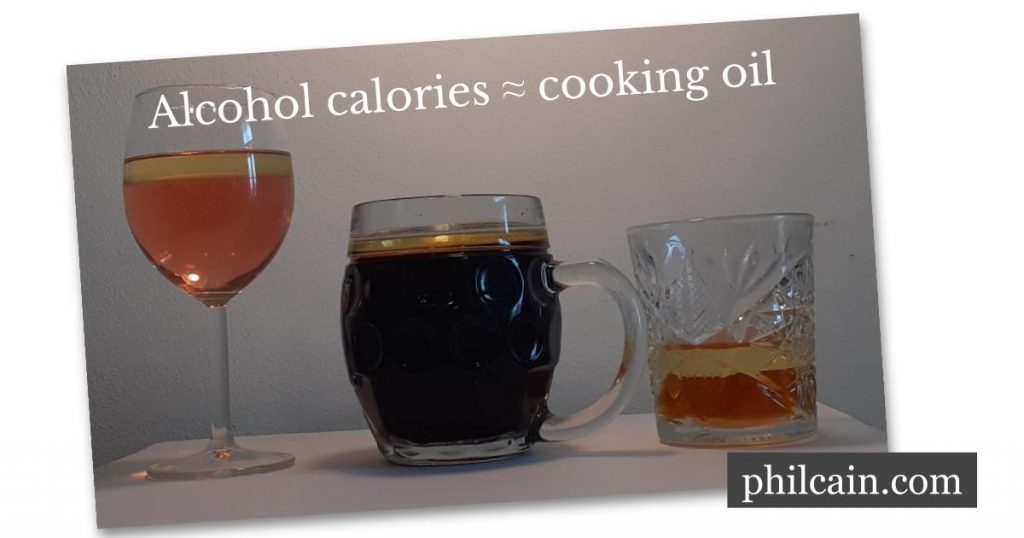
One way to visualise alcohol calories is to see it has has roughly the same amount as oil 5-9cal/ml. So 500ml of 5% lager alcohol contributes roughly the same as 25ml of oil, ~200 calories. And in a 75ml bottle of, say, 12% wine alcohol contribute about as much as 90ml of oil, 700 calories.

This high level should not be too surprising, given that alcohol is manufactured from sugar, again roughly the same order of calorie density. Part of Victorian doctors’ mistaken enthusiasm for prescribing alcohol was it provided weakened invalids with a “clean” source of energy.

It’s by no means perfectly accurate, but it is a reasonable way to get a feel for it, in the absence of clear labelling. ■

Brits back youth alcohol ad ban amid record deaths

January 10, 2024

Over three-quarters of Brits want laws to limit the exposure of children and young people to alcohol advertising amid record alcohol deaths across the country.

The alcohol death toll is highest among older, heavier drinkers whose intake increased under the strain of the covid-19 crisis. Stopping alcohol marketing to under-18s could help curb future problems.

Alcohol is not part of the government’s plans to stop junk food advertising online and stop TV ads for it before 9pm in 2023, despite killing record numbers of British people in 2020.

“If alcohol is not included in the plans, we risk alcohol advertising filling the void that is left behind,” said Professor Sir Ian Gilmore, head of the Alcohol Health Alliance, of the survey done by YouGov for Action on Smoking and Health.

The survey found 77% support a ban on advertising alcohol to children and young people, with 70% supporting a ban on TV ads before 9pm, and 72% a ban on cinema ads for films for under 18s, the legal drinking age.

Another 57% of the 12,000 surveyed support a ban on alcohol advertising in public spaces such as streets, parks and on public transport. Parents have little control of the messages their children see outside the house.

Advertising is done to make products as desirable as possible to maximise sales. Consequently alcohol advertising is causally linked to earlier and riskier alcohol use among young people, with the vast majority seeing it.

Alcohol marketing in the UK is informally overseen by the alcohol and advertising industries themselves, and in special cases Ofcom, a government body. The alcohol industry says genuine regulation is unnecessary.

Others disagree. “Limits on the marketing can help prevent young people’s relationship with alcohol being influenced by advertising,” said Richard McVey of Aquarius, which helps young people with alcohol and other drug problems.

“We need comprehensive restrictions on alcohol advertising across multiple media, including restrictions on sponsorships and activities targeting young people,” said the Alcohol Health Alliance.

The placement of alcohol brands in nominally non-commercial content of TV and films raises yet more complex issues. This may lie beyond the scope of even a legally-empowered advertising regulator. ■

Note: You can explore this topic through the Alcohol in the Media event, with expert presentations from researchers Alex Barker and Amanda Atkinson, and Alison Douglas, head of the charity Alcohol Focus Scotland.

Alcohol worsens disadvantages

January 10, 2024

With a welcome spotlight being shone on rising inequality this week it is worth noting that alcohol makes it harder for poorer people to succeed in a game already heavily weighted against them.

This fact is not as widely acknowledged as it should be. A large charity told me to call elsewhere because it focuses on poverty not alcohol. Of course, specialism is necessary, but not when it means neglecting clear links. Luckily it seems they will not be ignored much longer.

On the radar
“One cause for concern is a rise in ‘deaths of despair’” said the IFS Deaton Review, launched in the UK this week, referring to deaths from suicide, drug and alcohol overdose and alcohol-related liver disease. They have overtaken deaths from heart disease in recent years (see chart).

Of course death is the most stark outcome. With luck, the review’s army of sociologists, demographers and epidemiologists will also shed light on a myriad more nuanced inequalities to which alcohol contributes. As the Alcohol Change UK campaign pointed out alcohol harms poorer people more in many other ways.

Poorer people tend to live with fewer healthcare facilities, more crime, more stress and higher levels of alcohol availability, so slipping more easily into heavy drinking. The middle classes have their difficulties, but generally nothing to compare with the perils faced by people struggling to get by.

A dicey game
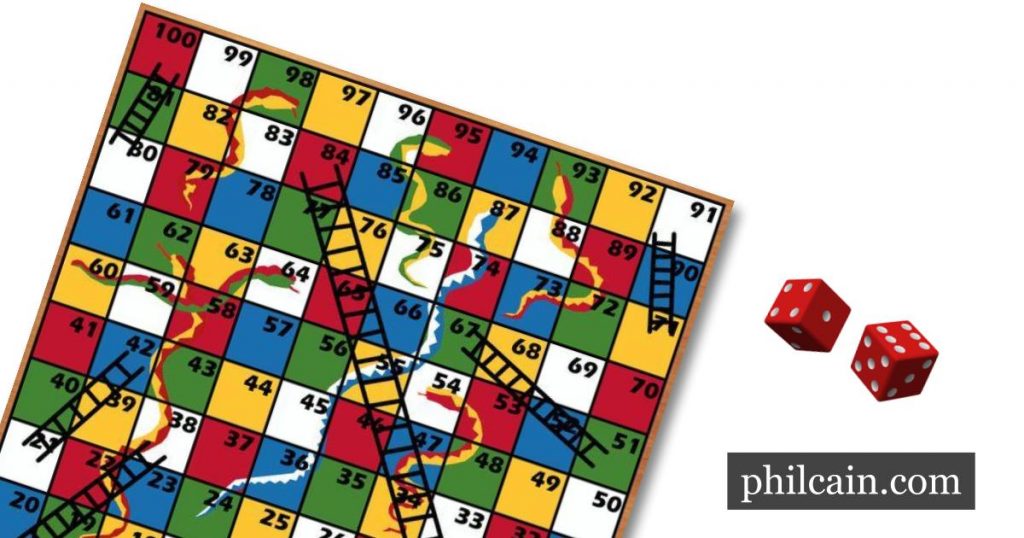
The board game snakes and ladders, or chutes and ladders in the US, can help picture how circumstances alter our chances of success or mishap. Each player moves along the board and when landing on a ladder takes a big step up and when they land on a snake they slip a long way down.

But, crucially, we do not all play on the same board. Poorer people start further away from the giddy heights of their terrain. And, to reflect their less fortunate circumstances, they face more penalties and fewer bonuses, so fewer and shorter ladders, and more, longer snakes. Consequently a smaller percentage of poorer people make as much progress.

To make it more realistic we should test a skill to decide whether we necessarily slide down a snake or climb a ladder. Maybe we have to answer an exam question or, something silly like catch a ball in a cup, anything really to mimic a real life test. Adding this extra obstacle simply multiplies the extra difficulties faced by poorer people.

Now, finally, we can add another level of realism to the model, alcohol. Consuming alcohol impairs our skills, judgement and planning, so meaning we fall down even more snakes and can take advantage fewer lucky breaks. Adding alcohol to the equation tips the balance of an unfair game even further against poorer people.

At the same time advertising relentless associates alcohol with success and winning, deliberately obscuring the fact that it is far more likely to increase our chances of losing.

Clear, not less subtle
The “alcohol paradox”, the name often given to the way alcohol disproportionately harms poorer people is unhelpful, adding intrigue to something which is not mysterious. It is not paradoxical that poorer people are harmed more It is simply a testament to the combined effect of more challenging circumstances and substance blunting our abilities.

It is, of course, vital for the review unveiled this week to go beyond this simplistic model and to shed light on the details. But, as a starting point, the reason alcohol tends to compound inequality can be an unfortunate effect everyone can readily understand and find ways to avoid. With luck, more policies will emerge to make it easier. ■

Brits drank less alcohol in early pandemic

January 10, 2024

Brits overall drank less alcohol than usual in the first few months of the pandemic last year, despite scenes of frenzied panic buying.

There was a fall of around 10% in England and Wales and 5% in Scotland in the second quarter of 2020, according to figures published by Public Health Scotland yesterday. But these were just averages.

“Unfortunately we know that some of us—particularly heavier drinkers— have been drinking more. We need to make support available,” wrote Alison Douglas of Alcohol Focus Scotland. 

Average amounts may not have changed much but the average context has. We now drink more often alone at home to soothe anxiety or cheer ourselves up, uses in which alcohol backfires in the longer term.

This means, taking the population as a whole, the dramatic rise in the amount consumed at home was not enough to outweigh the amount they would normally drink in pubs and bars.

In England and Wales men’s drinking on average fell by just under 13% and women’s by 7%. In Scotland the falls were 7% for men and just 1% for women.

What happened in the third and fourth quarters of 2020 is currently unclear, with tax figures suggesting a rise in overall alcohol consumption and industry figures a fall. ■

  • « Go to Previous Page
  • Page 1
  • Interim pages omitted …
  • Page 12
  • Page 13
  • Page 14
  • Page 15
  • Page 16
  • Interim pages omitted …
  • Page 21
  • Go to Next Page »

Primary Sidebar

  • Bluesky
  • Instagram
  • LinkedIn
  • Twitter
  • WhatsApp

Copyright © 2026 · Phil Cain Impressum

Manage Consent
To provide the best experiences, we use technologies like cookies to store and/or access device information. Consenting to these technologies will allow us to process data such as browsing behaviour or unique IDs on this site. Not consenting or withdrawing consent, may adversely affect certain features and functions.
Functional Always active
The technical storage or access is strictly necessary for the legitimate purpose of enabling the use of a specific service explicitly requested by the subscriber or user, or for the sole purpose of carrying out the transmission of a communication over an electronic communications network.
Preferences
The technical storage or access is necessary for the legitimate purpose of storing preferences that are not requested by the subscriber or user.
Statistics
The technical storage or access that is used exclusively for statistical purposes. The technical storage or access that is used exclusively for anonymous statistical purposes. Without a subpoena, voluntary compliance on the part of your Internet Service Provider, or additional records from a third party, information stored or retrieved for this purpose alone cannot usually be used to identify you.
Marketing
The technical storage or access is required to create user profiles to send advertising, or to track the user on a website or across several websites for similar marketing purposes.
  • Manage options
  • Manage services
  • Manage {vendor_count} vendors
  • Read more about these purposes
View preferences
  • {title}
  • {title}
  • {title}
Loading Comments...