• Skip to main content

Alcohol Review

Alcohol understanding for all

  • Highlights
  • AR2026
    • AR2025
    • Earlier events
  • Register
  • About
    • Organisers
    • Contact
  • Log In

alcohol

Some young Nigerians say heavy drinking is fun: controls must keep pace with culture

January 10, 2024

by Emeka Dumbili, Lecturer, Nnamdi Azikiwe University
Alcohol consumption has a long history in Nigeria, especially in the southern region, where it was not forbidden by religion. In the past, only adult men were culturally allowed to drink. It was taboo for young people to drink alcohol because it was generally believed that “drinking was a sign of being an elder”.

Alcohol served multiple societal functions in the past. It flowed during celebrations and significant events. These included chieftaincy enthronements, new yam festivals, child naming ceremonies, and even funerals. Although drinking was central to almost every social gathering, intoxication was forbidden. Intoxicated drinkers were punished by the community elders, as a deterrent to others.

With help from the British colonial government, Nigeria’s drinking culture changed, ditching abstinence and moderation. The British colonial government relied heavily on revenue from alcohol taxes and levies. To increase their cash-flow, the British encouraged the availability and heavy drinking of imported alcoholic beverages. When Heineken-owned Nigerian Breweries and Guinness Nigeria were established in 1946 and 1962, their marketing targeted women and young people. Their marketing departments drove sales by associating alcohol consumption with modernity and sexual enhancement.

Nigeria is a key market for competing multinational alcohol companies. To gain market share, these companies have developed sophisticated and aggressive marketing methods targeting young people, including adolescents. Alcohol availability has tripled, and so has the number of heavy drinkers. Consequently, alcohol-related problems are also rising. Alcohol is associated with problems such as cancer, violence, sexually transmitted infections and truancy.

Nigeria lacks alcohol control policies. Alcohol production and marketing are largely unregulated. Multinational alcohol producers often employed marketing strategies outlawed in their countries of origin, to sell their brands in Nigeria. The results are evident. Research has shown that abstinence and moderate drinking are now uncool, and heavy drinking and intoxication make good badges of honour in Nigeria.

A man wearing a hat and reflector jackets in a large warehouse.
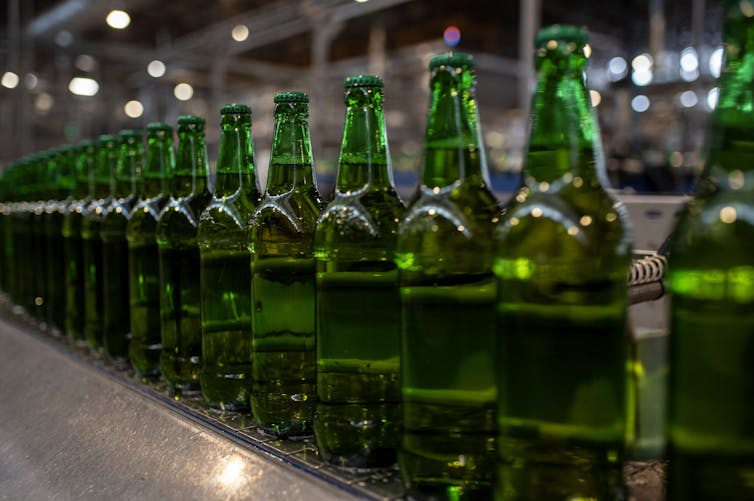
A worker monitors bottles on the production line at a beer factory, in Ogun State, Nigeria.
Stefan Heunis/AFP/Getty

In my recent research, I examined why adolescents and young adults in Nigeria drink heavily, and why they consider it a source of fun or pleasure. I also recorded whether they saw heavy drinking as rebellion against traditionalist values. My research is important because it shows treating alcohol use as pathological, and denying pleasure-seeking as a motive for drinking, is no longer tenable in contemporary Nigeria. The study also shows that understanding these changing motives for drinking could inform interventions that target harmful drinking practices.

Deliberate intoxication for fun and pleasure
I interviewed 72 young people aged 18-24 years, who live in Benin City, Nigeria, to understand their perspectives. Most of the participants were students. They all agreed that drinking alcohol was fashionable in communities of young people. Sobriety was considered obsolete, and deliberate over-consumption of alcohol was common. The reason they gave was that young people just want to feel drunk.

According to my study, fun and excitement – directly and indirectly – were acceptable reasons for heavy drinking and intoxication. Individuals didn’t consider the associated reduced mental control a big deal.

I took whisky; I wanted to drink to stupor. I wanted to see how it felt like to be really drunk and misbehaving; that was my aim of drinking that way. So I drank and drank and drank until (I became drunk).

Another added:

There was a day I took one full glass of (Johnnie Walker) Red Label (40% alcohol by volume), and in less than 10–15 min, I couldn’t feel myself again. I could barely walk, my friend took me home … To me, it was fun. I felt the way I have never felt before, so that is fun … it was exciting because friends will now remind you that this was what you did and you cannot remember.

There are also gender aspects to youth drinking culture. Female participants who were filmed while drunk considered the clips hilarious. Male participants said they took turns in providing alcohol for members of their friendship networks. This practice is generally believed to strengthen friendship bonds. Although providing alcohol may in part be a means of reenacting the male-dominated traditional drinking practice in contemporary Nigeria, it also led to heavy drinking and intoxication.

Surprisingly, these youths believed they had not breached any social norms by drinking to intoxication. But they did admit it all came at a cost. Some had experienced negative events like hangovers, injuries, violence, and missing key academic tests while passed out from alcohol consumption.

Solution to drinking problems
The current lack of alcohol policies in Nigeria only serves the interests of alcohol producers to the detriment of public health. Even though alcohol is a legal drug, increasing evidence has shown that no amount is risk-free.

Policymakers should focus on providing information on low-risk drinking measures for legal drinkers. Tailored, evidence-based interventions that discourage heavy drinking and support safe drinking norms or abstinence should be developed in Nigeria.

Interventions should draw from the elements of local drinking cultures that prohibit heavy drinking and intoxication. Given the prominent role of friendship networks, policymakers should develop interventions using such platforms to promote safe consuming cultures and other pleasurable activities with zero or low risk.

The World Health Organisation has also developed effective strategies called SAFER to reduce alcohol abuse and related harm. Nigeria could also adopt similar measures.The Conversation ■

This article is republished from The Conversation under a Creative Commons license.

Mental illness and substance use: the two often go hand in hand so why is it so difficult to get help?

January 10, 2024

by Simon Bratt, Staffordshire University

Sam Wordley

In the UK it’s estimated that 86% of people who access treatment for alcohol use experience mental health problems. Similarly, 70% of people in treatment for drug dependency also have a mental illness. For those people that report coexisting mental health difficulties, depressive and anxiety symptoms tend to be the most common.

Often people with substance use issues find getting help for their mental health is difficult and frustrating – as there’s often the view from mental health professionals that patients need to stop using drugs or alcohol before they can access treatment.

But herein lies the problem because, for many people, using a substance can be the way they cope – or mask mental health difficulties. Asking them to stop using drugs or alcohol means taking away their coping strategy and without immediate support it’s likely that person will return to using substances to cope with psychological distress.

This often leads to a revolving-door scenario, whereby the person will ask for support from mental health services only to be told to stop using substances. They stop using substances but can’t get support for months thanks to long waiting lists, so end up returning to substance use to cope.

‘Dual diagnosis’
Someone with both a mental illness and substance use disorder is considered to have a “dual diagnosis” – a concept that emerged in 1990. Back in 2002, the Department of Health reported that supporting people with dual diagnosis was one of the biggest challenges facing frontline mental health services.

The report highlighted how fragmented care leads to people falling between the cracks in services. It warned that “patients should not be shunted between different sets of services or put at risk of dropping out of care completely”.

The report also stated that people with dual problems deserve high-quality, patient-focused and integrated care, which should be delivered within mental health services. But 18 years on from these findings, sadly nothing has changed – if anything things have got worse.

Treatment and recovery
As part of my ongoing PhD research, I sent a freedom of information request to every mental health trust within England. I wanted to find out if high-quality and integrated care exists for people with a dual diagnosis.

Man holds his head in his hands.

Many suicides involve people with mental health problems and substance dependency. Viajero/Pexels

The results show that only 58% of the NHS trusts record data about people with a dual diagnosis and that only 28% of those trusts had specific teams that offered treatment. The remaining trusts outsourced treatment to voluntary or private sector substance use services. This means that where you live affects the type of care you will be given – creating a postcode lottery for people trying to access support and treatment.

From the data I collected, only 11,486 UK patients were recorded to have a dual diagnosis. Yet it’s estimated that 586,780 people are alcohol dependent in the UK – so it’s likely that the real figure is far higher.

A crisis on the frontline
There are several reasons why the data collected is not a true reflection of the prevalence of dual diagnosis – and one reason is the term itself. There isn’t a clear definition of “dual diagnosis” – and services often develop their own local word or use the term “co-occurring mental illness and substance use” instead.

Another reason is that people with a substance dependency may not go to the doctors for help with their mental health for fear of being rejected. Hearing the words: “We can’t treat your mental health if you are using substances” is becoming the norm for people with a substance use. This discrimination and stigmatisation puts people’s lives at risk.

Woman sitting by window with cup of tea

People can fall between the cracks and struggle to access any help or support. pexels/sarah dietz

COVID-19 has presented significant challenges to UK healthcare systems and public health policies. Disruption has led to community-based services grinding to a halt due to the redeployment of healthcare workers and quarantine restrictions. People with a dual diagnosis not only suffer from their mental health and substance use, but most will also have multiple needs. Some will have experienced significant trauma, live in poverty, may be known to the criminal justice system and have little or no support in the community.

Research has shown how past crises significantly affected the more vulnerable in society, leading to an increase in substance use. So it would be remiss to think that mental health difficulties and substance use will not increase in the wake of the pandemic. In fact it runs the risk of overwhelming an already exhausted NHS.

This is why an integrated approach to care is needed, as well as a culture change in terms of how healthcare professionals work with and treat people with mental health problems and substance use. The stigma must be banished now – before it’s too late.The Conversation ■

Simon Bratt, Mental Health Social Worker and PhD Candidate, Staffordshire University

Note: This article is republished from The Conversation under a Creative Commons license. Read the original article.

Alcohol shows ways we can improve

January 10, 2024

I started writing about alcohol nearly seven years ago now. Little did I imagine I would still be hard at it today. “Why are you?” you may well ask.

Well, for one, alcohol problems still kill 3m a year globally, playing a role in the untimely demise of one-in-ten people under 50, and bring misery to many millions more. 

That’s a story, even if few seem to care. But, for two, just as important, is that tackling alcohol problems hints at routes to wider renewal when we seem short of ideas.

Alcohol problems arise from an interplay of individuals, social groups, business and regulation. An effort to minimise alcohol harm allows us to imagine ways to improve all four.

As individuals we can learn to make better sense of the misleading first-hand impressions alcohol gives and to identify the half-truths passed to us by word-of-mouth and media.

Alcohol sellers employ populist methods: dubious science, misleading propaganda, uncritical coverage, denying consumers information and opportunistic advertising.

Not being duped can reduce our risk of harm, reduce the chances we harm others, slash our overheads, improve our critical thinking, and find upsides typically ascribed to alcohol elsewhere.

Our social groups, meanwhile, are improved by becoming more accepting of differences on this choice. This requires us to develop tolerance and respect to replace of a herd mentality.

On the bigger scale, it means holding elected politicians and nobody else is responsible for alcohol regulation. They cannot be allowed to evade blame for what is their indivisible responsibility.

Fixing the institutional flaws, influence peddling and muddled thinking which allows persistent regulatory failure could form part of a programme of democratic renewal.

The type of principles, laws and institutions which prevent undue commercial influence on alcohol regulation could be applied other vexed areas of government decision-making. 

Alcohol offers a window onto our vulnerabilities as individuals and as societies, and should provide our political leaders with plenty of ideas and inspiration for how to improve lives. 

This is why I think it remains important to write about alcohol. It is unglamorous, awkward and woefully ignored, but it is also a rich source of untapped ideas on how to improve at a time when we badly need them. ■

Little or no alcohol is a good move for our mental health

January 10, 2024

Consistently drinking little or no alcohol is a solid foundation for our mental health. So why don’t we say so?

Alcohol worsens and causes common aggravations like low mood and anxiety, while prolonging our recovery from traumatic events. So why would we make our lives harder?

There is not a one-size-fits-all alcohol guidelines for mental health, but the UK’s low-risk guidelines of drinking no more than 14 units (140ml) a week is, perhaps, a reasonable starting point.

Avoiding drinking entirely can be easier than trying to drink little. So a “sober sprint” like Dry January could be a good way to begin a long-term low-risk drinking lifestyle.

Finding our bounce
Developing an ability to cope with life’s slings and arrows of outrageous fortune without drinking alcohol tends to be better for our mental health in the long term.

Drinking alcohol has the opposite effect, worsening our mood and increasing our anxiety, although it may seem otherwise. This misleading impression can make it hard to go without it.

This misconception can mean we drink heavily when we suffer more significant traumas, and this may mean we start developing side-effects when we are alcohol-free, including low mood and anxiety.

Drinking more than a small amount of alcohol increases our chances of suffering more psychological discomforts. We are all likely to feel better for reducing this risk.

Drinking little or no alcohol is the best way to spare ourselves such needless mental anguish in the long term. This applies to everyone, regardless of our current drinking habits.

Lost in vaguery
This simple message is seldom clearly expressed. We tiptoe around it rather than simply telling people a simple fact which might spare them discomfort.

Counsellors and other caring professional are often loath to say it to clients, though the reasons for this reluctance are not easy for an outsider to understand.

Some say they do not want to “label” their clients, something they prefer to leave to the medical system. Perceived labelling, they say, would imperil the client-counsellor relationship.

There would also be, one counsellor says, legal risks to giving such advice too. Instead, then, counsellors prefer to point clients with alcohol worries to their GPs.

But patients often do not want to talk to their GPs. And GPs too can be squeamish about talking to their patients about our alcohol drinking, again for fear of dropping a clanger.

Put it straight
Wariness is understandable. But sensitivity should not get in the way of relaying simple information that can help us. The stigma around this advice is born of misunderstanding.

Observing that little or no alcohol drinking provides us the most reliable platform for better mental health applies to us all, regardless labels. ■

The year in alcohol

January 10, 2024

The world continued to bump its way through the covid pandemic, with alcohol playing a fringe role in public discussion, despite inflicting a far heavier death toll than before.

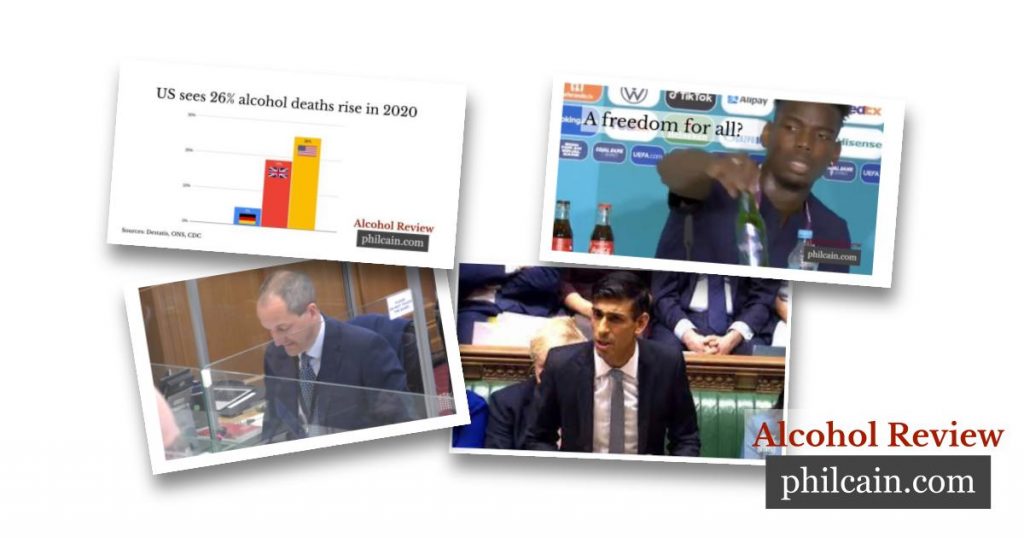
The year ended with the discovery that the US suffered a mystery 26% increase in alcohol-induced deaths last year, according to provisional CDC figures. This is higher than the UK’s 19% and five times the rise in Germany. The unexplained leap is set to be followed by 14% rise this year. The closest thing to an explanation for the US rise is the rise of home delivery.

In November Wales launched the first framework for caring for people with alcoholic brain damage, about 10% of people with dementia. At the same time the alcohol industry boasted that one in five alcoholic drinks in the UK does not include official guidelines, five years after they were introduced.

A lack of adequate labelling partly explains why few Brits know the basic facts about the alcoholic drinks they consume. Just one in five know how many calories are in their alcoholic drinks or know the official low-risk drinking guidelines, a survey found in July.

The UK Budget in October ignored health advice, freezing alcohol tax in 2022. This means prices will fall relative to inflation, so lowering the barriers to deadly levels of drinking despite 2020’s record rise. Tax reforms slated for 2023 were praised, but also leave a loophole for ultra-cheap cider.

There was little positive news for those who might develop alcohol drinking problems. Local government alcohol treatment services have seen their budgets cut by 17% over the last five years, according to Health Foundation figures. Alcohol was not part of its drugs strategy in December.

Not having an alcohol strategy may ultimately prove unpopular, with steps to help to curb future alcohol drinking problems wildly popular among the British public. Three-quarters of Brits want to see curbs on alcohol ads reaching children, an Alcohol Health Alliance survey found in August.

Not having an alcohol policy also runs counter to the government’s goal of “levelling up” society. A third of England’s alcohol deaths were among the most deprived, a Public Health England report said in July. Why, some ask, avoid popular policies and undermine a central manifesto commitment?

The government’s position was first confirmed in April by then health minister Lord Bethell to a parliamentary committee. His wife is a board member of alcohol giant Diageo and Tescos, the biggest UK alcohol retailer. Alcohol Review‘s reporting was followed up by Private Eye. He was removed in September amid controversy over covid contracts.

Among those who might appreciate action to spare media consumers of constant reminders about something we wish to avoid is the newly-sober-curious Queen Elizabeth. In October Vanity Fair reported she is skipping her favoured martinis ahead of her Platinum Jubilee in June.

French footballer Paul Pogba caused a stir in July when he tried to skip endorsing a Heineken-branded alcohol-free beer in a Euro 2020 [sic] press conference. Alcohol Review discovered it may be an option only open to the religious, Alcohol Review , and apparent breach of UN human rights principles.

The end of the covid era may finally be nigh, but only time will tell whether shortcomings that have led to so many more alcohol deaths are corrected or ignored. ■

Alcohol: Why not all use millilitres?

January 10, 2024

We could make alcohol health guidelines easier to picture, calculate and compare internationally by giving them all in millilitres.

We measure oil, water and every other liquid in metric units, so why use 20-odd different units for alcohol?

It is like a throwback to the bygone days in which Europe operated on a bewildering array of measurement systems.

An account of a medieval journey might mean converting the Finnish virsta (Russian or Swedish) to the Rheinland miele. 

This week’s new proposed weekly guideline of saw us scrabbling for the definition of the “Australian standard drink”.

Once converted to 125ml it could be compared easily to the UK one of 140ml, itself normally given in local units.

Offering it to begin with in millilitres would avoid this process, allowing consumers and nerds a ready-made comparison.

It would make recommendations more intuitive too. We can imagine 100ml far more easily than a bespoke unit.

The volume of alcohol is a good guide too, giving a direct picture of the number of molecules it contains, so its effects.

Using millilitres as a standard means only needing to do a one-step calculation to work out a dose, not two or three.

The alcohol present in a drink is just a drink’s alcohol percentage by volume multiplied by its volume. That’s it.

So, for example, in 500ml of 5% beer there is 0.05x500ml of alcohol, or 25ml. 

One large continental lager is, then, a fifth of the Australian weekly low-risk guideline total of 125ml.

Using alcohol specific units, by comparison, we might have two more stages, perhaps converting to mass on route.

We need not drop local units, which some may find helpful, but we could easily add the equivalent amount in millilitres in brackets.

This would be a simple way to reduce barriers in a field in which international cooperation is essential. ■

  • « Go to Previous Page
  • Page 1
  • Interim pages omitted …
  • Page 13
  • Page 14
  • Page 15
  • Page 16
  • Page 17
  • Interim pages omitted …
  • Page 22
  • Go to Next Page »

Copyright © 2026 · Phil Cain Impressum