• Skip to main content
  • Skip to primary sidebar

Alcohol Review

Alcohol understanding for all

  • Highlights
  • Events
    • AR2026
    • AR2025
    • Next year’s event
    • Earlier events
  • Register
  • About
    • Organisers
    • Contact
  • Log In

ar-newsletter

Alcohol Review – issue 92, July 14th 2023

January 10, 2024

Find this service useful?
Please join the Alcohol Review‘s supporters who make it possible

This week: Brits want alcohol-protected policy; CBT may help people with alcohol afflicted people sleep; Court ruling undermines Swedish alcohol monopoly

*Join the WhatsApp Group*

Seven in ten Brits want government policy to be protected from alcohol industry interference and a majority want a ban on alcohol advertising, says a survey for the Alcohol Health Alliance which launched its manifesto in Parliament this week.
https://twitter.com/alcohol_review/status/1678539848272187392

“Cognitive behavioural therapy (CBT) is an effective first-line treatment for insomnia among individuals with alcohol use disorder, regardless of abstinence from alcohol.”
https://twitter.com/alcohol_review/status/1679151249306820613

“Our research confirms that substance use induces long-lasting changes in the inhibitory communication between dMSNs and CINs [neurons], consequently dampening cognitive flexibility.”
https://twitter.com/alcohol_review/status/1679028325946105858

“Sweden’s Supreme Court on Friday said a Danish online wine retailer has the right to sell directly to Swedish households and businesses, in a ruling that could challenge the Nordic state’s alcohol retail monopoly.”
https://twitter.com/alcohol_review/status/1677312959297515521

“The percentage of [Kenyan] men who consume alcohol every day or almost every day decreases from 19% among men in the lowest quintile to 9% among those in the highest wealth quintile.”
https://twitter.com/alcohol_review/status/1676487967781662720

Alcohol Review – issue 93, July 22nd 2023

January 10, 2024

Find this service useful?
Please join the Alcohol Review‘s supporters who make it possible

*For alcohol books and resources, visit the homepage*

This week: US alcohol death surge rolled on; More US states allow teenage bartenders; Alice Springs’ restrictions prolonged; French tax tweak; Rwanda’s “Let’s drink less” campaign. Discussion: We should look more at the big picture.

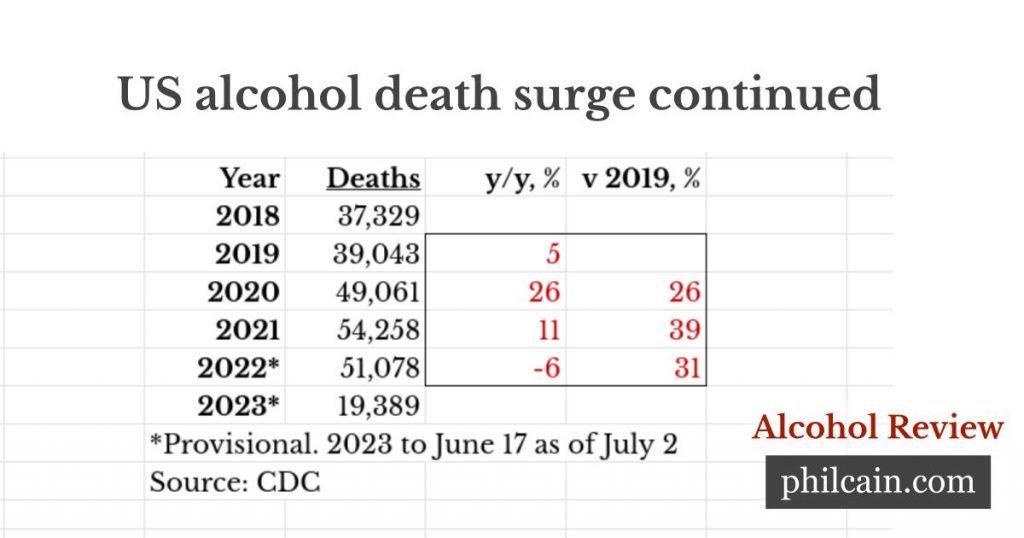
US alcohol death surge rolled on: The surge in US alcohol deaths continued last year with alcohol-induced fatalities at least 31% above pre-pandemic levels, according to the latest CDC estimates. The previous year saw a death toll 39% above pre-pandemic levels. The figure is only likely to increase as new cases are added to the CDC’s tally. It is already 6,000 higher than its February estimate.

More US states allow teenage bartenders: Nine US states have introduced bills to lower the minimum age for serving alcohol since 2021, according to a report by the Economic Policy Institute.

Alice Springs’ restrictions prolonged: Australia’s Northern Territory government will extended takeaway liquor restrictions in Alice Springs for at least the next 12 months, citing a dramatic reduction in harm to the community since their introduction. The local mayor and others, including the alcohol interests, are unhappy with the decision.

French tax tweak: France’s minister of economy told Le Figaro newspaper the government plans to increase alcohol taxes to curb excessive consumption. It appears to be considering a subtle change, indexing alcohol tax to last year’s inflation rather than that of the year before that.

“Let’s drink less” campaign: The Rwandan government this week launched the “TunyweLess”, or “Let’s Drink Less”, campaign in response to a survey showing a significant increase in alcohol consumption.

FASD nightmares: 60% of the children with foetal alcohol spectrum disorder experienced nightmares, while 44% exhibited frequent insomnia symptoms, according to a new study.

Discussion

Let’s look big picture: “It’s pretty clear why people don’t drink–the real question is why do people continue to drink when they don’t want to?” asked journalist Moya Lothian-McLean in a recent Guardian opinion piece. Alcohol Review suggests we should look more at the bigger picture and ways politicians can make healthier choices easier for us.

*For alcohol books and resources, see the homepage*

Alcohol Review – issue 94, August 3rd 2023

January 10, 2024

Find this service useful?
Please join the Alcohol Review‘s supporters who make it possible

This week: Brits now enjoy big savings from alcohol reduction; UK to end to-go alcohol from bars; Alcohol boosts blood pressure; A third of Irish farmers drink harmfully; Ad tracking aid shows promise

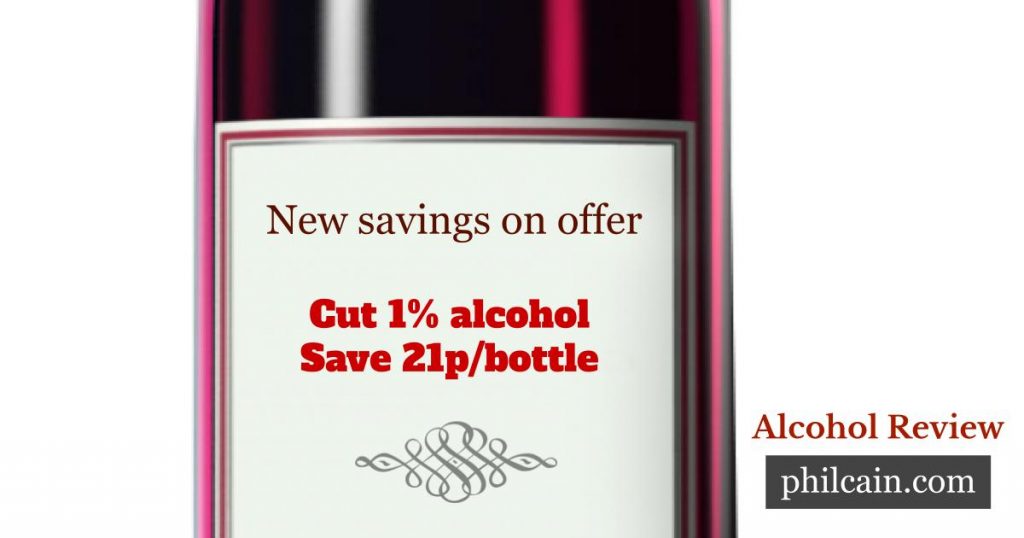
Brits now enjoy big savings from alcohol reduction: UK wine suppliers and their costumers now pay 21p less in tax for every percentage point they cut from any 75cl bottle of wine purchased. This means tax on a 75cl bottle of 9% wine is now £1.92 ($2.44), a 14% fall of 31p from the flat fee of £2.23 charged before August 1st. The old system meant that wines of 14% were charged 40% less per ml of alcohol than wines of 9%, despite posing less risk to consumers’ health. Public health advocates welcomed the new tax structure, as well as taxes rising to match inflation. The wine industry complained that it will lose money under the news system because its current offerings have not adapted to the new tax system. Others say there are no good low alcohol wines. Alcohol Review suggests that some businesses will succeed in profiting where others fail. 

UK to end to-go alcohol from bars: The UK will wind up a scheme to allow pubs to sell to-go alcohol on 30 September, the Home Office has said. It stands in marked contrast to the widespread extension of state level bar off-sales mandates in the US, where alcohol deaths were still up 31% on pre-pandemic levels last year.

Alcohol boosts blood pressure: As little as one alcoholic drink a day increased systolic blood pressure, according to a new study. The study found no beneficial effects in adults who drank a low level of alcohol compared to those who did not drink alcohol.

A third of Irish farmers drink harmfully: One in three farmers in Ireland drink alcohol at harmful levels, according to a new study, and one in 20 takes drugs, with most of them doing so to a risky degree. But 28% do not drink alcohol.

Ad tracking aid shows promise: An artificial intelligence called Zero-Shot Learning has shown promise in recognising alcohol exposures in media, a laborious task normally done by people.

*For alcohol books and resources, see the homepage*

Alcohol Review – issue 95, September 29th 2023

January 10, 2024

Find this service useful?
Please join the Alcohol Review‘s supporters who make it possible

In this issue: Australian alcohol deaths accelerate; Scotland plans minimum price adjustment; UK labelling relaxation; US costs to climb; TV shots off target; Dutch wariness rises

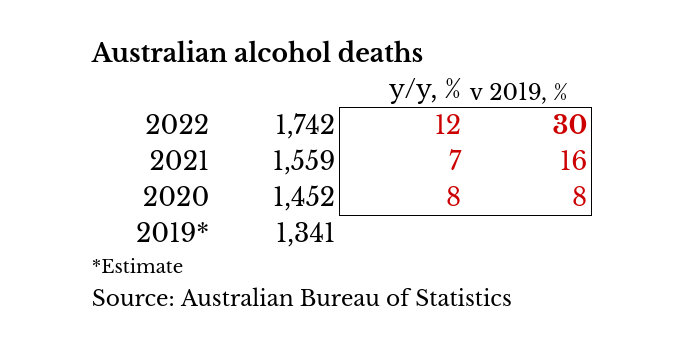
Australian alcohol deaths up 30% since pandemic

The number of alcohol-induced deaths in Australia increased to around 30% above pre-pandemic levels in 2022. They rose 11% year on year, on top of a 7% rise in 2021 and around 8% in 2020.

They are at their highest level for over a decade, a pattern seen in other anglophone countries, which are among the most scrupulous in reporting figures.

“It is absolutely devastating to see the ways that alcoholic products cause so much harm to so many families and communities across Australia. Every person that dies because of alcohol is a life cut tragically short…,” said Caterina Giorgi of alcohol harm NGO FARE Australia.

America’s alcohol death rates were up 31% on pre-pandemic levels in 2022, falling back from 38% above in 2021. Canada’s alcohol deaths were up a fifth during the pandemic, as were the UK’s. Comment/sources

Scotland plans minimum price adjustment

The Scottish Government published plans to increase the minimum unit price of alcohol from 50p to 65p to catch up with inflation since its introduction in 2018.

A study released in parallel said an increase to 60p would reduce the number of harmful drinkers by well over 26,000, while removing the minimum price would increase their number by about the same.

The industry response has so far been muted, focussing on the fact the increase would mean the price of some budget drinks goes up. Comment/sources

UK labelling relaxation

Drinks containing up to 0.5% alcohol could be labelled as “alcohol free” in the UK, as in Australia, Germany, New Zealand and the US. Some wonder if the rule may also allow them to be used to bypass alcohol advertising rules as 0.0 brews now do. Comment/sources

US costs to climb

The annual cost of alcoholic liver disease is expected to more than double to $66bn in the US by 2040. It is projected to cost a total $880bn between now and 2040, $355bn in direct healthcare-related costs, and $525bn in lost labour and economic consumption. Comment/sources

Shots off target

Broadcasters providing coverage of sporting events should avoid ‘problematic’ shots of fans drinking alcohol, a team of researchers said Thursday. The study’s observations were based on watching the Women’s World Cup. Comment/source 

Dutch wariness rises

Some 40% of the 10- 17-year-old in the Netherlands said alcohol was unhealthy, compared with 27% of adults. Those saying alcohol drinking was fun rose from 13% among 10-11-year-olds to over half of those aged 16 and 17. Comment/sources

US insurance denial down

18 US states still have laws allowing companies to deny insurance payments for treatment to people inebriated with alcohol when they were injured, down from 37 in 2004. The number of states explicitly banning the practice increased from three to 15. Comment/sources

Alcohol Review – issue 96, October 19th 2023

January 10, 2024

Alcohol understanding for all

*Get Alcohol books *Join Whatsapp group *Follow live Twitter, LinkedIn

In this issue: Australia expected to consider alcohol warning labels;  UK to lower wine alcohol minimum; High risk drinking treatment guidelines; Alcohol has lessons for cannabis

Australia expected to consider warning labels: The Australian federal government is seeking advice on ways to raise public awareness of alcohol harm, advice which is expected to include warning labels. Nearly 80% would support the move. Australian alcohol deaths are up 30% on pre-pandemic levels, on a par with Canada, the UK and US.

UK government set to lower wine alcohol minimum: The UK government plans to reduce the level of alcohol where a product can be called “wine” below 8.5% to zero . In August it proposed charging tax in line to its alcohol content rather than charging a flat fee per bottle, meaning potential savings of 21p ($0.25) per percentage point less in a bottle.

High risk drinking treatment guidelines: A paper published this month offered 15 recommendations for the screening, diagnosis, withdrawal management and treatment of high-risk drinking

Alcohol has lessons for cannabis: There is a lot legislators can learn from alcohol policy in regulating cannabis to “ensure that the power of commercial entities is sufficiently limited through regulation of price, availability and marketing” said the Institute of Alcohol Studies in a new report.

*Get Alcohol books *Join Whatsapp group *Follow live Twitter, LinkedIn

Alcohol Review – issue 97, November 24th 2023

January 10, 2024

Find this service useful?
Please join the Alcohol Review‘s supporters who make it possible

*Get Alcohol books
*Join Whatsapp group
*Follow live on Twitter, LinkedIn

In this issue: UK cuts taxes fuelling alcohol harm; Japan lays out draft guidelines; Ghanaian civil society supports celeb ad ban; Ireland’s 9pm ad ban begins 2025

UK cuts tax fuelling surge in alcohol harm: The UK government this week made another real terms cut in alcohol tax, despite surging alcohol harm, with alcohol deaths last year 27% above pre-pandemic levels in 2021. It is “utterly frustrating news”, said Professor Sir Ian Gilmore, chair of the UK Alcohol Health Alliance. An early tip-off of the decision to the Sun tabloid and alcohol industry meant almost no criticism was heard.

Japan lays out draft guidelines: Japan set out a draft for its first low risk alcohol guidelines of 50ml a day for men and 225ml for women. They also say, “It is important to keep alcohol intake as low as possible.” The UK guidelines are 20ml a day for both men and women. More research is needed on risk acceptability, said a new commentary.

Ghanaian civil society supports celeb ad ban: Civil society actors in Ghana support the Food and Drugs Authority’s position to ban alcohol advertisements by celebrities which is currently being challenged in court.

Ireland’s 9pm ad ban begins 2025: A ban on alcohol ads appearing on TV in Ireland before 9pm will come into effect on January 10th 2025, the Department of Health said.

  • « Go to Previous Page
  • Page 1
  • Page 2
  • Page 3
  • Go to Next Page »

Primary Sidebar

  • Bluesky
  • Instagram
  • LinkedIn
  • Twitter
  • WhatsApp

Copyright © 2026 · Phil Cain Impressum

Loading Comments...