• Skip to main content
  • Skip to primary sidebar

Alcohol Review

Alcohol understanding for all

  • Highlights
    • Messages
    • Newsletters
    • AR Live
  • Events
    • AR2026
    • AR2025
    • Next year’s event
    • Earlier events
  • Join
  • About
    • Organisers
    • Contact
  • Log In

philcain

Scant progress on global alcohol harm driver

January 14, 2026

Alcohol products were as affordable or became more affordable in most countries over the last few years, when evidence shows that reducing affordability is a crucial step to curbing alcohol harm, found a WHO report released yesterday.

Beer was at least as affordable in 69% of the countries where data was available when prices in 2025 werecompared to two years earlier. For spirits this was the case in 78% of countries. This was often because alcohol taxes failed to match inflation.

“Most alcohol taxes remain low and are not optimally designed,” the report says. Alcohol interests are strongly opposed to raising alcohol taxes because it reduces their profits which derive in large part from higher levels of consumption.
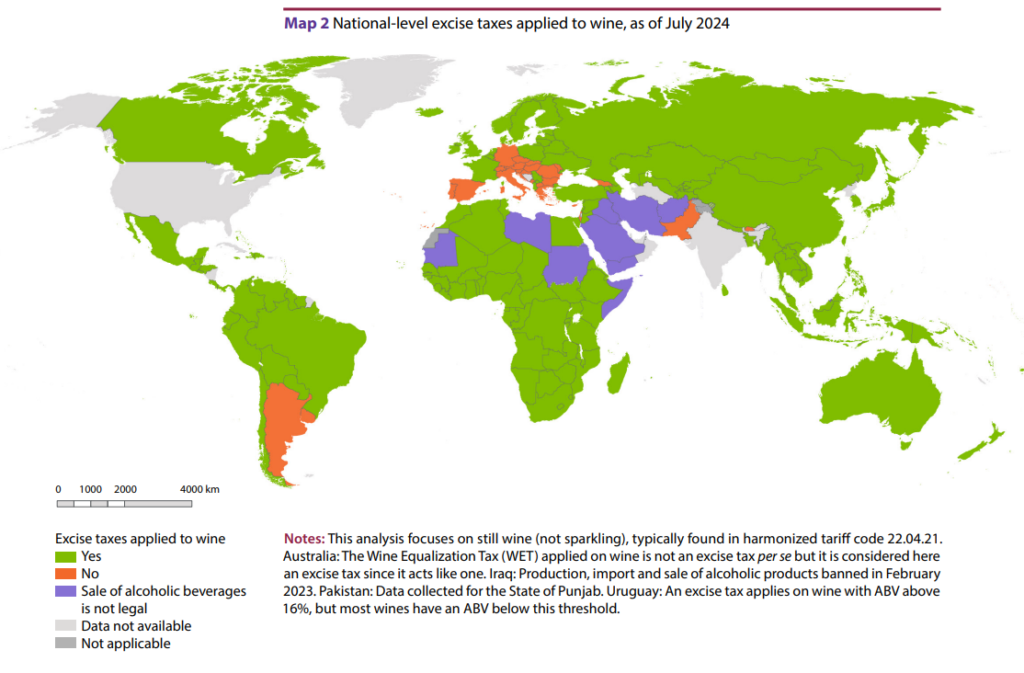
At least 167 of the 181 countries surveyed applied national-level alcohol excise taxes to at least one type of alcohol product, with most of the rest banning the sale of alcohol. Wine is not specifically taxed in 25 countries, 14 of them in Europe (see map).

The WHO launched an initiative called “3 by 35”  in July to encourage countries to reduce the affordability of alcohol, along with tobacco and sugary drinks. It hopes to see real terms price of “any or all” of these products by 50% by 2035. 

The affordability crisis is deeply unpopular, but raising alcohol taxes is not. A Gallup poll across five diverse countries–Colombia, India, Jordan, Tanzania and the US–found 69% support for higher alcohol taxes in 2023. ■
US post-covid alcohol death increase continues

January 13, 2026

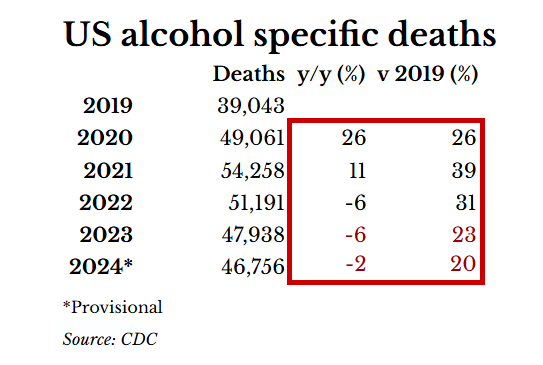
Alcohol deaths surged in the US in the wake of the covid pandemic, peaking in 2021 to almost 40% above the pre-pandemic level (see table). The alcohol death toll in 2024 was still 20% above that seen in 2019, according to the latest provisional CDC data for deaths directly attributable to alcohol. There is still no full-year figure for 2025, but extrapolating the provisional figure of 39,558 for the year to December 6th suggests alcohol deaths are likely to be at least 11% higher than in 2019. Provisional figures typically increase because the CDC data collection network adds to them over time. The provisional figure for 2024 increased by a thousand since Alcohol Review first reported it in April, adding three percentage points in the comparison to 2019. ■

Could you be more specific?

January 10, 2026

Alcohol harm experts this week criticised the Trump administration’s new guidance on alcohol for omitting low-risk amounts in favour of saying “consume less alcohol for better overall health”, leaving consumers to decide what this might mean in practice. Read more. ■

Trump administration drops clear alcohol guidance

January 10, 2026

Secretary of Health and Human Services Robert F Kennedy Jr launching the new 2025–2030 Dietary Guidelines on January 7th

The Trump administration this week advised Americans to “consume less alcohol for better overall health”, dropping specific low-risk amounts from its guidance after 35 years. Alcohol harm experts had recommended the low-risk amount should be halved for men.

Alcohol harm experts say the official dietary guidelines should tell consumers what a low risk amount of alcohol consumption is based on robust statistical research, rather than leave it up to them to decide for themselves.

“The guidelines abandon specific consumption benchmarks—such as the long-standing limits of two drinks per day for men and one for women—leaving consumers without clear, actionable guidance.,” wrote Mike Marshall, CEO of US Alcohol Policy Alliance in an email.

Earlier drafts of the guidelines reportedly kept specific low-risk guideline amounts. Officials from the US Department of Health and Human Services had drafted a proposal to halve the recommended low risk amount of alcohol for men to one standard drink (18ml) a day like for women, said a Reuters news agency report.

The new guidelines also have other flaws, Marshall said, omitting mention of underage drinking, alcohol’s links to cancer.The US lobbing disclosure register shows the alcohol industry spent millions on lobbying efforts over the last two years. Alcohol industry hailed the new guidelines as a victory.

Alcohol deaths in the US were 20% above the pre-pandemic level in 2024 and look to have been at least 10% above in 2025, according to an Alcohol Review estimate based on provisional CDC data. These numbers tend to increase over time as data is gathered from data centres across the country. ■

Opinion: Cutting down? Put alternative activities above alternative drinks

December 30, 2025

Looking to the bottom of alcohol-free drink bottles can only take us so far in any bid to curtail our alcohol consumption. Even alcohol’s bogus answers to life’s problems are not to be found there.

It is true alcohol-free drinks can be tastier and healthier alternatives to sickly soft drinks. This is good. And they can also provide a useful visual prop for places hostile to people not drinking alcohol. But they are not alcohol alternatives.

To genuinely replace alcohol they would need to help us relax, feel rewarded, gain confidence, have fun, feel carefree and be sociable. Alcohol-free drinks will not do this for us. We need to look to alternative activities, not alternative beverages.

The quest for sober satisfaction turns what might be seen as an act of self-denial into one of hedonistic exploration. There are an endless array of new experiences, new skills and new social situations to be had. It is a journey not an event. 

Eleven years ago I was a standard-issue British Gen X weekend binger and then I gave alcohol for a couple of years to inform my book on alcohol. I then stayed off it for another three years, before becoming a low-risk alcohol drinker.

The first month was hard, really hard. It was not nearly enough time to find new activities or to build and find environments which suited me. But it got easier over time, until it was the new normal. One never stops learning how to make it better.

One thing that is perhaps worth sharing is that while it is nice to feel okay as a non-drinker in alcohol drinking scenarios, it is a questionable end goal. Even after more than a decade alcohol drinking scenarios can be okay for a while, but typically it is not where I would want to do for the whole night.

Not drinking alcohol around alcohol drinkers is typically very challenging and is very likely to remain so. We are, after all, literally in a different state of mind. Why fight it? Why not invest all that energy into alternative activities instead?

It is typically far easier for non-drinkers to spend time in alcohol-free environments and make one at home. So why not do that? Dodge the alcohol aisle at the supermarket and filter whatever alcohol ad and media exposure you can.

We deserve the freedom to look for the feelings we might want, be it relaxation, excitement, humour, camaraderie, whatever it might be. There is an likely activity to get closer to all of them and none of them need involve a bottle. ■

Alcohol harm reducers honoured

December 30, 2025

The UK’s New Year’s Honours list today recognised six people working to reduce the impact of alcohol harm, a former frontbench Labour MP, a family judge and four public health directors. 

Jonathan Ashworth, a former shadow health secretary, receives a CBE in part for advocating on behalf of the children of people with alcohol problems for the Children of Alcoholics charity. He made a poignant speech in parliament about his own experiences in 2017.

Judge Patrick Perusko receives a CBE for services to the administration of justice for his work pioneering Family Drug and Alcohol Courts in Bedford and Bedfordshire. He talked about the courts, and his background, in Oct 2021.

The honours list also recognises the work of several directors of public health. Greg Fell, president of the Association of Directors of Public Health (ADPH) and director of public health at Sheffield council, received an OBE.

MBEs went to three more public health directors: Dr Tim Allison, recently retired from NHS Highland; Dr Catherine Mbema at Lewisham council; and Professor Alice Wiseman in Gateshead, who is also vice-president of ADPH. 

Professor Wiseman’s presentation on combatting alcohol industry influence at the local level at AR2025 in March is available on the event page under the heading “Full live plenary sessions”.  ■

  • « Go to Previous Page
  • Page 1
  • Interim pages omitted …
  • Page 8
  • Page 9
  • Page 10
  • Page 11
  • Page 12
  • Interim pages omitted …
  • Page 57
  • Go to Next Page »

Primary Sidebar

  • Bluesky
  • Instagram
  • LinkedIn
  • Twitter
  • WhatsApp

Copyright © 2026 · Phil Cain Impressum

Manage Consent
To provide the best experiences, we use technologies like cookies to store and/or access device information. Consenting to these technologies will allow us to process data such as browsing behaviour or unique IDs on this site. Not consenting or withdrawing consent, may adversely affect certain features and functions.
Functional Always active
The technical storage or access is strictly necessary for the legitimate purpose of enabling the use of a specific service explicitly requested by the subscriber or user, or for the sole purpose of carrying out the transmission of a communication over an electronic communications network.
Preferences
The technical storage or access is necessary for the legitimate purpose of storing preferences that are not requested by the subscriber or user.
Statistics
The technical storage or access that is used exclusively for statistical purposes. The technical storage or access that is used exclusively for anonymous statistical purposes. Without a subpoena, voluntary compliance on the part of your Internet Service Provider, or additional records from a third party, information stored or retrieved for this purpose alone cannot usually be used to identify you.
Marketing
The technical storage or access is required to create user profiles to send advertising, or to track the user on a website or across several websites for similar marketing purposes.
  • Manage options
  • Manage services
  • Manage {vendor_count} vendors
  • Read more about these purposes
View preferences
  • {title}
  • {title}
  • {title}
Loading Comments...