• Skip to main content
  • Skip to primary sidebar

Alcohol Review

Alcohol understanding for all

  • Highlights
    • Messages
    • Newsletters
    • AR Live
  • Events
    • AR2026
    • AR2025
    • Next year’s event
    • Earlier events
  • Join
  • About
    • Organisers
    • Contact
  • Log In

philcain

The year in alcohol

January 10, 2024

The world continued to bump its way through the covid pandemic, with alcohol playing a fringe role in public discussion, despite inflicting a far heavier death toll than before.

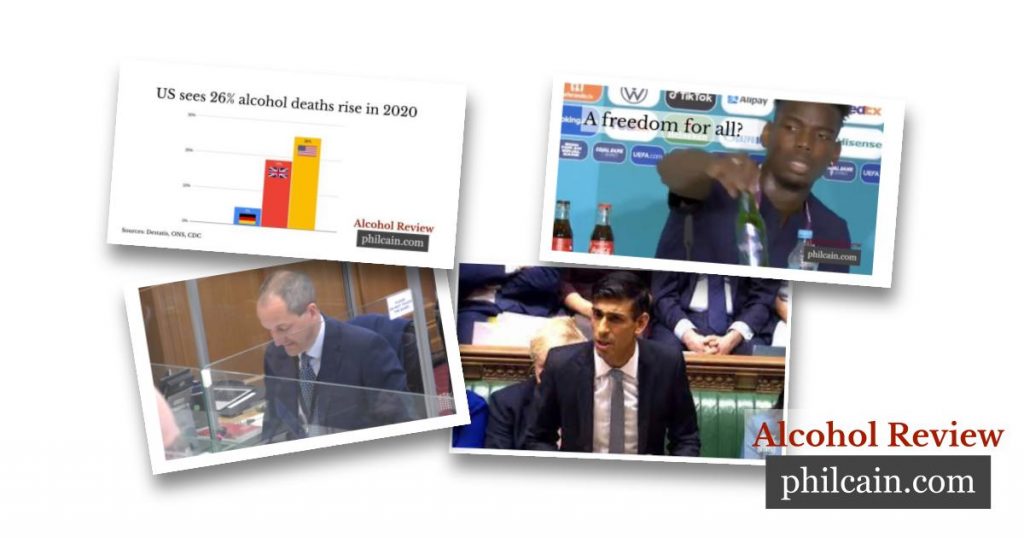
The year ended with the discovery that the US suffered a mystery 26% increase in alcohol-induced deaths last year, according to provisional CDC figures. This is higher than the UK’s 19% and five times the rise in Germany. The unexplained leap is set to be followed by 14% rise this year. The closest thing to an explanation for the US rise is the rise of home delivery.

In November Wales launched the first framework for caring for people with alcoholic brain damage, about 10% of people with dementia. At the same time the alcohol industry boasted that one in five alcoholic drinks in the UK does not include official guidelines, five years after they were introduced.

A lack of adequate labelling partly explains why few Brits know the basic facts about the alcoholic drinks they consume. Just one in five know how many calories are in their alcoholic drinks or know the official low-risk drinking guidelines, a survey found in July.

The UK Budget in October ignored health advice, freezing alcohol tax in 2022. This means prices will fall relative to inflation, so lowering the barriers to deadly levels of drinking despite 2020’s record rise. Tax reforms slated for 2023 were praised, but also leave a loophole for ultra-cheap cider.

There was little positive news for those who might develop alcohol drinking problems. Local government alcohol treatment services have seen their budgets cut by 17% over the last five years, according to Health Foundation figures. Alcohol was not part of its drugs strategy in December.

Not having an alcohol strategy may ultimately prove unpopular, with steps to help to curb future alcohol drinking problems wildly popular among the British public. Three-quarters of Brits want to see curbs on alcohol ads reaching children, an Alcohol Health Alliance survey found in August.

Not having an alcohol policy also runs counter to the government’s goal of “levelling up” society. A third of England’s alcohol deaths were among the most deprived, a Public Health England report said in July. Why, some ask, avoid popular policies and undermine a central manifesto commitment?

The government’s position was first confirmed in April by then health minister Lord Bethell to a parliamentary committee. His wife is a board member of alcohol giant Diageo and Tescos, the biggest UK alcohol retailer. Alcohol Review‘s reporting was followed up by Private Eye. He was removed in September amid controversy over covid contracts.

Among those who might appreciate action to spare media consumers of constant reminders about something we wish to avoid is the newly-sober-curious Queen Elizabeth. In October Vanity Fair reported she is skipping her favoured martinis ahead of her Platinum Jubilee in June.

French footballer Paul Pogba caused a stir in July when he tried to skip endorsing a Heineken-branded alcohol-free beer in a Euro 2020 [sic] press conference. Alcohol Review discovered it may be an option only open to the religious, Alcohol Review , and apparent breach of UN human rights principles.

The end of the covid era may finally be nigh, but only time will tell whether shortcomings that have led to so many more alcohol deaths are corrected or ignored. ■
Alcohol shows ways we can improve

January 10, 2024

I started writing about alcohol nearly seven years ago now. Little did I imagine I would still be hard at it today. “Why are you?” you may well ask.

Well, for one, alcohol problems still kill 3m a year globally, playing a role in the untimely demise of one-in-ten people under 50, and bring misery to many millions more. 

That’s a story, even if few seem to care. But, for two, just as important, is that tackling alcohol problems hints at routes to wider renewal when we seem short of ideas.

Alcohol problems arise from an interplay of individuals, social groups, business and regulation. An effort to minimise alcohol harm allows us to imagine ways to improve all four.

As individuals we can learn to make better sense of the misleading first-hand impressions alcohol gives and to identify the half-truths passed to us by word-of-mouth and media.

Alcohol sellers employ populist methods: dubious science, misleading propaganda, uncritical coverage, denying consumers information and opportunistic advertising.

Not being duped can reduce our risk of harm, reduce the chances we harm others, slash our overheads, improve our critical thinking, and find upsides typically ascribed to alcohol elsewhere.

Our social groups, meanwhile, are improved by becoming more accepting of differences on this choice. This requires us to develop tolerance and respect to replace of a herd mentality.

On the bigger scale, it means holding elected politicians and nobody else is responsible for alcohol regulation. They cannot be allowed to evade blame for what is their indivisible responsibility.

Fixing the institutional flaws, influence peddling and muddled thinking which allows persistent regulatory failure could form part of a programme of democratic renewal.

The type of principles, laws and institutions which prevent undue commercial influence on alcohol regulation could be applied other vexed areas of government decision-making. 

Alcohol offers a window onto our vulnerabilities as individuals and as societies, and should provide our political leaders with plenty of ideas and inspiration for how to improve lives. 

This is why I think it remains important to write about alcohol. It is unglamorous, awkward and woefully ignored, but it is also a rich source of untapped ideas on how to improve at a time when we badly need them. ■

Alcohol worsens disadvantages

January 10, 2024

With a welcome spotlight being shone on rising inequality this week it is worth noting that alcohol makes it harder for poorer people to succeed in a game already heavily weighted against them.

This fact is not as widely acknowledged as it should be. A large charity told me to call elsewhere because it focuses on poverty not alcohol. Of course, specialism is necessary, but not when it means neglecting clear links. Luckily it seems they will not be ignored much longer.

On the radar
“One cause for concern is a rise in ‘deaths of despair’” said the IFS Deaton Review, launched in the UK this week, referring to deaths from suicide, drug and alcohol overdose and alcohol-related liver disease. They have overtaken deaths from heart disease in recent years (see chart).

Of course death is the most stark outcome. With luck, the review’s army of sociologists, demographers and epidemiologists will also shed light on a myriad more nuanced inequalities to which alcohol contributes. As the Alcohol Change UK campaign pointed out alcohol harms poorer people more in many other ways.

Poorer people tend to live with fewer healthcare facilities, more crime, more stress and higher levels of alcohol availability, so slipping more easily into heavy drinking. The middle classes have their difficulties, but generally nothing to compare with the perils faced by people struggling to get by.

A dicey game
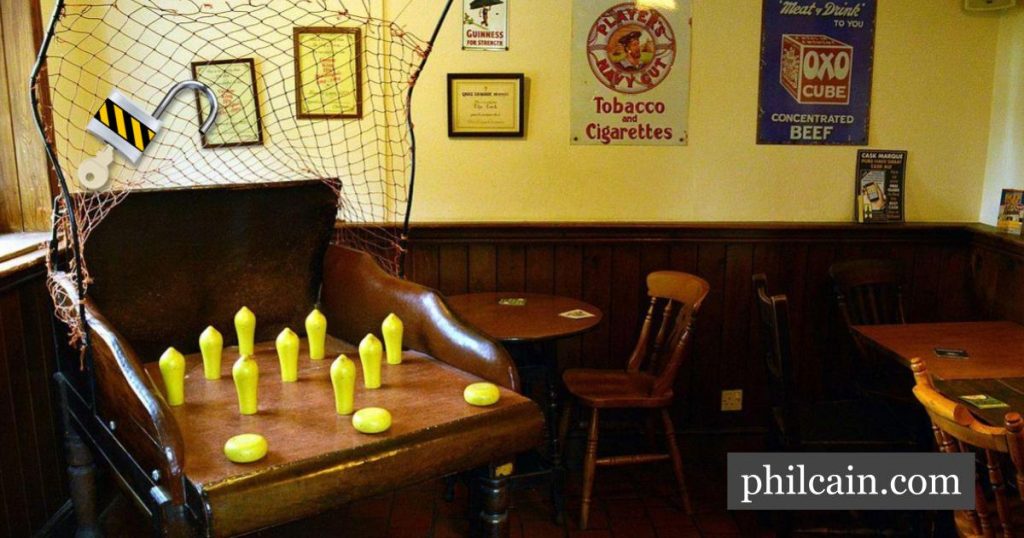
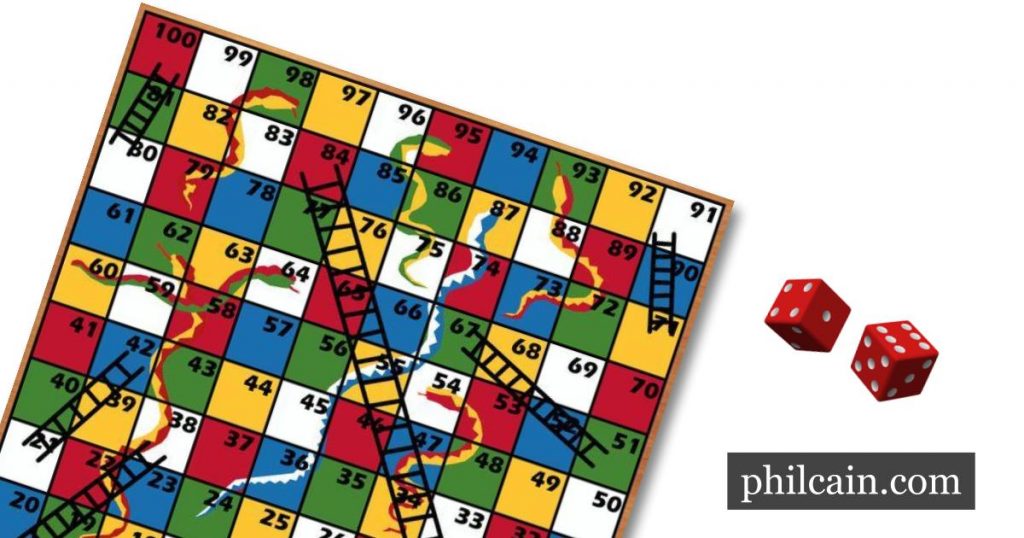
The board game snakes and ladders, or chutes and ladders in the US, can help picture how circumstances alter our chances of success or mishap. Each player moves along the board and when landing on a ladder takes a big step up and when they land on a snake they slip a long way down.

But, crucially, we do not all play on the same board. Poorer people start further away from the giddy heights of their terrain. And, to reflect their less fortunate circumstances, they face more penalties and fewer bonuses, so fewer and shorter ladders, and more, longer snakes. Consequently a smaller percentage of poorer people make as much progress.

To make it more realistic we should test a skill to decide whether we necessarily slide down a snake or climb a ladder. Maybe we have to answer an exam question or, something silly like catch a ball in a cup, anything really to mimic a real life test. Adding this extra obstacle simply multiplies the extra difficulties faced by poorer people.

Now, finally, we can add another level of realism to the model, alcohol. Consuming alcohol impairs our skills, judgement and planning, so meaning we fall down even more snakes and can take advantage fewer lucky breaks. Adding alcohol to the equation tips the balance of an unfair game even further against poorer people.

At the same time advertising relentless associates alcohol with success and winning, deliberately obscuring the fact that it is far more likely to increase our chances of losing.

Clear, not less subtle
The “alcohol paradox”, the name often given to the way alcohol disproportionately harms poorer people is unhelpful, adding intrigue to something which is not mysterious. It is not paradoxical that poorer people are harmed more It is simply a testament to the combined effect of more challenging circumstances and substance blunting our abilities.

It is, of course, vital for the review unveiled this week to go beyond this simplistic model and to shed light on the details. But, as a starting point, the reason alcohol tends to compound inequality can be an unfortunate effect everyone can readily understand and find ways to avoid. With luck, more policies will emerge to make it easier. ■

CAMRA launches minimum alcohol price investigation

January 10, 2024

The leaders of a UK organisation representing traditional pub and ale enthusiasts have decided to hold an investigation into the effects of minimum alcohol pricing.

The move comes in response to a motion passed at the Campaign for Real Ale (CAMRA) annual conference in Dundee last month calling for the organisation to back the “urgent introduction” of minimum pricing in England, after it was introduced in Scotland last year.

“The national executive are carrying out further investigation into the issue to determine the best way to deliver the decision taken by conference,” a CAMRA spokesperson said. “We are unlikely to have any different updates imminently.”

Alcohol has retailed for more than 50p ($0.66) per 10ml UK unit in Scotland since May last year. Supporters hope it will curtail the drinking of very heavy drinkers who gravitate towards cheap sources of alcohol. In England the price per unit starts at 16p.

The price of beer sold in pubs is unaffected by minimum pricing, typically being more than three times the 50p minimum price. Supporters within CAMRA argue minimum pricing may help counter the decline of British pubs by narrowing the price gap with supermarkets.

Others do not see it this way, saying on social media the pro-minimum price motion panders to “anti-alcohol” forces, threatening to cancel their CAMRA memberships. Some, however, wonder if an appreciation of untainted liberal economics is a necessary part of appreciating traditional beer.

Help may be at hand. An initial evaluation of the short-term economic impact of minimum pricing in Scotland is due later this year. And some insight into its effectiveness in achieving its goal of reducing harmful drinking is expected next year.

The conference also saw the arrival of a new CAMRA chairman, Nik Antona. ■

Forging language for change

January 10, 2024

Creating change around alcohol and elsewhere requires us to describe dynamic situations accurately, an area where English could be improved.

Our language often ties us to a static picture of situations more usefully seen as being in dynamic change, so blinding us to possibilities.

We are not, for instance, smokers in the same way we are right-handed, brown-eyed, male or female.

Being a smoker is a status we acquire as a result of what we consume and something we can change by making different choices.

English we say, “I am a smoker,” in the same way as, “I am from Manchester,” or “I am human.” But they are not the same.

In this way, as my brilliant friend and first giveaway book recipient pointed out,  we English-speakers have made a hash of it.

“There is no escape save by stepping out of it into another [language],” as Enlightenment polymath Alexander von Humboldt put it.

Not “to be”
If we are serious about change we should distinguish between inherent states and transient ones.

Making the distinction clear would  help us all see better where fruitful change is possible.

Portuguese and Spanish—and other Iberian languages—have a way to do this built in, using the word “estar” for potentially passing states.

Mixing it into English unforgivably, “I estar alcohol dependent,” would mean we are currently alcohol dependent, but not always and forever.

Using estar like this would convey a sense of changeability to a state of illness, boredom, sadness, or being a smoker too.

I am told estar is not often used to emphasise that substance use problems are shifting and dynamic, but doing so would be easy.

In English it is more difficult. A new word, an English estar, has only a very remote chance of catching on.

Emphasising change
Given introducing a new English verb is impossible we could still make better use of the language we already have.

“Now” is, perhaps, useful: I am now a smoker; I now have a cold; I am now alcohol dependent; I am now not alcohol dependent.

Yes, it is clunky, but perhaps we should accept some clunk if it means we avoid binding ourselves to things which we can change.

It offers the potential to soften and shift our outlook and allows, if we wish, our self-image to adapt to new circumstances.

Routinely acknowledging change is possible, in alcohol consumption, smoking and much else, can surely help us realise our choices. ■

Some young Nigerians say heavy drinking is fun: controls must keep pace with culture

January 10, 2024

by Emeka Dumbili, Lecturer, Nnamdi Azikiwe University

Alcohol consumption has a long history in Nigeria, especially in the southern region, where it was not forbidden by religion. In the past, only adult men were culturally allowed to drink. It was taboo for young people to drink alcohol because it was generally believed that “drinking was a sign of being an elder”.

Alcohol served multiple societal functions in the past. It flowed during celebrations and significant events. These included chieftaincy enthronements, new yam festivals, child naming ceremonies, and even funerals. Although drinking was central to almost every social gathering, intoxication was forbidden. Intoxicated drinkers were punished by the community elders, as a deterrent to others.

With help from the British colonial government, Nigeria’s drinking culture changed, ditching abstinence and moderation. The British colonial government relied heavily on revenue from alcohol taxes and levies. To increase their cash-flow, the British encouraged the availability and heavy drinking of imported alcoholic beverages. When Heineken-owned Nigerian Breweries and Guinness Nigeria were established in 1946 and 1962, their marketing targeted women and young people. Their marketing departments drove sales by associating alcohol consumption with modernity and sexual enhancement.

Nigeria is a key market for competing multinational alcohol companies. To gain market share, these companies have developed sophisticated and aggressive marketing methods targeting young people, including adolescents. Alcohol availability has tripled, and so has the number of heavy drinkers. Consequently, alcohol-related problems are also rising. Alcohol is associated with problems such as cancer, violence, sexually transmitted infections and truancy.

Nigeria lacks alcohol control policies. Alcohol production and marketing are largely unregulated. Multinational alcohol producers often employed marketing strategies outlawed in their countries of origin, to sell their brands in Nigeria. The results are evident. Research has shown that abstinence and moderate drinking are now uncool, and heavy drinking and intoxication make good badges of honour in Nigeria.

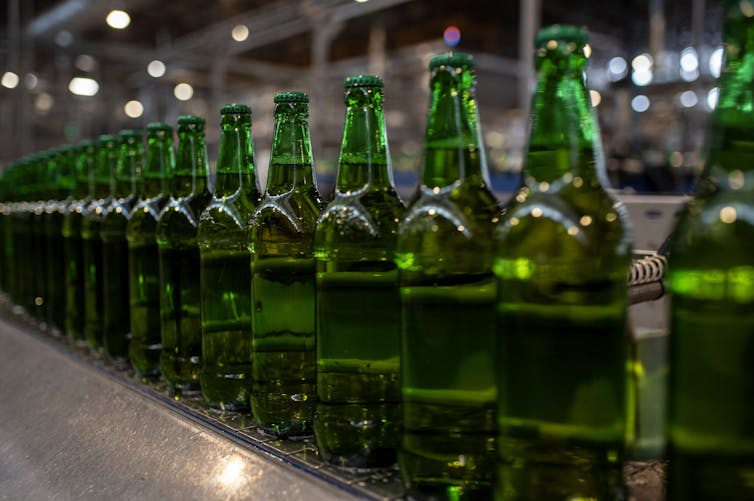
A man wearing a hat and reflector jackets in a large warehouse.
A worker monitors bottles on the production line at a beer factory, in Ogun State, Nigeria.
Stefan Heunis/AFP/Getty

In my recent research, I examined why adolescents and young adults in Nigeria drink heavily, and why they consider it a source of fun or pleasure. I also recorded whether they saw heavy drinking as rebellion against traditionalist values. My research is important because it shows treating alcohol use as pathological, and denying pleasure-seeking as a motive for drinking, is no longer tenable in contemporary Nigeria. The study also shows that understanding these changing motives for drinking could inform interventions that target harmful drinking practices.

Deliberate intoxication for fun and pleasure
I interviewed 72 young people aged 18-24 years, who live in Benin City, Nigeria, to understand their perspectives. Most of the participants were students. They all agreed that drinking alcohol was fashionable in communities of young people. Sobriety was considered obsolete, and deliberate over-consumption of alcohol was common. The reason they gave was that young people just want to feel drunk.

According to my study, fun and excitement – directly and indirectly – were acceptable reasons for heavy drinking and intoxication. Individuals didn’t consider the associated reduced mental control a big deal.

I took whisky; I wanted to drink to stupor. I wanted to see how it felt like to be really drunk and misbehaving; that was my aim of drinking that way. So I drank and drank and drank until (I became drunk).

Another added:

There was a day I took one full glass of (Johnnie Walker) Red Label (40% alcohol by volume), and in less than 10–15 min, I couldn’t feel myself again. I could barely walk, my friend took me home … To me, it was fun. I felt the way I have never felt before, so that is fun … it was exciting because friends will now remind you that this was what you did and you cannot remember.

There are also gender aspects to youth drinking culture. Female participants who were filmed while drunk considered the clips hilarious. Male participants said they took turns in providing alcohol for members of their friendship networks. This practice is generally believed to strengthen friendship bonds. Although providing alcohol may in part be a means of reenacting the male-dominated traditional drinking practice in contemporary Nigeria, it also led to heavy drinking and intoxication.

Surprisingly, these youths believed they had not breached any social norms by drinking to intoxication. But they did admit it all came at a cost. Some had experienced negative events like hangovers, injuries, violence, and missing key academic tests while passed out from alcohol consumption.

Solution to drinking problems
The current lack of alcohol policies in Nigeria only serves the interests of alcohol producers to the detriment of public health. Even though alcohol is a legal drug, increasing evidence has shown that no amount is risk-free.

Policymakers should focus on providing information on low-risk drinking measures for legal drinkers. Tailored, evidence-based interventions that discourage heavy drinking and support safe drinking norms or abstinence should be developed in Nigeria.

Interventions should draw from the elements of local drinking cultures that prohibit heavy drinking and intoxication. Given the prominent role of friendship networks, policymakers should develop interventions using such platforms to promote safe consuming cultures and other pleasurable activities with zero or low risk.

The World Health Organisation has also developed effective strategies called SAFER to reduce alcohol abuse and related harm. Nigeria could also adopt similar measures.The Conversation ■

This article is republished from The Conversation under a Creative Commons license.

  • « Go to Previous Page
  • Page 1
  • Interim pages omitted …
  • Page 36
  • Page 37
  • Page 38
  • Page 39
  • Page 40
  • Interim pages omitted …
  • Page 57
  • Go to Next Page »

Primary Sidebar

  • Bluesky
  • Instagram
  • LinkedIn
  • Twitter
  • WhatsApp

Copyright © 2026 · Phil Cain Impressum

Manage Consent
To provide the best experiences, we use technologies like cookies to store and/or access device information. Consenting to these technologies will allow us to process data such as browsing behaviour or unique IDs on this site. Not consenting or withdrawing consent, may adversely affect certain features and functions.
Functional Always active
The technical storage or access is strictly necessary for the legitimate purpose of enabling the use of a specific service explicitly requested by the subscriber or user, or for the sole purpose of carrying out the transmission of a communication over an electronic communications network.
Preferences
The technical storage or access is necessary for the legitimate purpose of storing preferences that are not requested by the subscriber or user.
Statistics
The technical storage or access that is used exclusively for statistical purposes. The technical storage or access that is used exclusively for anonymous statistical purposes. Without a subpoena, voluntary compliance on the part of your Internet Service Provider, or additional records from a third party, information stored or retrieved for this purpose alone cannot usually be used to identify you.
Marketing
The technical storage or access is required to create user profiles to send advertising, or to track the user on a website or across several websites for similar marketing purposes.
  • Manage options
  • Manage services
  • Manage {vendor_count} vendors
  • Read more about these purposes
View preferences
  • {title}
  • {title}
  • {title}
Loading Comments...