• Skip to main content
  • Skip to primary sidebar

Alcohol Review

Alcohol understanding for all

  • Highlights
    • Messages
    • Newsletters
    • AR Live
  • Events
    • AR2026
    • AR2025
    • Next year’s event
    • Earlier events
  • Join
  • About
    • Organisers
    • Contact
  • Log In

philcain

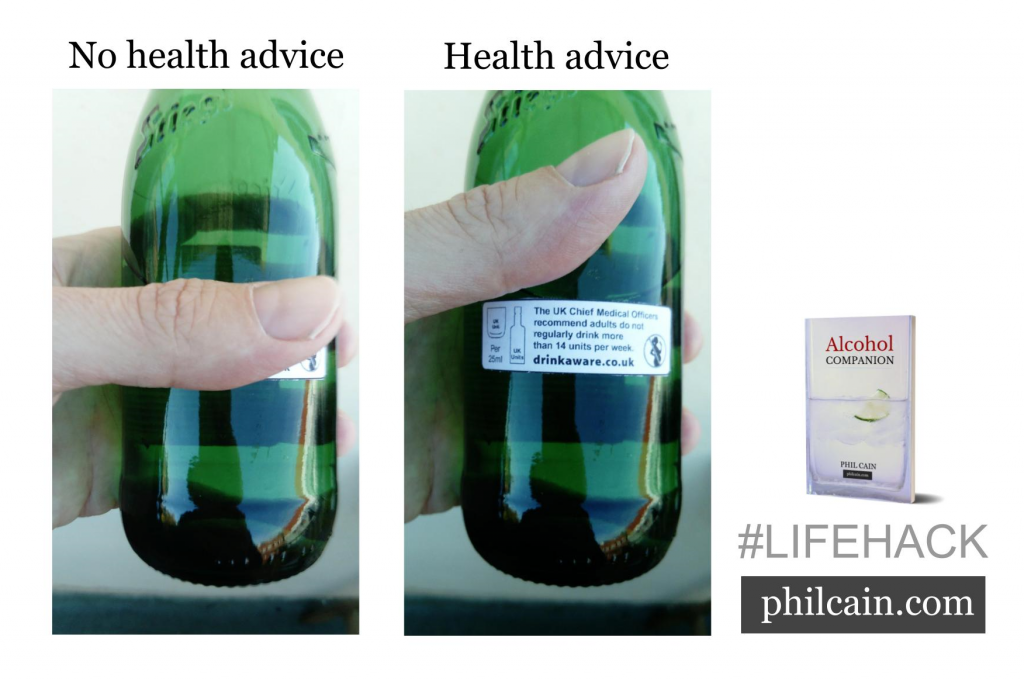
#Lifehack health advice | philcain.com

January 10, 2024

It is surprisingly easy to miss public health information on bottles and cans, like: “The UK Chief Medical Officers recommend adults do not regularly drink more than 14 units per week.” ■


Note: Read here why the label used in the demonstration is currently set to be a rare sight in the UK. ■

Sobriety sizzles

January 10, 2024

Any takers?

There are signs sobriety is creating the “sizzle” it needs to achieve the popularity it deserves.

Low-risk drinking is, on the face of it, the stuff of marketing executives’ dreams, a robust product with undisputed benefits, available to all at negative cost.

Yes, negative cost. It is not some something-for-nothing deal. This is a something-for-money-back deal. It is both beneficial and profitable for its adopters.

While easing the load on our wallets, it improves our sleep, relieves depression and anxiety, promotes clearer thinking, boosts resilience, reduces mistakes and accidents, and avoids disease.

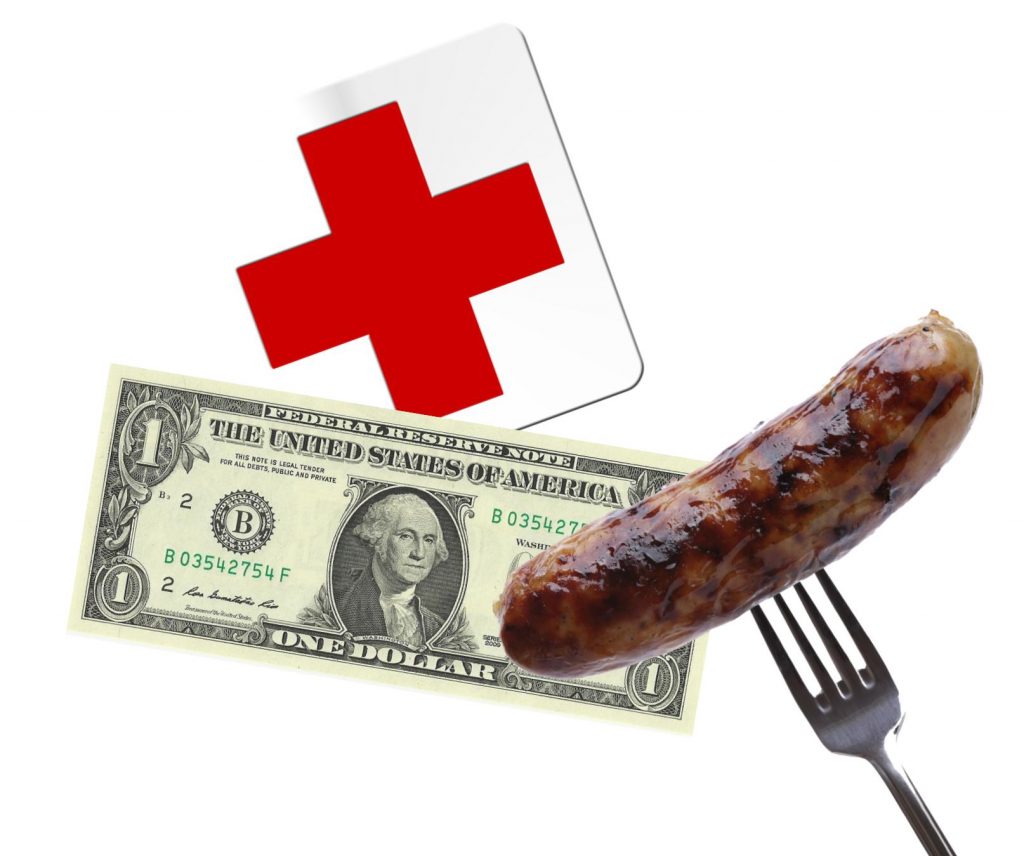
Drinking rates, nevertheless, barely budge from year to year. Imagine it: health payoffs and dollar bills lying around across the globe and yet few of us trouble to pick them up.

Is this a rational choice? Is heavy drinking really worth the price we pay? It seems doubtful. So, then, what is going wrong?

Knowledge and desire
It is partly misunderstanding. The scientific findings around alcohol are counterintuitive and constantly undermined, as I found while writing my book Alcohol Companion.

A stats-fest tickles our cortices but does not push the buttons which guide our humdrum choices.

Everyday decisions are rarely made through agonising rational computation. Think of a trip to a supermarket. We lob things in our trolleys mostly to answer emotional and sensory appeals.

We need to connect with choices on a non-intellectual level for them to be easy and enjoyable. This applies to rational choices as much as self-defeating ones.

Marketing people know this. Winning our decisions is about “selling the sizzle, not the sausage”.

It is not just meat though. We prefer crisped rice with added Snap, Crackle and Pop too. An iPhone is no better, yet is still more desirable.

Better health labelling, though important to have, will not be enough to provide the sizzle that makes low-risk alcohol choices desirable in the way which shifts our behaviour.

Low-risk drinking needs sizzle to turn its stock of wholesome statistical sausagemeat into a tempting consumer choice.

Turning up the gas
It is starting to happen. The online world is fulfilling our need for superficial socialising, an area where alcohol once reigned supreme. Psychology, meanwhile, is giving more insight into happiness.

These developments are being met by the arrival of a new generation of alcohol-free alternatives allowing us low-hassle alcohol opt-outs, with a positive placebo-effect thrown in.

The contribution of public health professionals, counsellors, treatment providers, campaigners and help groups, meanwhile, are being supplemented by fresh new communities like Club Soda and Soberistas.

The payoff is potentially huge. Globally alcohol is among the top four reasons for us to lose healthy years of life and a major contributor to crime rates and countless lesser cock-ups.

Reducing the impact by any significant amount would deliver benefits across society, particularly for poorer people. It would also free resources to tackle other problems.

Putting reasonable choices in attractive packages is as essential as the science they are composed of. Sobriety is becoming increasingly tempting and this is worth celebrating. ■

[book] Preventing Alcohol-Related Problems: Evidence and Community-based Initiatives | APHA Press

January 10, 2024

“… The book combines the latest research on community-level alcohol problems with success stories from community practitioners. …”
ISBN: 978-0-87553-291-2

Author: Edited by: Norman Giesbrecht and Linda M. Bosma
Publisher: APHA Press
Format: Soft Cover
Pages: 623
Publishing Date: 11/17

Source: secure.apha.org/imis/ItemDetail?iProductCode=978-087553-2912

Alcohol-dementia link far bigger than thought

January 10, 2024

Alcohol drinking is linked to 57% of cases of early-onset dementia, according to a new study, far more than most experts had guessed.

“Our findings suggest that the burden of dementia attributable to alcohol use disorders is much larger than previously thought,” says lead author Dr Michaël Schwarzinger of the Translational Health Economics Network.

“While it is widely recognised that heavy drinking can have detrimental physical effects, we have not tended to think about these in terms of brain functioning. This research suggests we should focus more of our attention in that direction,” says James Nicholls of Alcohol Research UK.

Alcohol use disorders were associated with three-times the risk of all types of dementia, making it the strongest modifiable risk factor for dementia onset. The paper suggests reducing dementia cases by having screening, interventions and treatment for heavy drinking.

The alcohol-dementia link may be stronger even than this study implies because alcohol problems are underdiagnosed. The French study made the link by looking at diagnoses of mental and behavioural disorders attributed to alcohol use or and alcohol-related liver disease.

The finding is “immensely important” according to Professor Clive Ballard of the University of Exeter. “We should move forward with clear public health messages about the relationship between both alcohol use disorders and alcohol consumption, respectively, and dementia.”

“The link between dementia and alcohol use disorders needs further research, but is likely a result of alcohol leading to permanent structural and functional brain damage,” says Dr Schwarzinger. He also recommends cutting availability, increasing tax and banning advertising.

Of the 57,000 early onset dementia cases examined, 18% came alongside a diagnosis of alcohol use disorder, in addition to the 39% of cases which were already recognised as being alcohol-related. Early onset dementia is dementia diagnosed before we are 65.

The association between heavy drinking and dementia onset has been poorly measured. This is a reason why it was not included in the modifiable risk factors included in the Lancet commission on dementia prevention last year, says Dr Schwarzinger.

Drinking consistently less than 14 UK units (140ml) of alcohol a week is reckoned to mean dementia risk is low. Alcohol is not a medicine or health tonic. ■

CAMRA leaders to discuss minimum alcohol pricing

January 10, 2024

The leaders of a traditional pub campaign group are set to discuss a call for it to support the “urgent introduction” of minimum alcohol pricing in England later this month.

The move comes in response to a motion passed at the Campaign for Real Ale (CAMRA) annual conference in Dundee earlier this month, which saw the arrival of a new chairman Nik Antona.

Alcohol has retailed for more than 50p ($0.66) per 10ml UK unit in Scotland since May last year. Supporters hope it will curtail the drinking of very heavy drinkers who gravitate towards cheap sources of alcohol. In England the price per unit starts at 16p.

The price of beer sold in pubs is unaffected by minimum pricing, typically being more than three times the 50p minimum price. Supporters within CAMRA argue minimum pricing may help counter the decline of British pubs by narrowing the price gap with supermarkets.

Others do not see it this way, saying on social media the pro-minimum price motion panders to “anti-alcohol” forces, threatening to cancel their CAMRA memberships. Some, however, wonder if an appreciation of untainted liberal economics is a necessary part of appreciating traditional beer.

The tension is not new. CAMRA’s former chairman Colin Valentine, who stood down last year, is said to have spoken in support of the minimum price motion. Yet, under Valentine’s chairmanship, CAMRA also echoed alcohol industry opposition to it.

Help may be at hand. An initial evaluation of the short-term economic impact of minimum pricing in Scotland is due later this year. And some insight into its effectiveness in achieving its goal of reducing harmful drinking is expected next year. ■

#brainawarenessweek, consider Alcohol Companion

January 10, 2024

Alcohol has a profound impact on our brains and consequently our well-being. Understanding this more fully provides a powerful way to help us improve our lives, letting our brains to look after us better. So, to coincide with #brainawarenessweek, there is a 50% off Alcohol Companion using code FT6RK7J9 redeemable at the philcain.com bookshop. ■
  • « Go to Previous Page
  • Page 1
  • Interim pages omitted …
  • Page 39
  • Page 40
  • Page 41
  • Page 42
  • Page 43
  • Interim pages omitted …
  • Page 57
  • Go to Next Page »

Primary Sidebar

  • Bluesky
  • Instagram
  • LinkedIn
  • Twitter
  • WhatsApp

Copyright © 2026 · Phil Cain Impressum

Manage Consent
To provide the best experiences, we use technologies like cookies to store and/or access device information. Consenting to these technologies will allow us to process data such as browsing behaviour or unique IDs on this site. Not consenting or withdrawing consent, may adversely affect certain features and functions.
Functional Always active
The technical storage or access is strictly necessary for the legitimate purpose of enabling the use of a specific service explicitly requested by the subscriber or user, or for the sole purpose of carrying out the transmission of a communication over an electronic communications network.
Preferences
The technical storage or access is necessary for the legitimate purpose of storing preferences that are not requested by the subscriber or user.
Statistics
The technical storage or access that is used exclusively for statistical purposes. The technical storage or access that is used exclusively for anonymous statistical purposes. Without a subpoena, voluntary compliance on the part of your Internet Service Provider, or additional records from a third party, information stored or retrieved for this purpose alone cannot usually be used to identify you.
Marketing
The technical storage or access is required to create user profiles to send advertising, or to track the user on a website or across several websites for similar marketing purposes.
  • Manage options
  • Manage services
  • Manage {vendor_count} vendors
  • Read more about these purposes
View preferences
  • {title}
  • {title}
  • {title}
Loading Comments...