story
Four percent of cancers linked to alcohol

One in 25 cancers is linked to alcohol consumption, with men accounting for three quarters of cases, according to a global study in Lancet Oncology.
“Public health strategies, such as reduced alcohol availability, labelling alcohol products with a health warning, and marketing bans could reduce rates of alcohol-driven cancer,” says Harriet Rumgay of the International Agency for Research on Cancer, also recommending higher taxes and minimum pricing.
The estimates would mean 740,000 cancer cases globally were linked to alcohol last year, with heavy drinkers contributing bar far the most. But there is no risk-free level of alcohol drinking and cancer. Low-level drinkers were one-in-seven of alcohol-linked cancer cases.
“It is safest not to drink alcohol, but if you do, you should stick to the UK Chief Medical Officers’ low-risk guidelines which is to drink no more than 14 units a week [or 140ml of alcohol] on a regular basis,” said Professor Sir Ian Gilmore, Chair of the UK’s Alcohol Health Alliance.

Cancers of the oesophagus, liver, and breast accounted for most of the cases. Alcohol damages DNA and affects hormone production, which can contribute to cancer development, as well as worsen the cancer-causing effects of substances like tobacco.
In the UK the alcohol-lined cancer rate was the global average of 4%, with 16,800 cases; The US, 3%, with 52,700 cases; China 6%, 282,300; Germany 4%, 21,500 cases; and France 5%, 20,000 cases. The percentage of alcohol-linked cancer cases were reckoned to be highest in Mongolia, at 10%, from 560 cases, and lowest in Kuwait, where it was 0%, with just a few cases.
The study made its estimate by looking at alcohol intake in 2010 and the number of cases of cancers known to be linked to alcohol last year. Some suspect the research may underestimate alcohol’s contribution to cancer cases, because a quarter of alcohol purchases are not captured by government figures. ■
Enhance anything by never pushing
Western culture makes a fetish of strenuous effort. Put in lots of effort, we are told, and we can reliably expect cracking results. I, like a lot of people, was brought up to believe it. Media reinforce the idea. But it is not true.
Many of us often work extremely hard and get very limited results in return. What we invariably get, however, is fatigue. Over the long term we often get chronic fatigue. We also increase our chances of injury and becoming jaded.
We also boost the chances we crave relief from the pain and strain we have induced. Enthusiastic efforts to improve our health can lead us to look for relief using alcohol or in other counterproductive ways.
I was brought up to be a firm believer in the try hard ethos. Whether it was memorising irregular foreign verbs or running round a playing field until we puked. It was all quite unpleasant, but rest assured the pain would have a pay off.
There is something to be said for seeing where our limits are and experiencing what happens when we reach them. It is instructive, but constantly pushing our gauges into the red is a flawed long-term strategy.
Real achievements typically emerge from steady, sustainable and enjoyable effort. Bodies strengthen, but they take time. Books, academic papers and brick walls take shape, but not thanks to an afternoon of frantic exertion.
Willing ourselves to regularly hit our pain thresholds can induce endorphins that soothe strain and stress. But over the long term this can backfire when we no longer want to endure discomfort simply for a painkilling payoff.
My own experience was that I became tired of the satisfaction and reward of enduring things as an end in itself. Eventually I found what Chinese philosophy calls wu wei, a slippery idea one might say means “never pushing”.
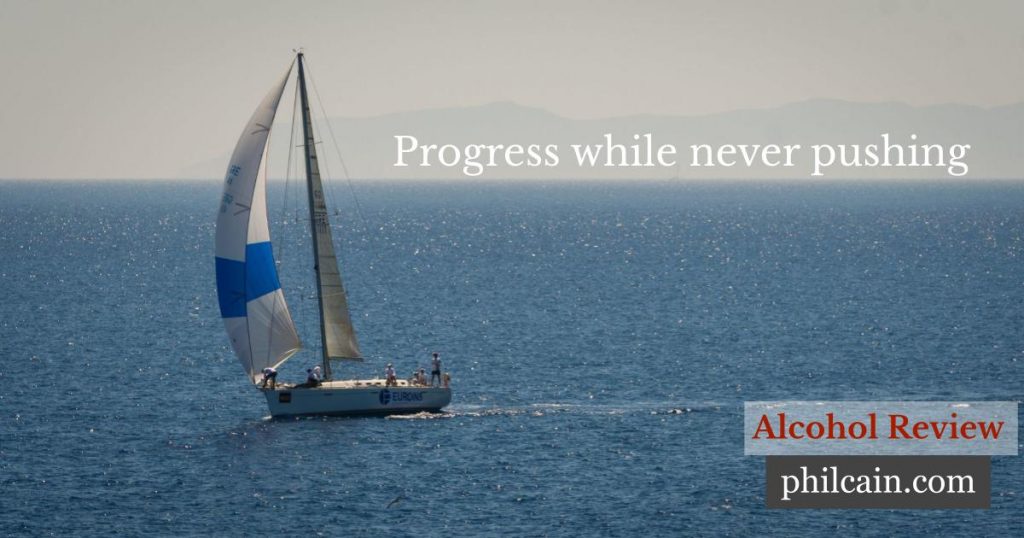
The idea is to never strain oneself. One should look at ways to sail rather than row to a destination. Rather than giving oneself a pat on the back for labouring, one should focus on technique, reducing effort and enhancing enjoyment.
It is an approach that can be well embodied in some tai chi classes. If you feel any pain or strain you are told to stop moving quite so much. The lesson for an inveterate try-harder is stop trying so hard, progress will come anyway.
I did no more than the tai chi basics, but “never pushing” works with anything. I swam this way for three years. I was never injured, tired or stressed and was able to enjoy every minute. I emerged far stronger and with technique improved.
The ultra low intensity meant there was no pain or discomfort during or after. This meant there was not the slightest temptation to self-medicate with alcohol or anything else. Swimming itself became a longed-for stress relief.
Making never pushing and enjoyment the key parameters of success make activities themselves the rewarding relaxation it should be. Well-being not effort is the most reliable basis for progress. ■
UPDATE: Men’s wellbeing charity defends controversial alcohol partnership

Updated 28.8.2024 to include response from Men’s Sheds.
The UK Men’s Sheds Association acknowledged concerns from health experts and shed users about its partnership with alcohol giant Diageo, while highlighting the benefits of the controversial deal.
“It is genuinely a response to harmful drinking especially in the 50-70 age group,” Men’s Shed chief executive Charlie Bethel told Alcohol Review. The 18-month pilot of the DrinkIQ-branded co-created product will allow the charity to assess its impact. One shed which closed now meets at a Wetherspoons, Bethel noted.
Bethel said some shed users have objected to the deal, but he said it is comparable to other charities taking money from National Lottery scratch cards. He said he could not speak for Diageo’s motives, but noted the success of its alcohol free beers. There is currently no evidence alcohol-free beer cuts harm.
“It’s prob too late but worth having a read of the evidence on partnerships with harmful product industries They don’t have men’s health–or women’s, for that matter–as a strategic aim,” said Greg Fell, President of the The Association Of Directors of Public Health (UK), on X at the time of the announcement in late July.
“There are other places to get your information about alcohol harm to help with recovery, addiction and mental health regarding alcohol than those that make it profit from it,” commented alcohol harm reduction campaigner Mick Unwin.
“This is a very unfortunate move by UK Men’s Sheds,” said Sheila Gilheany head of Alcohol Action Ireland, echoing the similar concerns about the expertise an alcohol company might have in offering information on alcohol harm.
“Very sad to see this corporate capture of Men’s Sheds,” said another commenter who sits on the board of a harm reduction charity. ■
Enhance your alcohol intuition
Remoulding our intuitions about alcohol can deliver an enriched experience requiring less effort.
Over time we can shape our unconscious as well conscious thoughts, allowing us to start to align our intuitive ideas about alcohol with scientifically establish facts.
Replacing our existing intuitions about alcohol with more reliable ones can be incredibly rewarding, allowing us to make good decisions quickly with little effort.
The intuitive responses do not necessarily come easily and, in the case of alcohol, as in other areas, can require perseverance, creativity and a wider rethink to cement them in place.
Brain training
We typically only really learn to walk, talk, eat and interact as a standard elements of our growing up curriculum. Beyond that what we learning is less uniform.
It is only thanks to years of practice and the efforts of our parents and wider society that most of us can draw, read, write and drive a car with ease. It is all down to training.
In the right circumstances we can acquire intuitive knowledge of obscure things too, like magnetic fields, like fluid mechanics, Russian irregular verbs, mitochondria, plastering or plumbing.
After years of consistent practice we all tend to become effortless performers in something that is likely to be marvelled at by people who have not had such immersion.
Similar learning process can also enable us to acquire softer skills like social skills, public speaking, or even correcting our posture.
Liquid learning
We learn about things we ingest too, like food and drink, medicines and psychoactives, with alcohol the most common and potent.
Most of us learn about alcohol much as we do riding a bike, with almost no theory and a lot of trial and error.
The fatal flaw is that hearsay and our own perceptions cannot be relied on when trying to form an understanding of a psychoactive.
Drinking alcohol leaves the overwhelming impression it eases stress, trauma, sleep and social awkwardness, but really makes them worse.
Vast advertising budgets and our need to fit in make our false first-hand impressions the easiest takeaways.
This means we can often live for years with very strong but very inaccurate intuitions about alcohol which backfire on us.
Reshaping our intuition
The good news is, however, that intuitions around alcohol are learned and can be remoulded to conform to reality.
A solid base of scientific research can be used to reshape them, allowing us to see where alcohol’s immediate impressions are misleading.
We can change our lifestyles and start gathering new impressions, so forming new intuitions, perhaps by having days and months off.
Like all learning remoulding our alcohol intuition comes most easily when seen as creative process with rewards along the way and payoffs.
There are many such payoffs: avoiding mishaps and illness, lower costs, and improved relationships, memories, mood, cognition and resilience.
Remoulding our intuition can enrich our ideas, shedding inspiring new light on psychology, relationships, lifestyle, philosophy and social goals.
Why would we not attempt to enrich our lives in this way? ■
Minimal drinking helps prepare for covid-19

Rejigging our alcohol consumption can help adapt to our current situation and prepare for the challenges ahead.
The easing of lockdowns is not the end or the beginning of the end. It is just, perhaps, the end of the beginning.
The UK still faces the deepest depression for perhaps 300 years, according to the Bank of England.
The political futures currently proposed by the UK and elsewhere are far from certain to improve the outlook.
We can only respond to world events such as these as best we can, trying to minimise damage and hasten recovery.
We need to brace for lower income, unemployment, curtailed freedoms and thousands of premature deaths.
One way to be ready as we can be for hard times is to adopt healthy, cost-saving choices early, including low-risk drinking.
This simple suggestion is strongly advocated by the WHO, though precious few governments have given it airtime.
Alcohol use weakens our immune system and judgement, and our capacity to cope with emotional challenges.
We can use the tranquility many of us now have in abundance to do this. There may be other times for it, but not better ones.
We are now free of one enormous challenge faced by people trying to cut down drinking: social pressure.
The UK’s low-risk consistently drinking under 14 UK units (140ml) a week of alcohol is a reasonable target.
Achieving this can help improve our better mental and physical health while slashing costs ahead of a downturn.
We can get help from our GP and from a wide range of organisations set up to support and assist.
Good news is set to be short supply. But, in its absence, we can at least celebrate and take the chance to act on good ideas. ■