• Skip to main content
  • Skip to primary sidebar

Alcohol Review

Alcohol understanding for all

  • Highlights
    • Messages
    • Newsletters
    • AR Live
  • Events
    • AR2026
    • AR2025
    • Next year’s event
    • Earlier events
  • Join
  • About
    • Organisers
    • Contact
  • Log In

story

Make a Burns Night dram 0.0

January 10, 2024

Burns Night is a great chance to see how much of the positive side of alcohol culture lies in its social trimmings rather than the substance, in this case a shared ritual and in being accepted on equal terms. With goodwill this is achievable regardless of our drinking preferences.

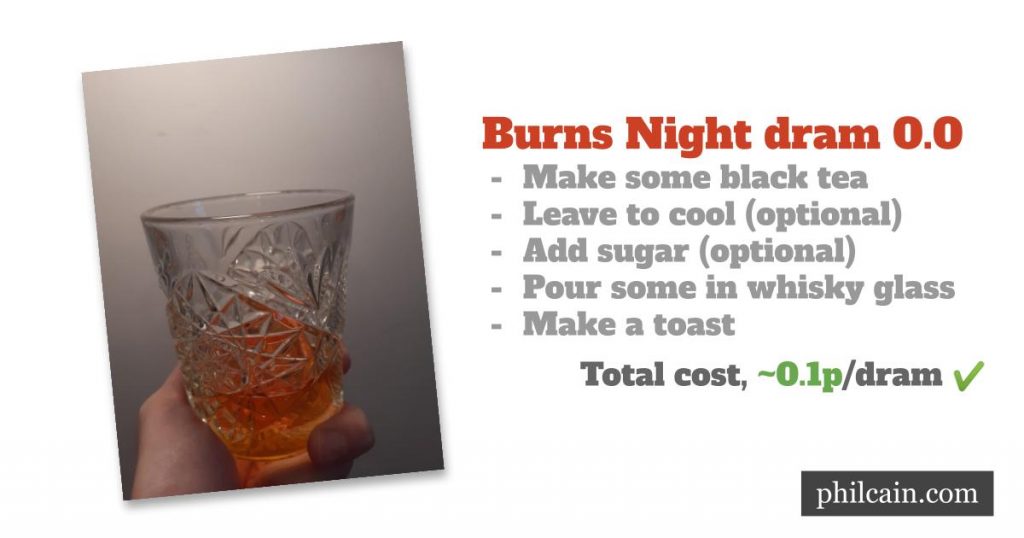
An alcohol-free Burns Night dram-alike can be a real help and you can make one for next-to-nothing with some black tea. a formula used for generations on stage and screen. As with most alcohol-free drinks its largely about joining in and avoiding unhelpful comments. Sláinte! ■

Alcohol and driving: an informative incompatibility

January 10, 2024

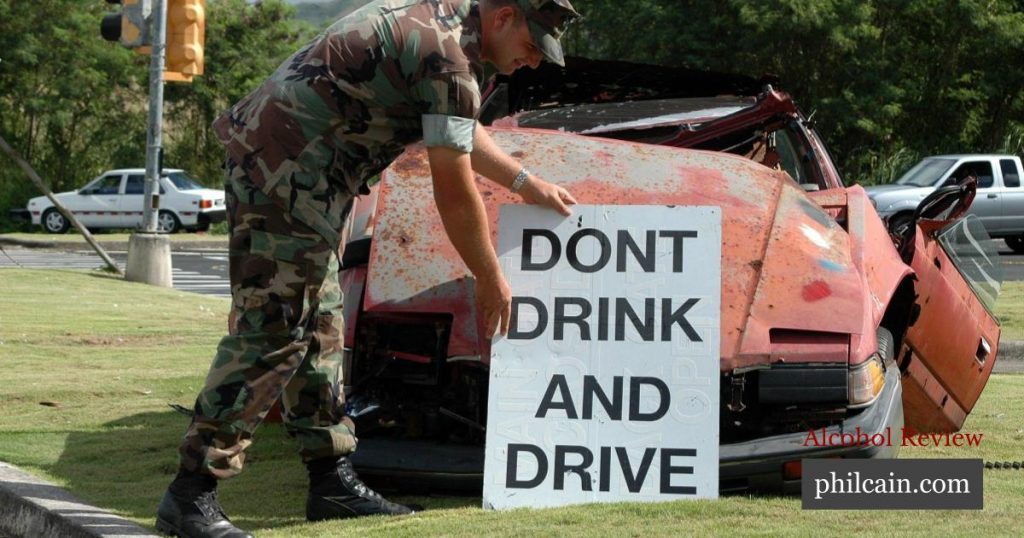
With a responsibility-driven covid unlocking in the news it is worth reminding ourselves that we are truly terrible at driving well after drinking alcohol. We can learn a lot from this.

Our ability to abide by legal limits and social norms on the road falls apart after alcohol resulting in countless injuries and deaths. This is because driving well needs more than a heartfelt wish to act “responsibly”. It needs drivers who have the skills and brain functions available to do it.

To drive well we need the mechanical skills to operate the wheel and pedals in a timely fashion; we need real-time perception and processing of what we see, hear and feel; navigational memory; the ability to read the road and think ahead; and a sense of what other drivers are thinking and doing too.

All this lot, and more, needs to be woven together to create a flow of clear, well-timed decisions and coordinated movements to propel us safely on our way. Alcohol renders us incapable of it, hampering the brain in delivering it. Driving well and drinking are simply incompatible.

One simple model of alcohol inebriation likens its effect to that of shortsightedness, limiting our mental horizons in all directions. It makes us unable to see beyond a relatively small set of factors in our immediate surroundings and, to make it worse, we also find it hard to see this profound limitation.

Our performance in other areas is similarly undermined by more than a little alcohol. Do we make any great business or personal decisions after a few drinks? Seen any timeless drunk performances? Any examples are mostly luck. Since we do not face prosecution or death, we tend not to register the effect.

Driving is a limited metaphor, as is every metaphor. But it can be useful if we see the whole. metaphorical picture For a society of tolerably good drivers we need a system of laws, good enforcement, etiquette, safe cars and, most importantly, trained, fully-functioning drivers at the wheel, which means they are sober.

Ignoring any link in the chain of factors allowing us to be good citizens on the road is itself irresponsible. Minimising mistakes from alcohol inebriation has to be part of any covid unlocking. And it we can also use it ourselves to eliminate many other avoidable errors. Searching for a parallel? Take a look at the roads. ■

Parliamentary influence worries touch alcohol harm

January 10, 2024

The discussion over parliamentary groups is important to tackling alcohol harm, with some promoting alcohol interests while another looks to curb alcohol harm. They are not mutually exclusive.

The chair of a group of UK parliamentarians focused on reducing alcohol harm is also co-chair of another recently revealed to have taken money from an alcohol-industry-linked group.

Christian Wakeford, who switched from the Conservatives to Labour in January, is chair of the Alcohol Harm All-Party Parliamentary Group (APPG), supported by charity Alcohol Change for a figure of £3,000.

But Wakeford is also co-chair of the alcohol-industry supported group on the Night Time Economy, which has the mission, “To recognise the cultural and economic importance of nightlife to the UK.” 

Records show this APPG received £7,500 or more from the Night Time Industries Association (NTIA), which campaigns to #SaveNightlife for pubs, clubs and alcohol companies including Pernod Ricard and Jägermeister.

Wakefield and Alcohol Change were both contacted for comment on the issues raised by this story, but had yet to respond at the time of publication. Any replies will be added accordingly.

Just over half the £25m put into all-parliamentary bodies since 2018 was from the private sector, says research from the Guardian newspaper, a sum which critics say gives them undue sway in politics.

Journalists and members of the public are, arguably, encouraged to confuse reports written and published by commercial interests with one which has had politically balanced parliamentary oversight.

The smallprint of a 46-page NTIA report on the impact of covid-19 last year was billed, “An inquiry by the All-Party Parliamentary Group for the Night Time Economy,” and bears the parliamentary portcullis logo. 

But, in a small footnote, it adds, “This is not an official publication of the House of Commons or the House of Lords. It has not been approved by either House or its committees.”

The disproportionate role of commercial interests in establishing and being the real power behind All-Party Parliamentary Groups has wider implications for alcohol harm too.

There APPGs for beer, recipient of £30,000 from beer business; scotch, set up by the Scotch Whisky Association; and wine and spirits, the brainchild of the Wine and Spirits Trade Association.

The wine and spirits APPG produced a report last week on the “unworkability” of the government’s tax proposals. Some of its contentions were inaccurate but still gained uncritical media attention. ■

Guest post: Most US women don’t know alcohol’s health risks

January 10, 2024

Targeted marketing may play a role in increasing alcohol consumption among women.
Lisa Schaetzle/Moment via Getty Images

By Monica Swahn, Kennesaw State University and Ritu Aneja, University of Alabama at Birmingham

Did you know that casual drinks with friends or having a “wine mom” moment to unwind could actually be nudging up your risk for breast cancer? It sounds like a buzzkill. But it’s a truth that many might not know: Alcohol actually causes breast cancer.

The World Health Organization and the National Institute on Alcohol Abuse and Alcoholism lay it out pretty clearly: Compared to those who don’t drink, just one drink a day can bump up your breast cancer risk by 5% to 9%.

As alcohol and cancer researchers, we wanted to learn more about what women actually know about the connection between alcohol and breast cancer, especially since alcohol use has been increasing among women.

Explaining the knowledge gap
For our recently published research, we asked more than 5,000 women ages 18 and older across the US in 2021 about whether they were aware of the link between alcohol consumption and breast cancer. We also asked them about their drinking habits and other health and background factors.

We were surprised to find that only one in four of these women knew that alcohol is a risk factor for breast cancer. Even more concerning, 35% didn’t think there’s any link at all. Another 40% were sitting on the fence about it.

Closeup of person cupping glass of whisky in two hands
Fully understanding alcohol’s health risks can help people make more informed choices about how they consume it.
aire images/Moment via Getty Images

We also saw a knowledge gap based on age, education and race.

Younger, more educated women and those facing alcohol-related issues were more in the know about the link between alcohol and breast cancer risk than older, less educated women and those who have not drank in the past year. Black women were also less aware of the risk between alcohol and breast cancer compared to white women.

Drinking less lowers breast cancer risk
Despite the attempts of alcohol researchers, health officials and advocates to inform women about alcohol’s risks and its connection to breast cancer, our findings show that this message isn’t getting across to most people.

There are also pervasive myths about the benefits of alcohol use because some people don’t want to know that drinking can cause harm and don’t want to talk about it. As a result, many women simply don’t know or are uncertain of the health harms alcohol causes.

A comprehensive communication approach to increase awareness of alcohol’s harms and its link to cancer can help support and encourage women to make healthier choices regarding alcohol use.

Educational campaigns can help inform people from diverse backgrounds about alcohol and breast cancer risk.

Warning labels can help increase awareness of alcohol’s health risks.

Policy changes with respect to alcohol marketing, access and availability can also make a difference in people’s drinking patterns.

These policies may also address the “feminization” of alcohol marketing, which intentionally entices women to drink and purchase alcohol by normalizing or glamorizing heavy alcohol use and ignoring the health risks and harm caused. The World Health Organization recommends stricter rules on alcohol advertising and marketing along with higher taxes on alcohol to reduce alcohol-related harm.

Today’s culture may normalize dealing with life’s stresses by popping the cork.

But cutting down on alcohol is something that can make a difference in breast cancer risk. Stepping back and thinking about alcohol’s effects on your health can help you make informed choices about whether to drink or not.The Conversation ■

Monica Swahn, Dean of the Wellstar College of Health and Human Services, Kennesaw State University and Ritu Aneja, Professor of Clinical and Diagnostic Sciences, Associate Dean of Research and Innovation in the School of Health Professions, University of Alabama at Birmingham. This article is republished from The Conversation under a Creative Commons license. Read the original article.

A coronavirus ethos can help with alcohol

January 10, 2024

The challenge of changing our behaviour to slow the spread of coronavirus offers valuable clues about how we all might help reduce the harms of alcohol.

There are those aspects of coronavirus aware behaviour adults must master alone, like washing our hands or the remarkably challenging feat of not touching our faces.

But the most difficult ones for coronavirus are the social ones: turning down invitations, spurning warm hugs, gleeful handshakes, high-fives and knuckle-bumps.

Reducing alcohol use can be a personal struggle too, with the urge to use it to sooth ourselves or lift our mood often heightened by withdrawal symptoms. But the social aspects are even harder to halt.

We might need to pooh-pooh a pub visit, if the environment is hard for us. We might need to say no to a drink or, maybe, explain our choices to people doing exactly the opposite.

It is awkward and difficult, all of it, particularly to begin with, but it is possible. We may miss our old habits, but we can grow fond of alternatives which serve the same purpose.

We can see why invitations have to be declined. And we can learn to greet one with namaste, or foot-bump, bow or alcohol-free beer, or whatever other hygienic greeting we can devise.

In both cases we are adaptable creatures able to combine science, flexibility, imagination and empathy to reduce the harm we do ourselves and to others. ■

Health minister meets alcohol industry over alcohol-free drinks

January 10, 2024

Health minister Jo Churchill chaired a meeting with alcohol industry representatives which began exploring how uptake of low-alcohol drinks might help prevent health problems on Monday.

Jo Churchill

“The roundtable was made up of representatives from the alcohol industry, trade bodies, consumer groups and retailers,” said the Department of Health and Social Care (DHSC).

The health department said the meeting “kickstarted discussions” on proposals first outlined in the Prevention Green Paper of summer 2019.

The paper suggested increasing the availability of low-alcohol products by 2025 and reviewing evidence on raising the threshold for officially using the term “alcohol-free” to 0.5% from 0.05%.

Portman Group (PG), which represents large alcohol producers and retailers, said yesterday it “co-hosted” the meeting.

At the sam e time released a poll highlighting role its members could play in weaning their customers off alcohol, noting a quarter of alcohol drinkers are regular consumers of low-alcohol drinks.

“Work will continue on developing proposals including a further meeting with public health organisations,” said the DHSC.

Many in public health complain of a chronic lack of resources for treatment services, low alcohol prices and high levels availability and advertising. ■

  • « Go to Previous Page
  • Page 1
  • Interim pages omitted …
  • Page 12
  • Page 13
  • Page 14
  • Page 15
  • Page 16
  • Interim pages omitted …
  • Page 42
  • Go to Next Page »

Primary Sidebar

  • Bluesky
  • Instagram
  • LinkedIn
  • Twitter
  • WhatsApp

Copyright © 2026 · Phil Cain Impressum

Manage Consent
To provide the best experiences, we use technologies like cookies to store and/or access device information. Consenting to these technologies will allow us to process data such as browsing behaviour or unique IDs on this site. Not consenting or withdrawing consent, may adversely affect certain features and functions.
Functional Always active
The technical storage or access is strictly necessary for the legitimate purpose of enabling the use of a specific service explicitly requested by the subscriber or user, or for the sole purpose of carrying out the transmission of a communication over an electronic communications network.
Preferences
The technical storage or access is necessary for the legitimate purpose of storing preferences that are not requested by the subscriber or user.
Statistics
The technical storage or access that is used exclusively for statistical purposes. The technical storage or access that is used exclusively for anonymous statistical purposes. Without a subpoena, voluntary compliance on the part of your Internet Service Provider, or additional records from a third party, information stored or retrieved for this purpose alone cannot usually be used to identify you.
Marketing
The technical storage or access is required to create user profiles to send advertising, or to track the user on a website or across several websites for similar marketing purposes.
  • Manage options
  • Manage services
  • Manage {vendor_count} vendors
  • Read more about these purposes
View preferences
  • {title}
  • {title}
  • {title}
Loading Comments...