• Skip to main content
  • Skip to primary sidebar

Alcohol Review

Alcohol understanding for all

  • Highlights
  • Events
    • AR2026
    • AR2025
    • Next year’s event
    • Earlier events
  • Register
  • About
    • Organisers
    • Contact
  • Log In

newsletter

Alcohol Review – Issue 117, October 30th 2025

October 30, 2025

Read original

Subscribe for more newsletters and events

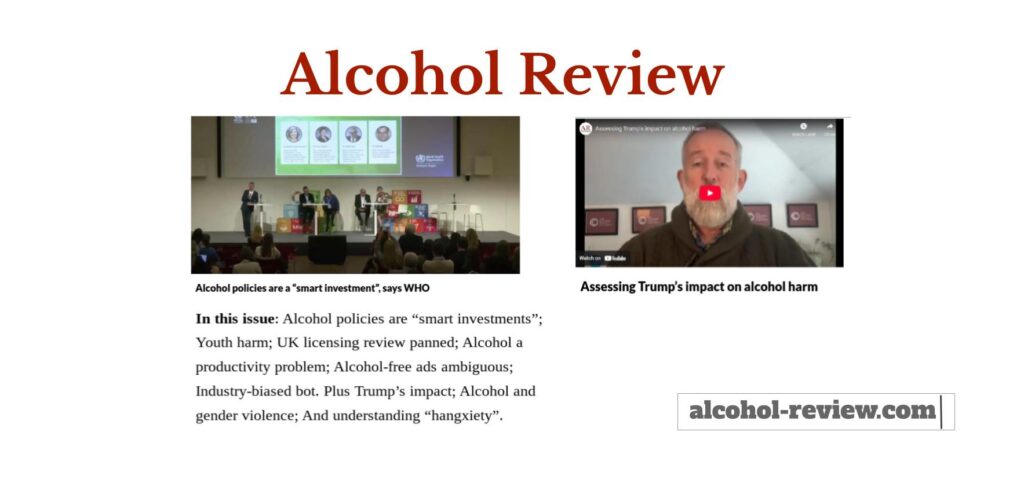
In this issue: Alcohol policies are “smart investments”; Youth harm; UK licensing review panned; Alcohol a productivity problem; Alcohol-free ads ambiguous; Industry-biased bot. Plus Trump’s impact; Alcohol and gender violence; Understanding “hangxiety”


Notices

AR2026, March 26th. Register now to join hundreds looking to disseminate and learn on a unique global platform. You will also gain full access to AR2025, giving you expert insight on how to push back against the alcohol industry at both the local and international levels. Please let us know if your organisation wants to support.


News

Alcohol policies are “smart investments”: “Strong alcohol policies are among the smartest investments you can make,” said the WHO Regional Office for Europe and the WHO’s International Agency for Research on Cancer this month.

Bid to quantify youth alcohol harm: The WHO’s EU-backed programme to reduce alcohol harm today launched an effort to quantify the burden alcohol places on young people to inform better alcohol policy.

Experts pan UK licensing review: The UK government’s current plans for alcohol licensing reflect the views of industry advocates. This “regulatory capture should be resisted by anyone with an interest in fair and effective governance” say its critics.

Alcohol a productivity problem: “When nearly half of young professionals are calling in sick after workplace drinking, it’s not just a hangover, it’s a productivity crisis,” says the UK’s left-leaning IPPR think-tank, calling for minimum pricing and tax rises.

Alcohol-free ads often ambiguous: “The trial [of AI analysis] found a higher rate of potential issues among alcohol-free product ads–around 48%–largely because of missing or unclear ABV information,” said the UK’s ad self-regulator, something especially problematic with spin off from an alcohol brand.

Bot to refer patients to alcohol industry: “Patients who engage with the [AI Surgery Assist] chatbot and mention alcohol concerns… will automatically be signposted to [alcohol industry funded] Drinkaware’s information and self-help tools.”

Feature

Assessing Trump’s impact on alcohol harm: The Trump administration has taken a chainsaw to efforts to reduce alcohol harm. Here Mike Marshall, CEO of the US Alcohol Policy Alliance, helps make sense of the bewildering news flow.

Opinion–Alcohol must be part of gender violence plan: It is impossible to address the high level of men’s violence in Australia without tackling alcohol use head on, write Anne-Marie Laslett, Cassandra Hopkins and Ingrid Wilson.

Understanding “hangxiety”: “People prone to anxiety or low mood, or those who drink to cope with stress, experience hangxiety more intensely – not because hangovers create new problems, but because alcohol temporarily dulls negative emotions,” write Rebecca Rothman and Blair Aitken.

Subscribe for more newsletters and events ■

Alcohol Review – Issue 116, September 18th 2025

September 18, 2025

Please subscribe for more

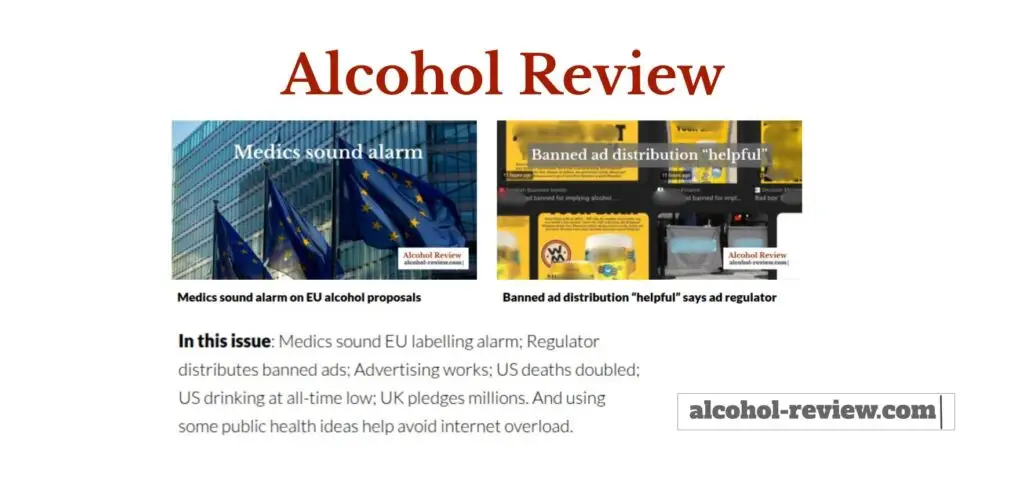
In this issue: Medics sound EU labelling alarm; Regulator distributes banned ads; Advertising works; US deaths doubled; US drinking at all-time low; UK pledges millions. And using some public health ideas help avoid internet overload.

AR2026: Date set for March 26th. Register now for full event participation and a year of premium newsletter access. You will also gain full access to AR2025, which gives expert insight on how to push back against the alcohol industry at both the local and international levels.

News

Medics sound alarm: Two recent EU labelling proposals risk decades of progress in reducing alcohol-related harm, warned the recently formed European Health Alliance on Alcohol. Belgium’s government also raised concerns earlier this month. Alcohol Review said the QR code proposal is a sham.

Regulator defends distributing banned ads: The UK’s advertising self-regulator is in favour of the distribution of alcohol ads it banned, Alcohol Review was told last month, after millions were exposed to a banned ad this week. The self-regulator then distributed more banned ads this month.

Advertising works: “Most evidence suggests that exposure [to alcohol marketing and advertising] is associated with increased intention to consume, consumption, and harmful consumption,” found a review from Public Health Scotland. A Polish NGO called for a complete ban on advertising it last month.

US deaths almost doubled since 1999: Alcohol-induced deaths in the US increased by 89% from 1999 to 2024, with the largest relative rise among females aged 25–34 which almost tripled.

US alcohol drinking at all-time low: Steep falls in alcohol drinking among women, Republicans and people at both the top and bottom ends of the economic spectrum reduced the percentage of alcohol drinkers in the US to its lowest point in 90 years, according to a Gallup poll.

UK pledges millions for research: The UK government said it will spend £10m ($14m) on addiction researchers through schemes from the Society for the Study of Addiction, National Institute for Health and Care Research and the Medical Research Council.

Feature

Using public health ideas to avoid internet overload
Alcohol Review’s editor applied some public health policies borrowed from alcohol to avoid internet overuse, with some success.

Please subscribe for more ■

Alcohol Review – Issue 115, July 21nd 2025

July 21, 2025

Please subscribe to get more

In this issue: Starmer fumbles prevention promise; Kenya moves forward; WHO sets tax target. Starmer should showcase change with effective labelling; The beer gardens of Bulawayo. Public health double-think

Alcohol Review 2025: Learn to push back against the alcohol industry at the local and international levels. Full event recordings available with a subscription, as well as extra content and entry to next year’s event.

News

Starmer fumbles prevention promise: The UK government infuriated alcohol harm advocates by omitting the strongest evidence-based policies from its plans amid an ongoing alcohol harm crisis. Campaigners continued their calls for minimum pricing in England, among the ignored measures. Delivering effective mandatory alcohol health labelling–which miraculously survived the alcohol policy cull–would be a good way to come good on cleaning up government, argues Alcohol Review.

Fourth biggest cause: Alcohol-specific disorders and poisonings was the fourth biggest preventable cause of death in the EU in 2022, after lung cancer, heart disease and covid, according to Eurostat figures.

Kenya moves forward: The Kenyan cabinet signed a national alcohol strategy, including plans to raise the legal drinking age from 18 to 21, ban online alcohol sales and ban celebrity alcohol endorsements. It was a “big milestone”, head of the Nairobi-based NGO International Institute for Legislative Affairs Celine Awuor told Alcohol Review. 

WHO sets tax target: The WHO launched the “3 by 35” initiative to persuade countries to use taxes to increase the price of alcohol, tobacco and sugary drinks by 50% by 2035, cutting health harm and raising $1trn in tax revenue.

Features

Opinion: Labour should showcase change with labelling: Sir Keir Starmer’s government could find much-needed focus by committing to policymaking process reform, with the delivery of effective mandatory alcohol health labels being an excellent place to start.

The beer gardens of Bulawayo
Many of the western suburbs of Bulawayo contain an  intriguing industrial-era institution, the beer garden. Development researcher Maurice Hutton explores their century-long history of pursuing the conflicting aims.


Public health double-think

Please subscribe to get more ■

Alcohol Review – Issue 114, June 20th 2025

June 20, 2025

Read original and subscribe for more

In this issue: US alcohol inclusion call; Heart benefits rejected; Lobbyist’s credentials queried; Tax plan Vietnam; New cancer risk identified. Why alcohol is bad injury medicine; US research funding cuts itemised. Man quiz.

Alcohol Review 2025: Watch takeaways and new session highlights from UK public health leader Alice Wiseman on pushing back against the alcohol industry at the local level. Full event recordings now available with the new monthly subscription.

News

Alcohol inclusion: “Alcohol kills more Americans each year than opioids and guns combined,” noted 24 NGOs which called on the Trump administration to make alcohol measures part of its efforts to reduce chronic disease. Alcohol harm reduction has so far been notably absent from US health plans. Alcohol Review this month itemised $31m research funding cuts.

Benefit claim rejected: The European Heart Network NGO formally recognised alcohol as a modifiable risk factor for cardiovascular disease and rejected “any claim that alcohol consumption, at any level, offers cardiovascular benefits.” Separately, the American Heart Association took a more hesitant step in the same direction saying, “It remains unknown whether drinking is part of a healthy lifestyle.”

Lobbyist queried: The credentials of the UK’s Night Time Industries Association are questionable, according to an investigation by investigative newsletter Democracy for Sale. Despite this the outfit has been granted high-level ministerial meetings and funds an all-party parliamentary group.

Vietnam tax hike: Vietnam is set to raise tax on alcoholic products over 20% from 65% to 90% by 2031. Tax on products below this strength threshold will rise from 35% to 60%. The WHO welcomed the move, but critics warned it still incentivises stronger products because the tax does not increase with total alcohol content.

Tax harmony: The East African Community agreed to harmonise alcohol excise duty at $6 per litre of alcohol in the product, regardless of the product.

Telling inconsistency: Recent alcohol industry statements show the “essential conflict of interest between alcohol industry economic objectives and public health goals”, said a new report from two leading UK NGOs.

New cancer: A large-scale study found a “modest positive association” between alcohol intake and pancreatic cancer. This suggests an eighth alcohol cancer risk, on top of breast, colorectal, esophagus, liver, mouth, throat (pharynx) and voice box (larynx).

Features

Five reasons to give up alcohol when injured
Current research shows there is no safe threshold of alcohol consumption during injury rehabilitation, according to sports scientist John Kiely, with even low-to-moderate drinking impairing athletic performance and injury recovery.

US research funding cuts itemised
The Trump administration has stopped funding at least 34 alcohol research projects promised $31m, with 58% of the funds still to be paid out, according to statistics collated by Alcohol Review. Around three-quarters of those nixed involve studies of sexual and gender minorities.

Mens health special

Quiz: Can you name the famous men who didn’t drink?

■

Alcohol Review – Issue 113, May 15th 2025

May 15, 2025

Read original

In this issue: Online ad ban draft; New FASD guidelines; NZ policy support strong: New alliance launches; Brits back health; Top doc doubt. Plus: Approaching addiction through environment; And US alcohol normalisation after Prohibition

Alcohol Review 2025: The entire programme of 14 sessions is available to watch in full, as well as in some concise takeaways. 

News
Online ad ban: Ethiopia’s food and drug regulator is reportedly drafting a law to ban alcohol ads on social media, having banned them on TV and radio five years ago.

FASD guidelines: Australian health professionals now have access to the first officially approved clinical practice guidelines to help assess and diagnose fetal alcohol spectrum disorder. 

Support strong: A large majority of New Zealanders agree with almost every alcohol policy out of ten polled: 71% agree alcohol industry should pay no part in forming alcohol policy; and 62% agree with a complete ad ban.


New alliance: This month saw the launch of the European Health Alliance on Alcohol, WHO backed collaboration between 20 pan-European medical societies committed to reducing alcohol harm.

Health over profit: Around three-quarters of Brits want the government to prioritise the public’s health over business growth, a new survey found. A similar proportion back alcohol health labeling, while just under two-thirds support a “polluter pays” alcohol levy. 

Top doc doubt: Controversial US Surgeon General pick Casey Means, a wellness influencer, has recognised there is no safe level of alcohol and reset her own alcohol intake. But she has also been called “breathtakingly misinformed” and a “grifter”.

Features

Interview: Making alcohol okay again — rehabilitating alcohol after Prohibition
The US alcohol industry restarted from ruins in 1933 after 14 years of Prohibition, with its shattered reputation its biggest challenge. Yet by the end of WW2 alcohol had regained respectability. Cultural historian Professor Lisa Jacobson explains how.

Addiction isn’t just about brain chemistry, nor is it just bad choices
Rather than blaming individuals or pathologising them as brain-damaged, we can focus on reshaping environments to make non-drug alternatives more visible, available and valuable, writes psychology professor Matt Field.

Read original ■

Alcohol Review – Issue 112, April 14th 2025

April 14, 2025

Get more. Subscribe
Receive on Whatsapp

In this issue:
Briefing: Some key points at Alcohol Review 2025.
News: Trump cuts predicted to have“severe” impact: EU offers “licence to hide”; Sub-Saharan harm; Zero difference
Feature: Alcohol causes cancer, Pranoti Mandrekar of the University of Massachusetts explains.

Briefing
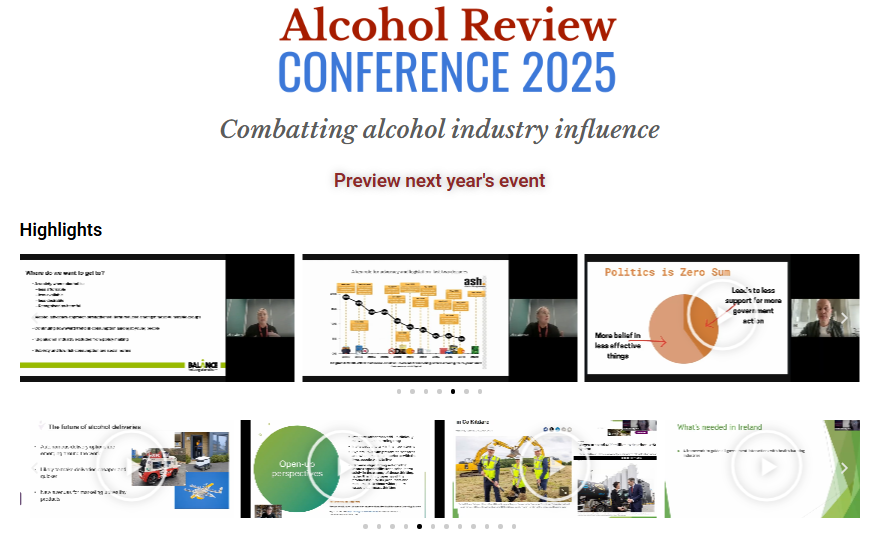
Alcohol Review 2025: The entire programme of 14 sessions is available to watch in full at alcohol-review.com. These include a global perspective from author Grant Ennis and a local one from UK public health leader Alice Wiseman, both discussed with leading figures in the field. And dozen concise “spotlight” sessions outlining the key findings and views of prominent alcohol researchers and campaigners. 

This month’s takeaways: There is room for ”Brief Interventions 2.0”; There is overwhelming support for health policy protection; the need to repeat tobacco success; and a call to ask our representatives about the alcohol deficit.

News
Trump cuts predicted to have“severe” impact: Cuts announced by the US Health and Human Services department are expected to “severely” impact efforts to reduce continued elevated levels of alcohol harm. In the right-leaning male podosphere, meanwhile, Trump-aligned Joe Rogan and tycoon-in-chief Elon Musk–architect of the Trump cuts–agreed on the logic of quitting alcohol. The level of US alcohol deaths were 17% above pre-pandemic levels last year despite a 5% year on year fall. Over 70% of these were of men.

EU offers “licence to hide”: The European Commission’s “wine package” proposals offered a “licence to hide” nutrition and ingredients information from consumers, said European Cancer Organisation’s policy chief. Alcohol Review noted that QR codes do not work.

Sub-Saharan harm: Global alcohol companies undermine public health and regulation in sub-Saharan Africa, according to a study from Norwegian NGO FORUT, which criticised Norway’s pension fund for a $13bn holding in the companies mentioned. A separate paper blamed the delay of a bill in South Africa on “regulatory capture”.

Zero difference: Teenagers think of zero-alcohol beverages as a type of alcoholic drink, leading researchers at Australia’s Flinders University to voice concerns about exposing them to zero-alcohol branding and advertising. Public health professionals widely consider 0.0 brands as a ruse to dodge restrictions on alcohol ads.

Feature
Guest post: Alcohol causes cancer: If you ask clinicians and scientists how much alcohol is safe to drink, you might not like the answer, explains Pranoti Mandrekar of the University of Massachusetts.

Get more. Subscribe
Receive on Whatsapp ■

  • « Go to Previous Page
  • Page 1
  • Page 2
  • Page 3
  • Page 4
  • Interim pages omitted …
  • Page 6
  • Go to Next Page »

Primary Sidebar

  • Bluesky
  • Instagram
  • LinkedIn
  • Twitter
  • WhatsApp

Copyright © 2026 · Phil Cain Impressum

Manage Consent
To provide the best experiences, we use technologies like cookies to store and/or access device information. Consenting to these technologies will allow us to process data such as browsing behaviour or unique IDs on this site. Not consenting or withdrawing consent, may adversely affect certain features and functions.
Functional Always active
The technical storage or access is strictly necessary for the legitimate purpose of enabling the use of a specific service explicitly requested by the subscriber or user, or for the sole purpose of carrying out the transmission of a communication over an electronic communications network.
Preferences
The technical storage or access is necessary for the legitimate purpose of storing preferences that are not requested by the subscriber or user.
Statistics
The technical storage or access that is used exclusively for statistical purposes. The technical storage or access that is used exclusively for anonymous statistical purposes. Without a subpoena, voluntary compliance on the part of your Internet Service Provider, or additional records from a third party, information stored or retrieved for this purpose alone cannot usually be used to identify you.
Marketing
The technical storage or access is required to create user profiles to send advertising, or to track the user on a website or across several websites for similar marketing purposes.
  • Manage options
  • Manage services
  • Manage {vendor_count} vendors
  • Read more about these purposes
View preferences
  • {title}
  • {title}
  • {title}

Loading Comments...